
3 Ready Cycle Aware Carb Cycling Plans for Women Without the Math
Nourished · September 8, 2026
3 Ready Cycle Aware Carb Cycling Plans for Women Without the Math
Carb cycling works for women who train regularly, like structure, and have stalled on a flat calorie deficit. It helps mainly by making a deficit easier to stick with and matching carbs to workout days, not by unlocking some hidden metabolic switch. It’s not a fit for pregnancy, uncontrolled diabetes, or a history of disordered eating. If you want to skip straight to a plug-and-play plan, the sample templates further down are built for that.
TL;DR:
- Carb cycling benefits women mainly by easing adherence to a calorie deficit and optimizing carb timing around workouts, not by increasing fat loss.
- The most effective pattern involves high-carb days on intense training, moderate on light days, and low on rest days, with protein intake remaining steady.
- It is most suitable for women who train regularly, have hit a plateau, and are comfortable tracking food, while unsuitable for pregnancy, diabetes, thyroid issues, or disordered eating history.
- Evidence supporting carb cycling’s superiority for fat loss is limited; its main advantage is better training energy and reduced bingeing, not faster fat reduction.
- Automated, cycle-aware platforms exist that simplify planning by adjusting carbs around training and hormonal shifts, eliminating manual calculations.
Table of Contents
- What Is Carb Cycling and How Does It Actually Work?
- Do the Benefits Hold Up, and What Are the Real Limits?
- Who Should Try Carb Cycling? Candidates and Red Flags
- Sample Meal Plan Templates You Can Copy This Week
- How to Start Carb Cycling: A Step-by-Step Setup
- Cycle-Aware Carb Adjustments for Every Life Stage
- Safety, Downsides, and Troubleshooting Common Problems
- A Simple Starting Point Worth Testing
- Try a Cycle-Aware Plan Without the Manual Math
- Where to Read More on Carb Cycling and Women’s Health
- Sources
What Is Carb Cycling and How Does It Actually Work?
Carb cycling means rotating your carbohydrate intake across the week: higher on hard training days, lower on rest days, and moderate in between. Total calories and protein usually stay fairly steady while carbs shift around your schedule.
The performance benefit comes from timing carbs to refill glycogen (the stored fuel in your muscles) before and after intense sessions, and short-term studies on carbohydrate timing show this can support better output and recovery. But the fat-loss piece is mostly about calories, not magic. Rotating carbs simply makes it easier to sit in a deficit without feeling depleted every single day, which is exactly what Healthline’s overview of carb cycling points out as the real driver.
Common patterns for women include:
- High-carb days: a higher proportion of calories from carbs, timed around your toughest workout
- Moderate-carb days: a moderate amount of carbs, for light training or active recovery
- Low-carb days: a lower amount of carbs, reserved for full rest days
- Visual portion method (no tracking): a fist of carbs on high days, half a fist on moderate days, a cupped handful on low days, alongside a palm of protein at every meal
Do the Benefits Hold Up, and What Are the Real Limits?
Carb cycling can genuinely help women preserve muscle during a cut, push through a stalled plateau, and train harder without the flat, foggy feeling that comes with chronic low-carb eating. Athletes and women lifting several times a week tend to see the clearest payoff, since they have workouts worth fueling.
Where it falls short is the part marketers gloss over: carb cycling doesn’t outperform a matched-calorie diet for fat loss. Clinical reviews consistently find that fat-loss differences between diet structures come down to energy balance, with structure mainly influencing how well someone sticks to the plan.
By the numbers: WebMD’s overview of carb cycling notes the evidence base is still limited, though it may help athletes and lifters fuel intense sessions when carbs are timed around training.
Realistic wins and limits:
- Best case: better training energy, fewer binge episodes from restriction, easier adherence over months
- Not a given: faster fat loss than a plain calorie deficit at the same total intake
- Best candidates: women training 3 or more times weekly who have hit a plateau on a steady low-carb or low-calorie approach
- Weaker fit: sedentary women or anyone who finds daily carb math stressful rather than clarifying
Who Should Try Carb Cycling? Candidates and Red Flags
Carb cycling suits women who already track food loosely, train with some consistency, and want a structured reason to eat more on hard days and less on easy ones. If you’ve plateaued on a flat diet for more than a few weeks despite consistent effort, cycling carbs around training is a reasonable next experiment.
It’s not the right starting point for everyone. Run through this before committing:
- Are you pregnant or breastfeeding? Skip carb cycling and talk to your provider about nutrition needs specific to that stage.
- Do you have diabetes or blood sugar issues? Don’t adjust carbs without medical guidance, since low-carb days can affect insulin needs and medication timing.
- Do you have a history of disordered eating or restrictive dieting? Structured “good day, bad day” carb rules can reinforce that pattern. Work with a professional instead.
- Do you have a thyroid condition? Extended low-carb stretches can affect thyroid hormone conversion, so keep low days moderate rather than extreme.
- Are you new to tracking food? Start with a simpler calorie-deficit approach for a few weeks first, then layer in carb cycling once portions feel intuitive.
If two or more of these give you pause, a conversation with a doctor or registered dietitian is worth having before you start.
Sample Meal Plan Templates You Can Copy This Week
You don’t need a spreadsheet to carb cycle well. Three templates cover most training weeks, and you can rotate them based on what you’ve got planned each day.
High-carb day (hard training):
- Breakfast: Greek yogurt, oats, banana, honey
- Lunch: chicken, rice, roasted vegetables, olive oil
- Dinner: salmon, sweet potato, green beans
- Snack: rice cakes with peanut butter, or a piece of fruit
Moderate-carb day (light training or steady activity):
- Breakfast: eggs, whole-grain toast, avocado
- Lunch: turkey wrap with whole-wheat tortilla, side salad
- Dinner: lean beef, quinoa, roasted broccoli
- Snack: cottage cheese with berries
Low-carb day (rest day):
- Breakfast: eggs, spinach, feta, olive oil
- Lunch: grilled chicken salad, olive oil dressing, minimal starch
- Dinner: white fish, asparagus, cauliflower rice
- Snack: nuts or celery with almond butter
A typical training week might place high days on your two hardest lift or cardio sessions, moderate days on lighter activity, and low days on the one or two days you genuinely rest:
| Day | Activity | Carb level |
|---|---|---|
| Monday | Heavy lift | High |
| Tuesday | Light cardio | Moderate |
| Wednesday | Rest | Low |
| Thursday | Heavy lift | High |
| Friday | Light cardio | Moderate |
| Saturday | Active recovery | Moderate |
| Sunday | Rest | Low |
For macro ranges, a woman training regularly might consume varying grams of carbs on high, moderate, and low days, with protein held steady at an adequate daily amount. If tracking grams isn’t your thing, the fist/half fist/cupped handful visual method from the earlier section works just as well without an app open at every meal. On higher-carb days especially, carbohydrate quality matters: whole grains, fruit, and starchy vegetables support steadier blood sugar than refined carbs at the same gram count.
How to Start Carb Cycling: A Step-by-Step Setup
Getting carb cycling right isn’t about perfect numbers. It’s about building a rhythm you can actually repeat for two months straight.
- Pick a pattern and lock your protein target first. Choose the high/moderate/low structure from above and set protein around 0.7 to 1 gram per pound of body weight daily. Protein doesn’t move; carbs do.
- Map high-carb days onto your hardest workouts. Leg day, long runs, or heavy lifting sessions get the extra carbs. Rest days get the least.
- Choose a tracking method that fits your life. That could be a food-logging app, a kitchen scale for a couple weeks to calibrate portions, or the visual-portion method if numbers stress you out. There’s no bonus prize for spreadsheets.
Time carbs loosely around training: some carbohydrate within an hour or two before a hard session, and more in the meal after, when your muscles are primed to refill glycogen. Drink water consistently and add a pinch of salt or an electrolyte packet on low-carb days, since carb restriction pulls water out with it and can leave you feeling flat.
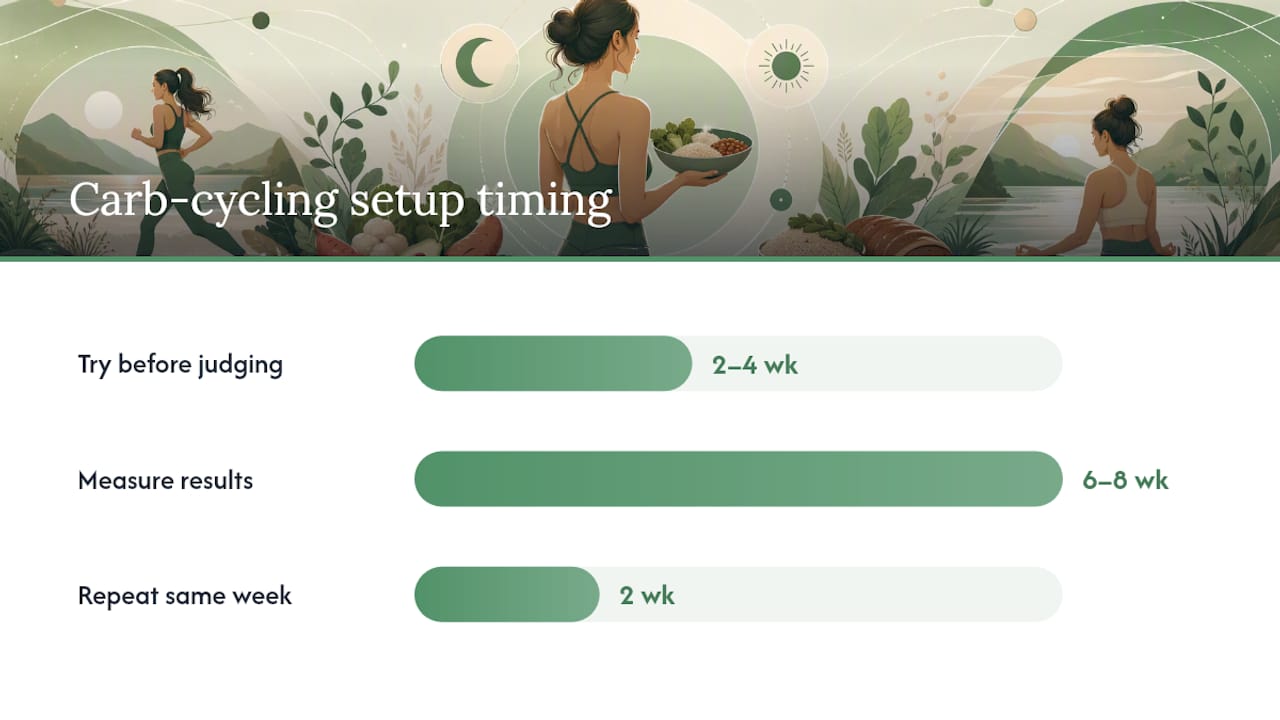
Give the plan two to four weeks before judging it. That’s usually long enough to tell if energy, sleep, and workout performance are trending better or worse. At six to eight weeks, look for measurable change: weight trend, waist measurement, or lifts going up. If nothing’s moved, adjust total calories slightly rather than overhauling the whole structure.
Pro Tip: Repeat the same week twice before changing anything. Most women quit a plan not because it’s not working, but because they never gave one version of it a fair, repeated shot.
Cycle-Aware Carb Adjustments for Every Life Stage
Your hormones aren’t static across the month, and carb cycling gets a lot more useful when it accounts for that instead of ignoring it. Research on insulin sensitivity across the menstrual cycle shows sensitivity tends to run higher during the follicular phase (right after your period) and lower during the luteal phase, meaning your body handles carbs somewhat differently depending on where you are in the month.
Practical phase-by-phase swaps:
- Menstrual phase: prioritize protein and iron-rich foods (red meat, lentils, spinach) alongside your usual carb level to offset blood loss.
- Follicular phase: this is often when you feel strongest, so lean into higher-carb training days here if your schedule allows.
- Ovulatory phase: energy and strength often peak; a good window for your hardest sessions and highest carb intake.
- Late luteal phase: a slight bump in complex carbs (oats, sweet potato) can ease cravings and support sleep before your next cycle starts.
Perimenopause and menopause change this picture. Cycles get irregular or stop, which makes phase-based syncing unreliable as a planning tool. The more dependable approach at that stage is placing high-carb days around your actual workouts rather than around a cycle you can’t predict, since metabolic changes during this transition already shift how your body handles carbs and stores fat. Preserving muscle matters more here too, and protein needs often increase during perimenopause as a result.
This is exactly the kind of adjustment that’s hard to do manually and easy to automate. Nourished’s AI-driven planning can shift carb placement based on where you are in your cycle, or switch to training-based placement automatically once cycles become irregular, without you needing to recalculate anything by hand.
Pro Tip: If your cycle has been unpredictable for more than three months, stop trying to sync food to it and sync food to your training calendar instead. It’s simpler and it actually works.
Safety, Downsides, and Troubleshooting Common Problems
Carb cycling isn’t risk-free, and a few groups should get medical input before starting: women with diabetes, anyone pregnant or breastfeeding, women with thyroid disease, and anyone with a history of disordered eating. Restrictive “good day, bad day” eating patterns can quietly reinforce disordered habits even when that’s not the intent.
Sustained very-low-carb stretches carry their own risks. Harvard Health’s reporting on low-carb and keto-style eating notes that severely restricting carbs long-term can disrupt menstrual cycles, affect thyroid function, and worsen sleep in some women, which is exactly why the low-carb days in the templates above stay moderate rather than extreme.
Common downsides and quick fixes:
- Afternoon energy crashes: your low-carb day may be too aggressive; add 20 to 30 grams of carbs back in.
- Cravings spiking on low days: this is often a sign the cycle is too restrictive, not a willpower failure.
- Sleep getting worse: try adding a small carb portion at dinner even on lower-carb days.
- Progress stalled after 4 weeks: check total calories before blaming carb placement.
By the numbers: Practical guidance from Glow Women Fitness’s breakdown for women warns that adherence tends to drop as carb-cycling schedules get more complicated, especially for beginners who dislike tracking.
A Simple Starting Point Worth Testing
Most of the carb cycling advice out there overcomplicates a genuinely simple idea: eat a bit more on hard days, a bit less on easy ones, and keep protein steady. The women who stick with this longest aren’t the ones with the most detailed spreadsheets. They’re the ones who picked one of the three templates above and repeated it without fuss for a full month before touching anything.
Try this for four to six weeks: pick your pattern, hold protein steady, and track energy and workout performance more closely than the scale at first. If your cycle is irregular, place high-carb days on your hardest training days instead of guessing at a phase. Watch sleep and mood along the way. If something feels off, that’s real feedback, not something to push through.
— Brittany
Try a Cycle-Aware Plan Without the Manual Math
There are platforms built to address the problem this article keeps circling back to: matching carbs to your training and your cycle without spending your evenings recalculating macros. Such platforms can generate personalized meal plans, adjust carb placement around training days and cycle phase, and switch to workout-based fueling automatically once cycles get unpredictable in perimenopause. They often do not require calorie counting, since plans can be built around specific hormonal stages.

If you’ve read this far and are already picturing yourself trying to build a phase-by-phase carb schedule by hand, that’s the exact gap Nourished closes. You can see how the setup works in a few steps, browse the full platform overview to see what a plan looks like for your stage, or check the research behind the approach if you want the clinical grounding before you commit.
Where to Read More on Carb Cycling and Women’s Health
- Healthline’s carb cycling primer for a clear overview of the method and its limits.
- WebMD’s carb cycling overview for medically reviewed safety context.
- Harvard T.H. Chan’s carbohydrate guide for choosing quality carbs.
- Nourished’s reference library for the studies behind cycle-aware meal planning.
- For women managing bone health alongside diet changes, safe exercise guidance for osteoporosis is worth a look too.
This article is general information, not a substitute for advice from a qualified doctor. Consult a qualified healthcare professional about your own circumstances before acting on anything here.
Sources
- Carb cycling 101 — Healthline
- Carb cycling: Overview, benefits, and implementation — WebMD
- PMC review on diet strategies
- Harvard T.H. Chan — Carbohydrates overview