Avoid Mistimed Results: For Women, Test FSH/LH on Cycle Days 2–5
Nourished · August 31, 2026
Avoid Mistimed Results: For Women, Test FSH/LH on Cycle Days 2–5
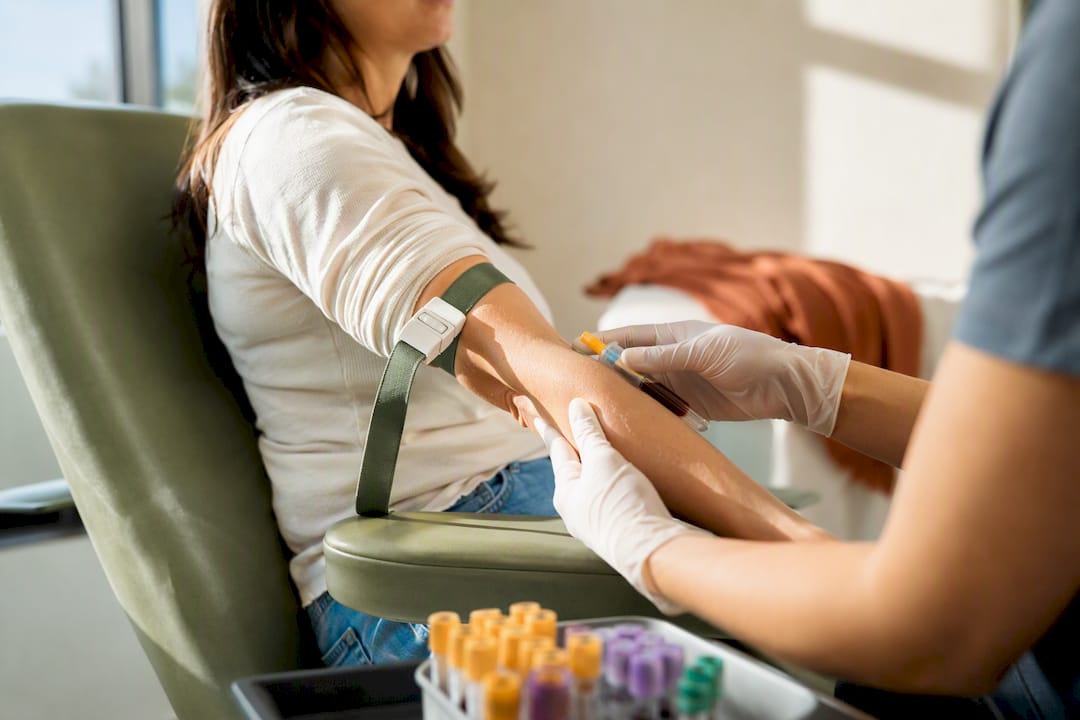
For ovarian markers like FSH, LH, and estradiol, test during the early follicular phase of your cycle. For progesterone, test 5 to 7 days after ovulation, which for many women is in the mid-luteal phase. Cortisol and testosterone should be drawn in the morning, ideally before 10 a.m. If your cycle is irregular or you’re in perimenopause, any morning works as long as you record the date. Stop biotin supplements 48 to 72 hours beforehand, and fast if your panel includes insulin or glucose.
TL;DR:
- Testing hormone levels on specific cycle days is crucial, with FSH, LH, and estradiol best measured between days 2 and 5 of the cycle.
- Progesterone should be checked 5 to 7 days after ovulation, not on a fixed calendar day like day 21, especially in irregular cycles.
- Morning draws for testosterone, DHEA-S, and cortisol are optimal for accurate results, with timing especially important for hormonal activity peaks.
- Hormonal birth control, irregular cycles, or menopause alter standard testing protocols, requiring tailored timing or interpretation adjustments.
- Preparing properly by fasting, stopping biotin, avoiding intense exercise, and tracking your cycle enhances the accuracy and reliability of test results.
Table of Contents
- Quick timing checklist for common hormone tests
- Timing by hormone: what the research says and why it matters
- Special situations: contraception, irregular cycles, and menopause
- Preparing for the draw: what to do the day before and the day of
- Reading your results and knowing when to retest
- How nutrition habits keep your hormone results reliable
- Practitioner perspective: two scheduling examples
- How Nourished helps you get test-ready
- Sources
Quick timing checklist for common hormone tests
Print this, screenshot it, or hand it to whoever’s drawing your blood. Getting the day and hour right matters more than most people realize. A progesterone test drawn on the wrong cycle day can read as “low” when it’s actually just mistimed, and that misread has sent plenty of women down an unnecessary supplement rabbit hole.
- FSH, LH, estradiol: Days 2 to 5 of your cycle, any time of day. Reference ranges labs use are built around this early follicular window, so testing outside it skews results.
- Progesterone: 5 to 7 days after ovulation, not a fixed calendar day. In a 28-day cycle that’s usually days 19 to 22.
- Testosterone and DHEA-S: Morning draw, 7 to 10 a.m., when levels peak and results are most representative of daily average.
- Cortisol: Single morning sample, 8 to 9 a.m., unless your clinician has ordered a multi-point or dynamic test.
- Thyroid panel (TSH, free T4, free T3): Morning is preferred but less strictly required. Consistency between tests matters more than the exact hour.
- Insulin and fasting glucose: Morning draw after 10 to 12 hours of fasting. HbA1c has no timing requirement since it reflects a 2 to 3 month average.
If you’re pregnant, on hormonal birth control, using topical testosterone, or taking hormone replacement therapy, tell your lab before the draw. Each of those situations changes what a “normal” result looks like, and your clinician needs that context to interpret the numbers correctly.
Timing by hormone: what the research says and why it matters
Cycle-day rules aren’t arbitrary. They exist because reference ranges were built around specific testing windows, and a result drawn outside that window gets compared to the wrong baseline.
FSH, LH, and estradiol
Days 2 through 5 of the cycle, known as the early follicular phase, is when labs anchor their reference ranges for these three hormones. Reference windows for hormone panels are built around this period specifically because it’s the most hormonally stable stretch of the cycle, before follicle recruitment shifts estradiol upward.
An elevated FSH on day 3 is one of the more useful early signals of declining ovarian reserve, particularly in women over 35. If your FSH comes back high, that’s a conversation to have with your clinician, not a moment to panic. One elevated value on one cycle can reflect natural month-to-month variation. Two elevated readings across separate cycles carry more weight.
Progesterone
Progesterone is the hormone people get wrong most often, mainly because “day 21” advice gets repeated regardless of cycle length. The rule isn’t day 21. It’s 5 to 7 days after ovulation, which only lands on day 21 if you ovulate on day 14 of a textbook 28-day cycle.
Here’s the math for anyone whose cycle doesn’t fit that mold: if you have a 35-day cycle and typically ovulate around day 21, your progesterone test belongs closer to day 27 or 28, not day 21. Testing on day 21 in that scenario would catch you in the follicular phase, before ovulation has even happened, and the result would come back low regardless of how healthy your progesterone production actually is.
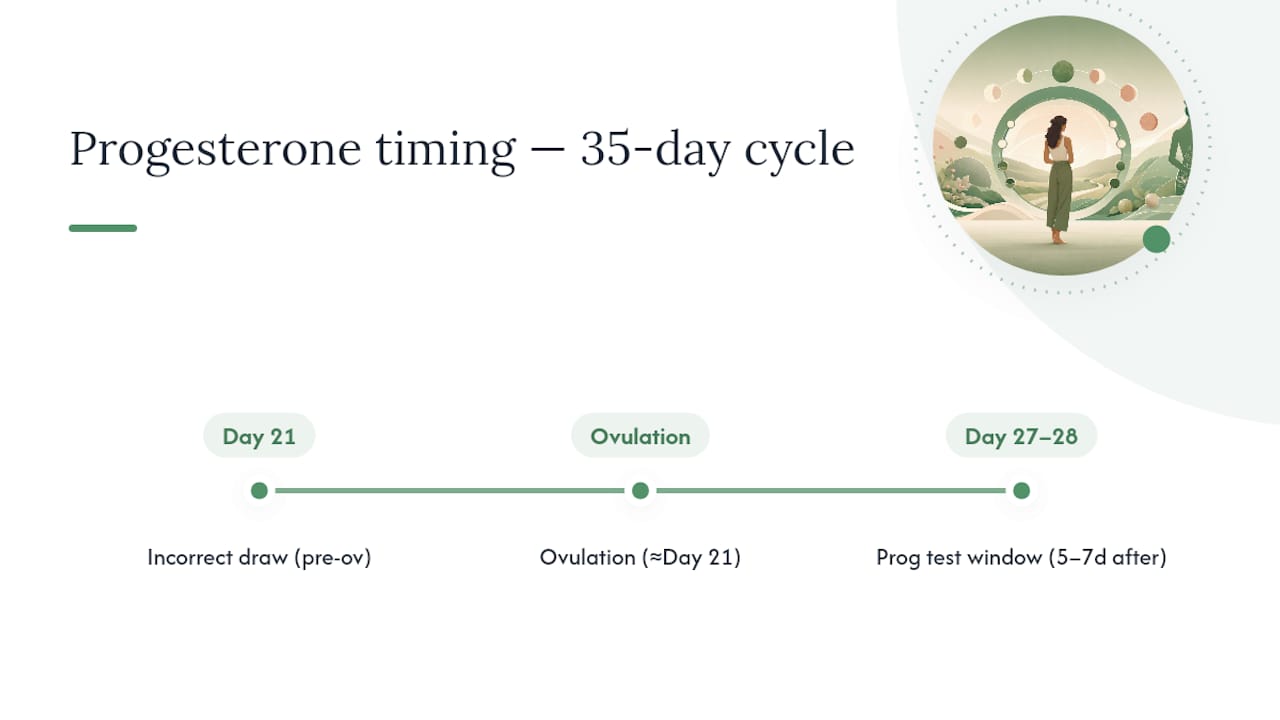
If you don’t know your ovulation date, detecting ovulation directly with an LH strip, basal body temperature tracking, or cervical mucus monitoring beats guessing based on average cycle length. MedlinePlus notes that progesterone tests need no special prep, but the result is meaningless without accurate cycle context, and some situations call for more than one draw to see a pattern rather than a single snapshot.
Testosterone and DHEA-S
Draw these in the morning, between 7 and 10 a.m. Labcorp’s guidance for female hormone panels specifically flags this window because DHEA-S, prolactin, and testosterone all run higher and more consistent earlier in the day.
There’s a second issue that has nothing to do with timing: testing method. Standard immunoassays, the cheaper and more common lab technique, are notoriously unreliable at the low concentrations typical of female testosterone. If accuracy actually matters for your situation, ask specifically for LC-MS/MS testing, a mass spectrometry method that performs far better at female-range levels. Not every lab offers it, but it’s worth the extra step if you’re troubleshooting symptoms like hair thinning or low libido.
Statistic-style takeaway: Timing errors alone can’t explain a bad testosterone result. Getting the hour right and choosing the right assay method both need to happen for the number to mean anything.
Cortisol
A single morning sample, 8 to 9 a.m., is a reasonable starting point for a general cortisol check. Cortisol follows a sharp diurnal rhythm, peaking shortly after waking and dropping through the day, and morning draws reduce that variability enough to be clinically useful for screening.
That single sample has limits. If your clinician suspects an actual HPA-axis disorder, like Cushing’s syndrome or adrenal insufficiency, a one-time morning draw won’t cut it. Those cases call for dynamic testing: a 4-point salivary cortisol series across the day, or a stimulation test that measures how your adrenal glands respond to a triggered signal.
Thyroid panel
TSH, free T4, and free T3 shift far less across the day than cortisol or testosterone. Morning testing is still preferred for consistency, but the stakes for missing that window are lower. What matters more is drawing at a similar time each time you retest, so you’re comparing apples to apples rather than a morning result to an afternoon one from three months ago.
Insulin and fasting glucose
These need a fasting draw, typically 10 to 12 hours without food, first thing in the morning. Eating even a small snack a few hours before the draw can push glucose and insulin numbers up enough to distort the picture of your metabolic baseline. HbA1c is the exception here. It reflects an average over 2 to 3 months, so timing and fasting status don’t move the needle.
Special situations: contraception, irregular cycles, and menopause
Cycle-day rules assume you have a cycle to count from. That assumption breaks down for a lot of women, and testing without adjusting for it produces results that look abnormal but aren’t.
On hormonal birth control, your FSH, LH, and progesterone results are essentially meaningless as ovarian function markers. Hormonal contraception suppresses the signaling loop that these tests are designed to measure, so a “low” FSH on the pill doesn’t tell you anything about your natural ovarian reserve. If you need accurate baseline ovarian hormone levels, that conversation with your clinician usually involves either testing after stopping contraception for a defined period or accepting that certain markers simply can’t be assessed while you’re on it.
With irregular cycles, counting to an assumed day stops working. Two more reliable options exist:
- Track ovulation directly using LH test strips, basal body temperature, or cervical mucus changes, then test progesterone 5 to 7 days after that confirmed ovulation.
- If ovulation tracking isn’t practical, test any morning and log the exact date. Timing strategies for irregular or absent cycles become less about hitting a perfect window and more about repeating the same conditions across multiple tests so you can see a trend instead of relying on one isolated number.
In perimenopause and menopause, the cycle-day framework mostly stops applying. Cycles become unpredictable or stop entirely, so testing can happen on any morning. Labs interpret these results against a different reference framework built for establishing a baseline rather than tracking a monthly pattern, and a morning draw is still preferred simply for consistency if you test again later.
Preparing for the draw: what to do the day before and the day of
A handful of preparation steps determine whether your result reflects your actual hormone status or just noise from something you ate, took, or did the night before.
- Fast if your panel includes insulin or glucose. Ten to twelve hours without food, scheduled for a morning appointment, keeps these numbers accurate. Most other hormone panels don’t require fasting.
- Stop biotin 48 to 72 hours before your draw. Biotin interferes with the assay technology many labs use, particularly for thyroid and some reproductive hormone tests, and can produce falsely high or low readings that have nothing to do with your actual levels.
- Skip heavy exercise for 24 hours beforehand. Intense training can temporarily spike cortisol and shift other hormone levels enough to muddy the result.
- Get a normal night of sleep. Sleep deprivation raises cortisol and can throw off reproductive hormone readings too.
- Go easy on alcohol in the day or two before testing, since it can affect several hormone pathways short term.
- Bring a written record: your cycle day, the exact time of your draw, and any medications, supplements, or topical hormones you’ve used recently.
Pro Tip: Keep a simple note on your phone with your last period start date updated every cycle. When a lab asks “what cycle day are you on,” you want an answer in seconds, not a mental scramble through a calendar app.
Reading your results and knowing when to retest
A single hormone value only means something in context. The context is the cycle day, the time of day, and whatever was happening in your body that morning, so protect that context every time you test again.
Consistency matters more than perfection. If your first progesterone test was drawn at day 21 at 9 a.m., your follow-up test should aim for the same relative timing, not just “sometime in the luteal phase.” Comparing a day 21 result to a day 25 result from a different cycle isn’t a fair comparison, even though both fall in the luteal phase.
Retest intervals depend on what you’re tracking. Cycle-dependent hormones like progesterone and estradiol are usually worth rechecking the following cycle, especially if you’re investigating a suspected luteal phase issue. Metabolic markers like insulin, glucose, or thyroid hormones after starting a new medication typically get rechecked 1 to 3 months later, giving the change enough time to show up in the numbers.
Know when a single result isn’t enough. A single morning cortisol sample is fine for screening, but if it comes back significantly abnormal, that result usually triggers a referral for dynamic testing rather than a repeat of the same single draw. The same goes for abnormal thyroid results that don’t fit the clinical picture, or sex steroid levels that conflict with your symptoms.
Before your appointment, put together a short list for your clinician:
- Cycle day and date of your last period
- Exact time of the blood draw
- Every medication and supplement you’re currently taking, including when you last took biotin
- Any recent illness, major stress, or big dietary change
If you’re pregnant, expect additional or repeated testing across trimesters, rather than a single draw, since hormone levels shift substantially as pregnancy progresses and a single snapshot rarely tells the full story.
How nutrition habits keep your hormone results reliable
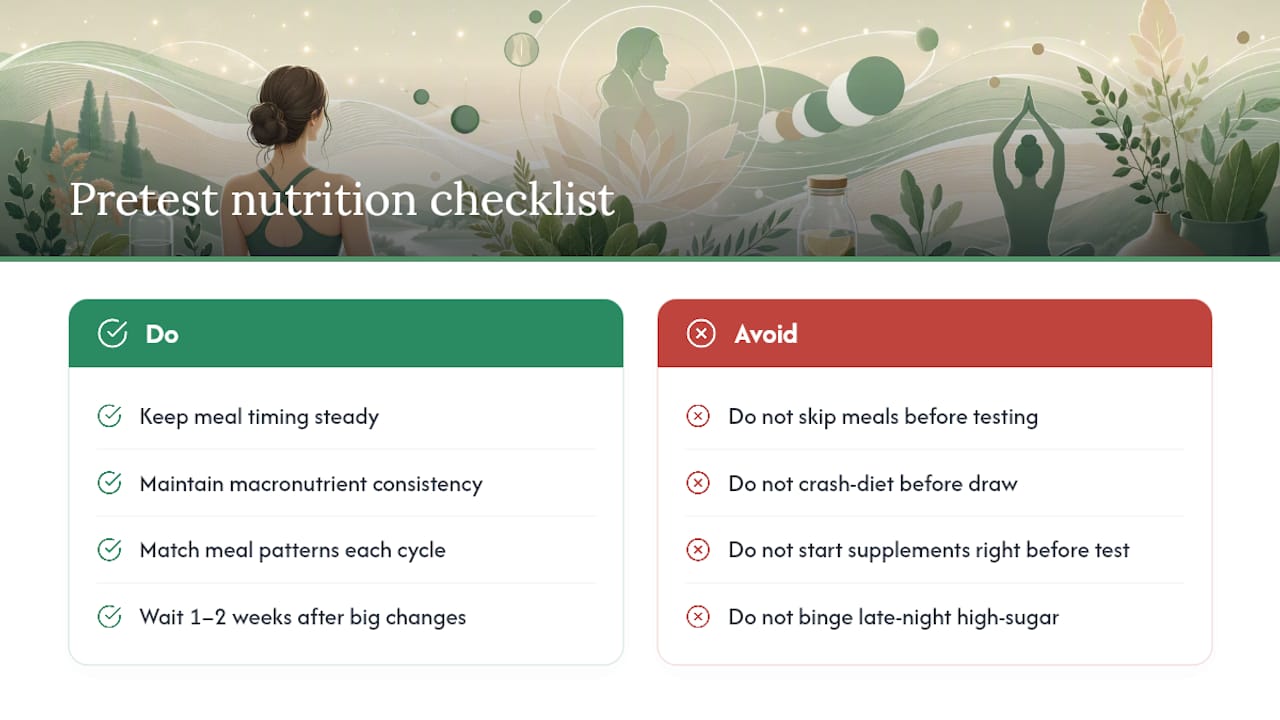
Hormone testing captures a moment, but that moment is shaped by what happened in the days before it. Skipping meals, crash dieting, or starting a new supplement regimen right before a draw introduces noise that has nothing to do with your baseline hormone health.
Insulin and cortisol are especially sensitive to short-term metabolic stress. A day of undereating or a late-night high-sugar binge can shift both enough to distort a fasting glucose or morning cortisol reading. Keeping meal timing and macronutrient intake steady in the days leading up to testing removes one variable from the equation.
Timing also matters around major changes. If you’ve just started a high-dose biotin supplement, begun a rapid weight-loss plan, or significantly cut calories, give your body time to stabilize before testing. A week or two of consistency produces a far more trustworthy result than testing mid-transition.
This is where tracking your cycle phase alongside your nutrition pays off. Matching your meal patterns and testing conditions cycle after cycle means your results reflect your actual hormone status rather than whatever you happened to eat that week.
Practitioner perspective: two scheduling examples
Picture a woman with regular 28-day cycles investigating fatigue and irregular periods. The plan: FSH and estradiol on day 3, progesterone around day 21, and a morning testosterone and cortisol draw on whichever day she does the progesterone test, all logged with exact times.
Now picture someone with unpredictable 35 to 45 day cycles. Counting to a fixed day won’t work here. She uses LH strips to catch ovulation, then tests progesterone 5 to 7 days later. On months she can’t pin down ovulation, she tests any morning, logs the date, and repeats it the following cycle to build a pattern instead of chasing a single number.
— Brittany
How Nourished helps you get test-ready
Nourished built its cycle tracker and meal plans specifically because timing is only half the equation. What you eat and track in the days before a draw matters just as much as the calendar day you choose. Use the free period and cycle tracker to log ovulation and cycle days over a full cycle, so you walk into your next test with an actual data point instead of a guess. Pair that with a cycle-aware meal plan in the week leading up to testing to keep insulin and cortisol steady rather than reactive to whatever you ate the night before.

Start simple: track one full cycle, stop biotin 72 hours before your draw, and follow a consistent meal pattern for the three days prior. Set up your cycle tracker today and walk into your next lab appointment with the timing already handled.
Sources
- PubMed article on effects of hormonal contraception on endocrine markers
- Progesterone test | MedlinePlus
- 24 hours in the life of a hormone: what time is the right time for a pituitary function test? | The Endocrinologist
- The Right Way to Test Progesterone with the Menstrual Cycle | Lara Briden
This article is general information, not a substitute for advice from a qualified doctor. Consult a qualified healthcare professional about your own circumstances before acting on anything here.