
Does Your Menstrual Cycle Really Affect Your Workouts?
Nourished · August 19, 2026
Does Your Menstrual Cycle Really Affect Your Workouts?
Yes, but probably less than you’d think. Research shows cycle phases can nudge things like VO2max, sprint output, and post-workout soreness for some women, but the effects are usually small, inconsistent, and swamped by sleep, stress, and training history. The U.S. Office on Women’s Health is clear that exercise is safe in every phase and can actually ease PMS symptoms.
Here’s what matters practically:
- Some women notice more delayed-onset muscle soreness (DOMS) and strength dips right after their period starts.
- VO2max and sprint times may run slightly lower in the early days of the cycle, according to a 2026 meta-analysis, though the evidence is rated low certainty.
- A single bad workout day says almost nothing on its own. Patterns across several cycles say a lot.
Pro Tip: Don’t build your training plan around a calendar app’s guess at your phase. Track your heart rate variability (HRV) and resting heart rate (RHR) for a few cycles instead. That combination tells you whether a rough session was hormonal or just a bad night’s sleep.
Key Takeaways
Cycle phase can slightly influence VO2max, sprint output, and muscle soreness, but individual tracking beats population averages every time.
| Point | Details |
|---|---|
| Effects are small and inconsistent | VO2max may dip slightly in early follicular phase (SMD -0.28), but evidence certainty is low. |
| Early follicular needs more recovery | DOMS and strength loss run higher in this window per the IronFEMME meta-analysis. |
| Nutrition can offset some effects | Carbohydrate intake before aerobic sessions helps blunt cycle-related endurance dips. |
| Track before you adjust | Combine HRV, RHR, and a symptom log for 8 to 12 weeks before changing your training plan. |
| Nourished supports the process | Its free cycle tracker and personalized meal plans help apply these adjustments without extra guesswork. |
Table of Contents
- How Does the Menstrual Cycle Affect Workout Performance, According to Research?
- What Happens in Each Phase of Your Cycle?
- What Training and Nutrition Changes Actually Help?
- How Should You Track Your Cycle to Find Your Own Pattern?
- When Should You See a Doctor About Cycle-Related Symptoms?
- Why I’d Rather You Track Than Follow a Phase Chart
- Personalize Your Training and Nutrition Around Your Actual Cycle
- Frequently Asked Questions
- Sources
How Does the Menstrual Cycle Affect Workout Performance, According to Research?
The honest answer from the research: modestly, and not for everyone. A 2026 systematic review and meta-analysis found VO2max tends to run slightly lower during the early follicular phase, with a standardized mean difference of -0.28 (95% CI -0.40 to -0.15). Sprint performance showed a similar small dip in the same window. That’s a real signal, but the authors rated the certainty of that evidence as low, which means don’t treat it as gospel.
The numbers: VO2max SMD -0.28 (95% CI -0.40 to -0.15) in early follicular phase, per the 2026 meta-analysis on elite athlete performance.
Muscle damage tells a clearer story. The IronFEMME systematic review and meta-analysis found significantly worse DOMS and greater strength loss after eccentric exercise during the early follicular phase compared to the midluteal phase. Strength loss was higher in early follicular compared to midluteal phases, a difference notable for training planning.
None of this means you should skip workouts around your period. The Office on Women’s Health guidance is unambiguous: exercise is safe throughout the entire cycle and can help with cramps, mood, and PMS.
Where the research gets shaky:
- Many studies never confirmed cycle phase with blood hormone tests, relying instead on calendar counting or less reliable saliva measures.
- Sample sizes are often small, and elite athletes are underrepresented, so findings may not generalize to your training level.
- Cohorts mix recreational exercisers with competitive athletes, which muddies comparisons.
Pro Tip: Treat every “phase X causes Y” headline as a group-average finding. Your body is an n-of-1 experiment, and the only way to know your pattern is to track it over several cycles, not one.
What Happens in Each Phase of Your Cycle?
Early follicular (roughly days 1 to 5). This is where the research signal is strongest. Studies point to a mild VO2max dip and, per IronFEMME, more DOMS and strength loss after tough eccentric sessions, like heavy squats or downhill running. If you’re sore and flat during this window, that’s not weakness. It’s likely biology asking for a lighter load or an extra recovery day.
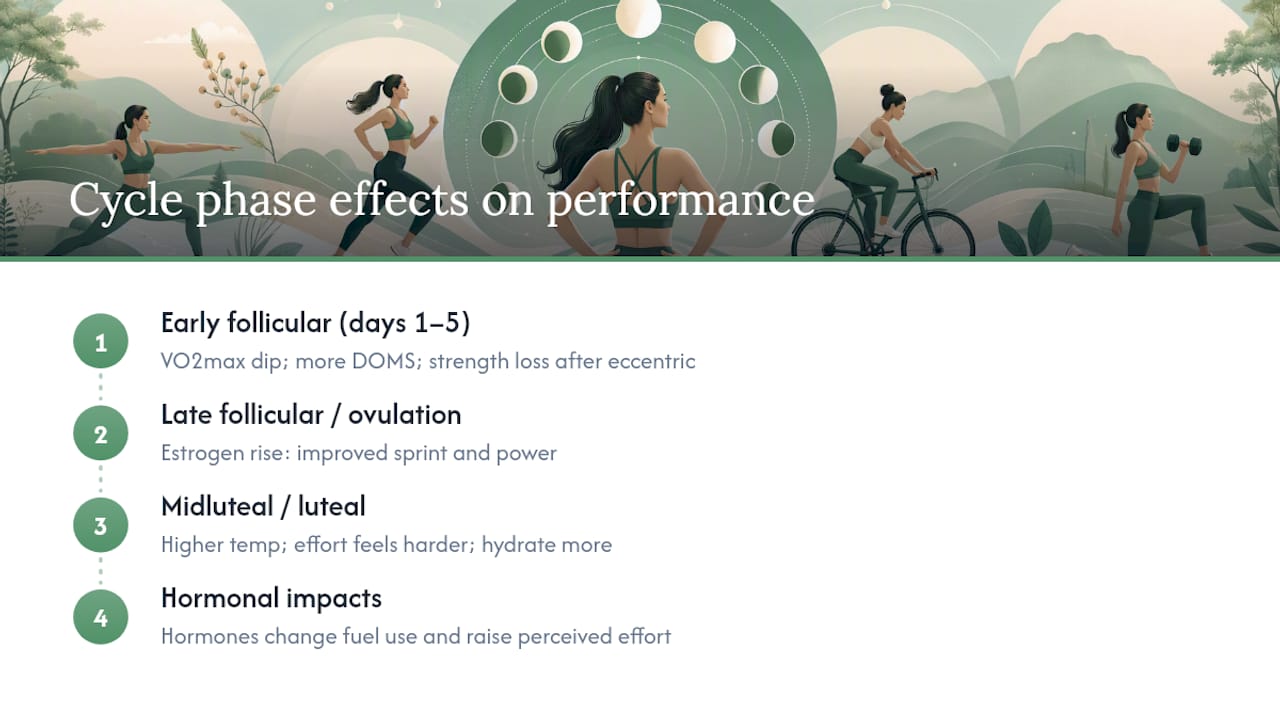
Late follicular / ovulation. Rising estrogen appears to support better neuromuscular efficiency in some studies, and a few report slightly improved sprint and power output here. If you’ve got a big lifting PR attempt or an interval session on the calendar and you’re feeling good, this window often rewards pushing harder. Sprint and repeated-effort tests seem to pick up phase differences more reliably than single strength-max tests, which often show no consistent pattern at all.
Midluteal / luteal. Progesterone climbs, which raises resting body temperature and can make effort feel harder than it actually is. Findings on strength and endurance here are mixed. Some studies report lower maximal strength; others find nothing. Hydration and carbohydrate intake matter more in this window because your body is working against a higher thermal baseline.
Why does any of this happen? Estrogen and progesterone shift how your body uses carbohydrate and fat for fuel, affect ventilation, and change core temperature regulation. Perceived effort and energy levels shift too, sometimes more than actual physical capacity does.
Pro Tip: Use phase patterns as a hypothesis, not a rulebook. If the research says early follicular tends to be tougher but your HRV and symptom log say you feel great, trust your data over the population average.
What Training and Nutrition Changes Actually Help?
Small, targeted adjustments beat overhauling your whole program. After a heavy eccentric session (deadlifts, sprints, downhill runs) in the early follicular phase, build in an extra recovery day or swap the next hard session for low-impact aerobic work. If your personal tracking shows you feel strong in late follicular or around ovulation, that’s often a good window to schedule interval work or a strength test, provided your data backs it up rather than a generic calendar rule.
Nutrition can blunt some of these effects. A narrative review found that carbohydrate, or glucose, intake before long aerobic sessions can help offset cycle-related dips in endurance performance. A few practical moves:
- Fuel long cardio sessions with carbs beforehand, especially in the early follicular window.
- Prioritize protein daily to preserve muscle, particularly after high-DOMS sessions. Nourished’s guide on protein needs across cycle phases breaks this down further.
- Drink more in the luteal phase, since higher body temperature increases fluid needs.
- Lean on anti-inflammatory foods (fatty fish, berries, leafy greens) around your period to help with cramps and soreness.
For day-to-day decisions, combine HRV, resting heart rate, and a quick subjective wellbeing score rather than relying on any single number. Research on combined-metric training protocols found that athletes using vmHRV, RHR, and wellbeing scores together saw bigger performance gains than those tracking HRV alone.
Pro Tip: A cycle-aware meal plan does the timing math for you. Nourished’s phase-based nutrition guide maps carbohydrate and protein needs to where you are in your cycle, so you’re not guessing before a demanding session.
How Should You Track Your Cycle to Find Your Own Pattern?
Population data tells you what’s common. Your own log tells you what’s true for you. Track your bleed and spotting days, energy, cramps, and mood daily, alongside HRV (specifically RMSSD if your wearable reports it), resting heart rate, sleep quality, and any DOMS after hard sessions with a physical period tracker planner for tangible menstrual health monitoring.
Give it 8 to 12 weeks of combined objective and subjective tracking before changing your long-term training plan. One rough week proves nothing; three cycles of the same pattern does. A free tool like Nourished’s period and cycle tracker paired with an HRV-enabled wearable and a 30-second daily wellbeing score covers the essentials without turning your morning into a spreadsheet exercise.
Pro Tip: Don’t panic over one low HRV reading. Look for a repeatable dip that shows up in the same phase, cycle after cycle, before you decide it’s meaningful.
When Should You See a Doctor About Cycle-Related Symptoms?
Most performance changes across the cycle are normal noise, not warning signs. But some symptoms deserve a clinician’s attention, not a training tweak:
- Missed periods (amenorrhea), especially alongside a jump in training volume.
- Very heavy bleeding or pain that doesn’t respond to your usual approach.
- A sharp, unexplained drop in performance paired with fatigue or weight loss.
- Signs of PCOS or another hormonal disorder.
Sudden increases in training load can themselves disrupt menstrual function, so if your cycle changed after ramping up intensity, mention that timeline to a sports medicine provider. Hormonal contraceptives can also change how (or whether) you notice phase effects at all, which is worth discussing if you’re trying to interpret your own data.
Why I’d Rather You Track Than Follow a Phase Chart
The gap between what cycle-syncing content promises and what the research actually supports is real. Phase charts make tidy claims; the data behind them is often low certainty, built on small studies with inconsistent phase-verification methods. That doesn’t mean the cycle doesn’t matter. It means your own HRV, RHR, and symptom log will tell you more than any generic four-phase calendar ever will.
Most women can train hard through every phase of their cycle. The goal isn’t avoidance. It’s noticing your own pattern and making small, smart adjustments instead of overhauling everything based on a stranger’s average.
Personalize Your Training and Nutrition Around Your Actual Cycle
Nourished takes the guesswork out of applying everything above. Instead of memorizing phase charts, you track your actual cycle and let personalized meal plans adjust to what your body needs that week.

The free period and cycle tracker logs your bleed days, symptoms, and energy alongside your training, so patterns show up in weeks instead of guesswork. Pair that with a personalized, AI-generated meal plan that adjusts carbohydrate and protein timing to your cycle phase, no calorie counting required. If you want to see exactly how the plans get built around your hormonal data, the tutorial walks through it step by step, and the research hub has the underlying evidence for readers who want to dig deeper. Start by logging this cycle. That’s the only real way to know what your body actually does.
Frequently Asked Questions
Can your cycle affect workout results in a way you’d actually notice? Sometimes. Research links the early follicular phase to slightly lower VO2max and more muscle soreness for some women, but effects vary widely by person and are often smaller than perceived.
Does exercise performance during periods get worse for most women? Not necessarily. The Office on Women’s Health notes exercise is safe and beneficial throughout your period, though some women report lower energy that week.
How does the cycle influence fitness over the long term? Cycle phase mostly affects day-to-day metrics like soreness and perceived exertion rather than long-term fitness gains, which respond more to consistent training and recovery.
Should you change your workouts based on your cycle phase? Small adjustments, like extra recovery after heavy sessions in early follicular phase, can help. But base changes on your own HRV and symptom data, not a generic chart.
Do birth control pills change how your cycle affects performance? Yes, hormonal contraceptives can flatten or alter the natural hormone fluctuations that drive some of these effects, so your personal pattern may differ from someone with a natural cycle.
This article is general information, not a substitute for advice from a qualified doctor. Consult a qualified healthcare professional about your own circumstances before acting on anything here.
Sources
- Physical activity and your menstrual cycle — U.S. Office on Women’s Health
- The Effects of Hormone Changes over the Menstrual Cycle on Elite Athlete Performance: Meta-analysis and Suggested Standardised Protocol
- Exercise-induced muscle damage during the menstrual cycle: A systematic review and meta-analysis (IronFEMME study group)
- Exercise performance at different phases of the menstrual cycle: measurements, differences, and mechanisms - a narrative review