3 Real Weekly Plans for Menopause: Cardio, Strength, and Protein
Nourished · September 2, 2026
3 Real Weekly Plans for Menopause: Cardio, Strength, and Protein
Both matter, but after menopause, strength training becomes the priority while cardio stays essential for your heart and metabolism. The American Heart Association recommends at least 150 minutes of moderate aerobic activity weekly, plus a minimum of two resistance sessions. If you only have time for one, lift. If you have time for both, you cover nearly every menopause-related health risk at once.
TL;DR:
- Resistance training is essential for maintaining muscle mass and bone density, especially since these decline rapidly after menopause.
- Combining aerobic and strength exercises helps address menopause-related issues such as belly fat, metabolic shifts, and mood swings more effectively than either alone.
- Short, compound resistance workouts and weight-bearing cardio like walking and stair climbing maximize efficiency and bone health without excessive time commitment.
- Progression in strength training should be gradual, adding small weight or rep increases every four to eight weeks to avoid plateauing.
- Prioritize protein intake of 25 to 30 grams per meal and avoid calorie restriction without resistance training to preserve muscle and bone during fat loss efforts.
Table of Contents
- Menopause Cardio vs Weights: What Each One Actually Fixes
- The Research Behind the Recommendation
- How to Build a Weekly Plan That Actually Fits Your Life
- Staying Safe: Modifications for Bones, Joints, and Lower Fitness
- Eating to Support the Work You’re Putting In
- Making the Plan Something You’ll Actually Keep Doing
- How Nourished Fits Into Your Cardio and Strength Routine
- Sources
Menopause Cardio vs Weights: What Each One Actually Fixes
Cardio and resistance training solve different problems, which is exactly why the debate over which one wins misses the point. Falling estrogen accelerates several things at once: visceral fat storage, bone loss, muscle loss, and disrupted sleep. No single type of exercise handles all of it.
Cardio does the heavy lifting for your cardiovascular system and blood sugar control. Regular aerobic work lowers resting heart rate, improves cholesterol markers, and helps regulate insulin sensitivity, which matters more after menopause because metabolic risk climbs even without weight gain. Aerobic activity also has a real, measurable effect on mood and sleep quality during a life stage when both often get worse. Not all cardio pulls equal weight for bone health, though. Weight-bearing cardio like brisk walking or stair climbing loads bone tissue in a way that swimming or cycling simply cannot, even though those non-weight-bearing options are still excellent for your heart.
Resistance training earns its priority status because it’s the only tool that directly counters two of the most consequential menopause changes: muscle loss and bone density decline. Building or maintaining muscle mass also keeps your resting metabolic rate higher, which matters when your body’s calorie-burning baseline drops with age regardless of activity level. Strength work additionally trains balance and functional movement, which becomes protective against falls later.
Here’s how the two map onto common menopause complaints:
- Belly fat and metabolic shifts: both help, but resistance training’s effect on resting metabolism gives it a slight edge.
- Bone density loss: weights win decisively, with weight-bearing cardio as a strong second.
- Mood swings and anxiety: cardio has the stronger, faster-acting evidence base.
- Sleep disruption: cardio again, particularly morning or early-afternoon sessions.
- Muscle and strength loss: resistance training, with no real substitute.
A 2023 meta-analysis of 7,141 postmenopausal women found that resistance training uniquely increased upper-body muscle strength in a way cardio didn’t replicate, while both modalities improved general fitness. That’s the clearest evidence yet that this isn’t an either-or decision.
The Research Behind the Recommendation
Guideline bodies didn’t arrive at “150 minutes plus two strength sessions” arbitrarily. The AHA’s physical activity recommendations reflect decades of cardiovascular outcome data, and menopause-specific research has only reinforced why the resistance component can’t be optional for women in this life stage.
The 7,141-woman meta-analysis mentioned above is the largest single piece of evidence specific to postmenopausal exercise response. Its main takeaway: cardio and resistance training both move the needle on general fitness, but resistance training does something cardio doesn’t, meaningfully building upper-body strength that tends to decline fastest after menopause.
Separately, randomized trials on weight loss during menopause consistently show a pattern worth knowing if you’re trying to lose fat. When women diet without resistance training, a larger share of the weight lost comes from muscle rather than fat. When exercise is paired with dietary changes, fat-free mass gets preserved far more effectively than with diet alone. In practice, this means:
- Cutting calories without lifting weights risks losing hard-won muscle along with fat.
- Combining resistance training with moderate calorie adjustments protects lean mass during weight loss.
- Institutions including UCLA Health now frame strength training as the foundation of post-menopause fitness, not an add-on to cardio.
Excessive steady-state cardio without any resistance work carries its own quiet risk. Long, frequent endurance sessions can elevate cortisol, and without strength training to offset it, that combination can accelerate the very muscle loss you’re trying to prevent.
How to Build a Weekly Plan That Actually Fits Your Life
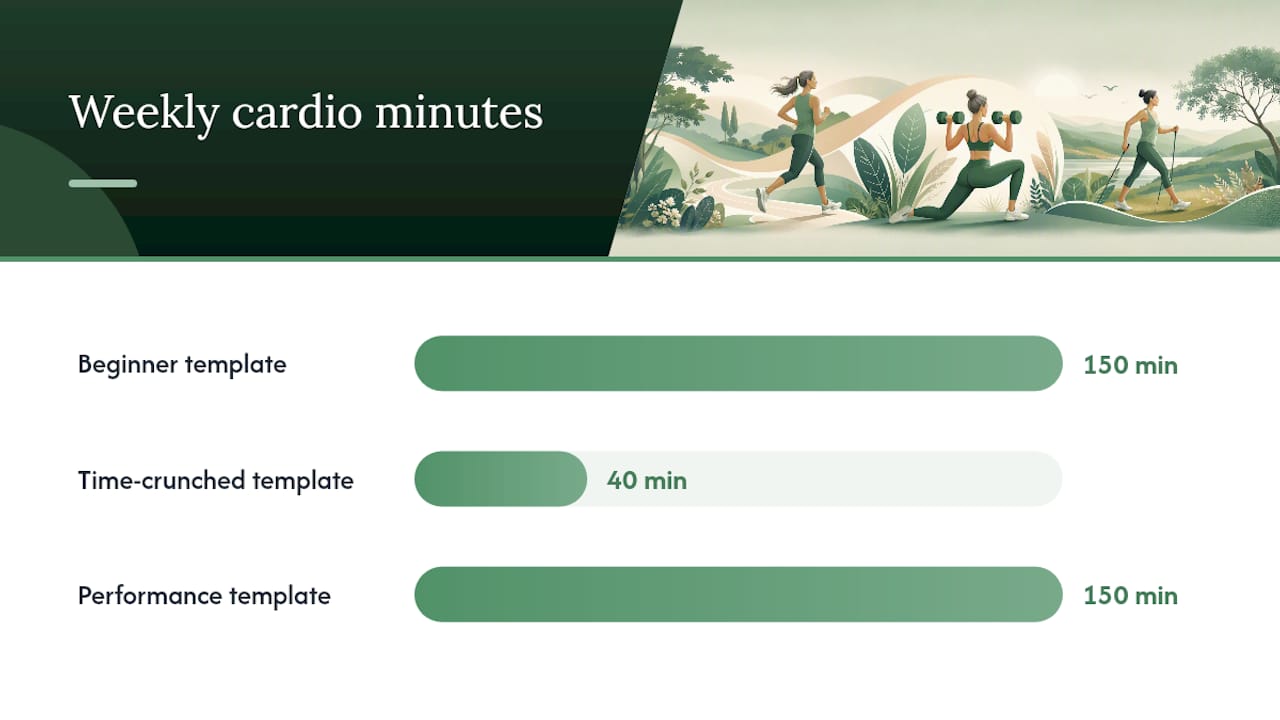
You don’t need two hours a day to hit the guidelines. You need consistency and a plan that matches your actual schedule. Here are three templates that all satisfy the 150-minutes-plus-two-strength-sessions target.
- Beginner template. Two strength sessions of 30 to 40 minutes (bodyweight squats, rows, wall push-ups, resistance bands), plus five 30-minute walks spread through the week.
- Time-crunched template. Two 30-minute strength sessions focused on compound moves (goblet squats, deadlifts, push-ups), plus two 20-minute HIIT sessions or brisk walks to close the aerobic gap.
- Performance template. Three strength sessions using progressive overload (barbell or dumbbell squats, deadlifts, bench presses, rows), plus 150 minutes of cardio that includes one HIIT session for efficiency and cardiovascular payoff.
Compound lifts like squats, deadlifts, and rows give you the most return per minute because they recruit multiple muscle groups at once, which matters if resistance training for women in this stage needs to be efficient, not exhausting. For cardio, alternate weight-bearing options (walking, stair climbing, dancing) with non-weight-bearing favorites (cycling, swimming) so you get bone benefits without sacrificing joint-friendly variety.
Progression should be gradual: add small amounts of weight or reps every four to eight weeks rather than jumping intensity all at once.
Pro Tip: Track reps and weight in a simple notes app for six weeks. If you’re not adding weight or reps somewhere in that window, your body has adapted and it’s time to increase the challenge.
Staying Safe: Modifications for Bones, Joints, and Lower Fitness
If you have osteoporosis or low bone density, favor controlled, weight-bearing strength moves and skip high-impact spinal loading (like heavy overhead barbell work) unless a clinician or trainer has cleared it specifically for you. Guided progression under a physical therapist or certified trainer reduces risk considerably in this group.
For joint pain or arthritis, swap high-impact cardio for cycling, swimming, or elliptical work, and use machines or bands for strength training until your joints tolerate more range of motion.
- Take at least one full rest day between strength sessions targeting the same muscle groups.
- Prioritize sleep, since recovery capacity often drops during the menopause transition.
- Ramp up intensity slower than you think you need to, especially in the first eight weeks.
- Stop and consult a clinician if you experience chest pain, joint swelling that doesn’t resolve, or sharp, localized pain during movement.
Eating to Support the Work You’re Putting In
Exercise without adequate protein is like paying for a gym membership you don’t use. Muscle tissue is metabolically active, and protecting it matters more after menopause because resting energy expenditure depends heavily on how much lean mass you’re carrying.
- Aim for roughly 25 to 30 grams of protein per meal, spread across three to four meals daily.
- Prioritize a protein source within a couple of hours after strength training to support muscle repair.
- Avoid aggressive calorie restriction without resistance training. It accelerates both muscle and bone loss.
This is where personalized nutrition support, like the meal and workout plans Nourished builds around your hormonal stage, makes the difference between guessing and actually preserving what you’re working to keep.
Making the Plan Something You’ll Actually Keep Doing
The best exercise routine is the one you don’t dread. Pick a cardio activity you’d choose even without a health mandate, dancing, hiking, a sport, because adherence beats optimization every time. Reframe strength training as functional capability, not aesthetics; you’re training to carry groceries and get off the floor easily at eighty, not to “tone.” Track a few simple numbers monthly, weight lifted, minutes walked, and let small wins build momentum.
— Brittany
How Nourished Fits Into Your Cardio and Strength Routine
Building a plan that balances cardio, strength, and nutrition takes more guesswork than most women have time for, especially when hormonal shifts change what your body actually needs month to month. Nourished removes that guesswork by generating personalized meal plans and hormone-aware workout guidance based on where you are in perimenopause, menopause, or post-menopause, no calorie counting required.
The platform’s AI-tailored plans account for the protein needs and muscle-preservation priorities covered above, and pair them with workout guidance that reflects your actual hormonal stage rather than a generic template. If you want the strength-training side broken down further, Nourished’s guide on strength training through perimenopause walks through progression in more detail, and the protein timing guide covers exactly when to eat after a session. For readers who also want support with in-home wellness services during this stage, VÉLOURA’s accessible beauty offerings for seniors are worth a look too. Start by exploring Nourished’s personalized plans to see how a hormone-adaptive approach compares to generic fitness advice.
This article is general information, not a substitute for advice from a qualified doctor. Consult a qualified healthcare professional about your own circumstances before acting on anything here.
Sources
- AHA recommendations for physical activity in adults
- Meta-analysis of exercise effects in postmenopausal women (2023)
- The best way to work out after menopause | UCLA Health