
Menopause Macros: Your Personalized Nutrition Guide
Nourished · August 13, 2026
Menopause Macros: Your Personalized Nutrition Guide
Start here: a practical macro split for menopause is roughly a balanced distribution of protein, carbohydrates, and fats with roughly equal proportions, with a protein floor of approximately moderate-to-high intake per pound of body weight consistent with muscle preservation recommendations. For a 160-pound woman, that’s 112–160 g of protein daily. These targets are higher than standard adult recommendations because protein intake during the menopause transition supports lean-mass preservation as estrogen declines and muscle loss accelerates.
This is a starting point, not a prescription. If you have diabetes, thyroid disease, kidney disease, or take medications that affect metabolism, work with a registered dietitian nutritionist (RDN) or your primary care clinician before making major dietary changes. The 2020–2025 Dietary Guidelines for Americans and the Academy of Nutrition and Dietetics both recommend individualized guidance for women navigating this transition. Nourished builds that personalization into its AI-driven meal plans, but the numbers below give you a solid foundation to start from today.
Key Takeaways
Protein-first macros, a modest calorie deficit, and resistance training form the most effective foundation for managing weight and body composition during menopause.
| Point | Details |
|---|---|
| Start with the macro split | Aim for 30–35% protein, 30–35% carbs, 30–35% fat, with 0.7–1.0 g protein per pound of body weight. |
| Calculate your personal targets | Use your body weight × an activity multiplier to estimate TDEE, then apply a 10–20% deficit for fat loss. |
| Distribute protein across meals | Target 25–40 g protein per meal to maximize muscle protein synthesis throughout the day. |
| Adjust by signals, not frustration | Change calories by ±100–150 kcal only after tracking trends for 2–4 weeks; use strength and energy as primary signals. |
| Nourished automates the process | Nourished generates hormone-aware, protein-first meal plans for perimenopause and menopause without manual macro math. |
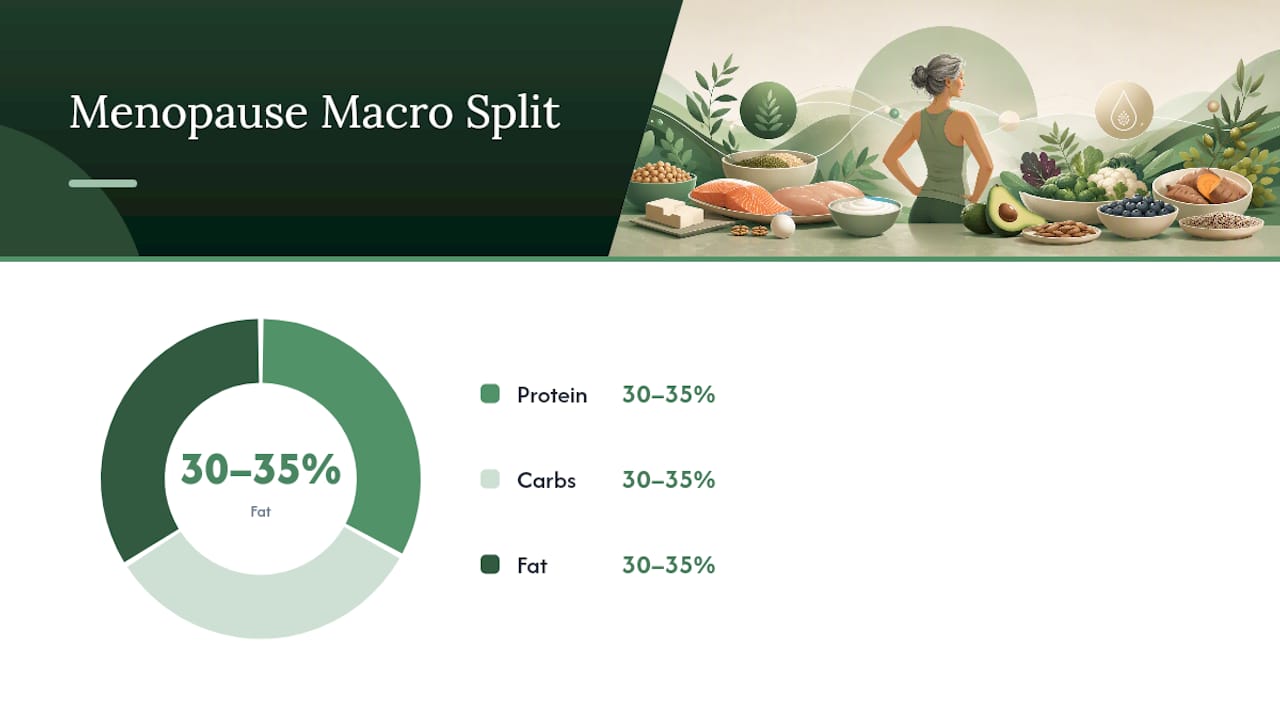
Table of Contents
- How do you calculate your menopause macros step by step?
- Sample meal plans for three common calorie goals
- How to track your macros and know when to adjust
- Menopause-specific nutrients that interact with your macros
- Who benefits most from a personalized menopause plan?
- When should you consult a clinician or RDN?
- What most menopause nutrition advice gets wrong
- Nourished takes the macro math off your plate
- Sources
How do you calculate your menopause macros step by step?
The math is straightforward once you have your total daily energy expenditure (TDEE). Here’s the full method.
Step 1: Estimate your TDEE
Multiply your body weight in pounds by an activity multiplier:
A 160-pound woman who exercises three times a week should multiply her weight by the activity factor to estimate TDEE, resulting in several thousand calories per day.
Step 2: Set your goal calories
Menopause-aware calculators recommend a modest deficit of 10–20% for fat loss rather than aggressive cuts, which tend to accelerate muscle loss. Apply that to your TDEE:
- Fat loss: TDEE × 0.80–0.90 (a 10–20% deficit)
- Maintenance: TDEE × 1.0
- Muscle building: TDEE × 1.05–1.10 (a 5–10% surplus)
Using the 2,400-kcal example: fat-loss target = roughly 1,920–2,160 kcal. For simplicity, the examples below use 1,600 kcal and 1,800 kcal, which reflect common real-world targets for smaller or less active women.
Step 3: Convert percentages to grams
Each macronutrient has a calorie value per gram: protein = 4 kcal/g, carbohydrates = 4 kcal/g, fat = 9 kcal/g.
At common calorie levels, protein, carbohydrate, and fat gram targets can be calculated by applying approximate percentage splits to total calories and then dividing by their caloric density.
Perimenopause vs. postmenopause: does the split change?
Somewhat. During perimenopause, hormonal fluctuations are still active, so carbohydrate tolerance can vary week to week. After menopause, resting energy expenditure tends to drop further and insulin sensitivity often decreases, which is why structured nutrition combined with resistance training is especially effective at preserving lean mass in postmenopausal women. Postmenopausal women who are sedentary may need to sit at the lower end of the calorie multiplier and the higher end of the protein range.

The physiological rationale is worth understanding: estrogen loss reduces muscle protein synthesis efficiency, lowers resting metabolic rate, and shifts fat storage toward the abdomen. Higher protein targets counteract the first two; resistance training addresses all three. Macros alone won’t close that gap.
Pro Tip: If you’re unsure whether you’re in perimenopause or postmenopause, your clinician can confirm with a simple FSH blood test. The distinction affects which calorie multiplier and protein target to start with.
Sample meal plans for three common calorie goals
The table below shows macro gram targets for three calorie levels, using a protein-forward split consistent with nutrition guidance for midlife women.
Aim to distribute protein intake reasonably evenly across meals to enhance muscle protein synthesis throughout the day.
Fat-loss day (approx. 1,500 kcal)
- Breakfast: 3-egg omelet with spinach and feta + ½ cup oats with berries (~35 g protein)
- Lunch: 5 oz grilled chicken breast over a large mixed-greens salad with olive oil and lemon (~40 g protein)
- Snack: 1 cup plain Greek yogurt + 1 tbsp chia seeds (~17 g protein)
- Dinner: 4 oz salmon, ½ cup quinoa, roasted broccoli (~35 g protein)
Maintenance day (approx. 1,700 kcal)
- Breakfast: Protein smoothie (1 scoop whey or pea protein, 1 cup unsweetened almond milk, ½ banana, 1 tbsp almond butter) (~30 g protein)
- Lunch: Turkey and avocado wrap in a whole-grain tortilla with tomato and arugula (~35 g protein)
- Snack: 2 oz cottage cheese with sliced cucumber and a small apple (~14 g protein)
- Dinner: 5 oz lean ground turkey stir-fry with brown rice and mixed vegetables, cooked in olive oil (~40 g protein)
Muscle-building day (approx. 2,000 kcal)
- Breakfast: 4-egg scramble with black beans, salsa, and a slice of whole-grain toast (~38 g protein)
- Lunch: 6 oz tuna mixed with Greek yogurt, celery, and mustard on whole-grain crackers + a side salad (~45 g protein)
- Snack: Edamame (1 cup) + a small handful of walnuts (~17 g protein)
- Dinner: 6 oz grilled flank steak, sweet potato, steamed green beans, drizzled with olive oil (~45 g protein)
Vegetarian and vegan swaps: Replace animal proteins with tofu, tempeh, edamame, lentils, or a high-quality pea or soy protein powder. Lactose-intolerant? Swap Greek yogurt for coconut-based yogurt fortified with calcium, and use plant-based protein powder in smoothies.
How to track your macros and know when to adjust
Tracking doesn’t have to mean logging every gram forever. A focused 2–4 week tracking period gives you enough data to calibrate your targets, and then you can shift to periodic spot-checks.
Tracking options, from most to least detailed:
- App-based logging (MyFitnessPal, Cronometer, or the food tracker inside Nourished): scan barcodes, build meals, and see daily totals in real time. Most accurate for the first few weeks.
- Plate method: fill half your plate with vegetables, a quarter with lean protein, a quarter with complex carbs, and add a thumb-sized portion of fat. Less precise, but sustainable long-term.
- Food diary: write down what you eat and estimate portions. Useful if apps feel tedious; less accurate but still reveals patterns.
For top nutrition trackers and muscle preservation strategies for women, a dedicated review covers the practical trade-offs in detail.
When to adjust your targets:
- Energy crashes by mid-afternoon: add 100–150 kcal, primarily from carbohydrates, and check that you’re hitting your protein floor each day.
- Strength declining over 2+ weeks: protein may be too low; increase by 10–15 g/day before touching calories.
- Weight stalling for 3+ weeks despite a deficit: reduce calories by 100–150 kcal, or add one resistance training session per week before cutting food further.
- Weight dropping faster than 1–1.5 lbs/week: increase calories by 100–150 kcal; rapid loss at this stage typically means muscle loss, not just fat.
Timeline: body composition shifts (more muscle, less fat) typically become visible in 6–12 weeks when paired with resistance training. Weight trends are best read over 2–4 weeks, not day to day. Hormonal water retention during perimenopause can mask fat loss on the scale for weeks at a time, which is why strength metrics and how clothes fit are often more reliable signals than the number on the scale.
Menopause-specific nutrients that interact with your macros
Getting the macro split right is only part of the picture. Several micronutrients and food categories have outsized relevance during perimenopause and postmenopause, and they interact directly with how you build your meals.
Nutrition interventions for midlife women should prioritize protein, calcium, vitamin D, and heart-healthy fats to reduce age-related disease risk. A Mediterranean-style eating pattern built around lean proteins, whole grains, vegetables, legumes, and olive oil aligns well with these targets and has evidence behind it for symptom management and long-term health.
Soy and phytoestrogens
Soy foods (edamame, tofu, tempeh, miso) contain isoflavones, which are phytoestrogens that may weakly mimic estrogen in the body. Individual response varies considerably. A food-first approach, meaning whole soy foods rather than concentrated supplements, is generally considered safe for most women and fits neatly into a protein-forward meal plan. If you have a history of hormone-sensitive conditions, discuss soy intake with your clinician before increasing it significantly.
Alcohol, caffeine, and spicy foods
All three are common hot flash triggers. Alcohol also disrupts sleep architecture, which worsens fatigue and can increase appetite the following day. Practically, this means timing matters: if you’re going to have caffeine, earlier in the day is better for sleep. Alcohol adds calories with no macronutrient value, so it competes directly with your fat and carbohydrate targets. Reducing or eliminating it is one of the higher-leverage dietary moves for women struggling with sleep and weight simultaneously.
Hydration
Drinking water before meals can modestly reduce intake for some people, and adequate hydration supports thermoregulation, which matters when hot flashes are frequent. Aim for at least 8–10 cups of water daily, more if you exercise or live in a hot climate. Dehydration can mimic hunger, which makes hitting macro targets harder without overshooting calories.
A note on supplements: calcium and vitamin D are the two most commonly recommended supplements for postmenopausal women, but dosing depends on your dietary intake, sun exposure, and bloodwork. Nutrition and menopause guidance from the Academy of Nutrition and Dietetics recommends working with an RDN to determine whether supplementation is needed rather than self-prescribing high doses, which can interact with medications or cause adverse effects.
Who benefits most from a personalized menopause plan?
Generic macro calculators treat a 52-year-old postmenopausal woman the same as a 35-year-old athlete. That gap is where personalized plans earn their value.
Women who tend to benefit most from individualized macro guidance include:
- Those experiencing persistent weight gain despite eating the same way they always have (a sign that metabolic rate has shifted, not that willpower has failed)
- Women with changing body composition, specifically losing muscle and gaining abdominal fat, even without a scale change
- Anyone whose eating patterns shift significantly with symptoms like hot flashes, poor sleep, or mood changes
- Women managing multiple health conditions (thyroid disease, prediabetes, cardiovascular risk) where generic targets could be counterproductive
Nourished addresses this directly. Its AI-personalized meal plans account for your menopause stage, activity level, and health goals, then generate phase-aware recommendations that adjust as your needs change. Rather than doing the macro math manually every few weeks, the platform handles recalculation and meal generation automatically. The Nourished approach to hormone-healthy nutrition is built specifically for women navigating perimenopause, menopause, and postmenopause, with protein-first meal distribution baked in from the start.
For women who want the clinical depth without the manual effort, Nourished’s AI nutrition chat and food tracker let you ask questions, log meals, and get real-time guidance without needing to book an appointment. That said, for complex medical situations, a referral to an RDN remains the right call.
When should you consult a clinician or RDN?
Most women can start with the macro targets in this guide safely. A few situations call for professional input first.
Contact your clinician promptly if you notice:
- Unexplained rapid weight loss or gain (more than 5–10 lbs in a month without intentional change)
- New chest pain, shortness of breath, or severe dizziness when changing positions
- Significant changes in appetite or metabolism after starting or changing a medication
- Symptoms that suggest thyroid dysfunction: extreme fatigue, hair loss, cold intolerance, or rapid heart rate
Ask for a targeted referral when:
- You haven’t had a bone density scan (DEXA) and are postmenopausal or have risk factors for osteoporosis
- You want a metabolic panel to assess fasting glucose, insulin, and lipids before making major dietary changes
- You’re on medications that affect nutrient absorption (metformin, proton pump inhibitors, corticosteroids)
For women managing diabetes, thyroid disease, or significant cardiovascular risk, shared decision-making with an RDN is the standard of care, not an optional extra. Macros are a tool, not a treatment.
What most menopause nutrition advice gets wrong
The loudest message in menopause nutrition tends to be “eat less.” Eat less sugar, less fat, fewer calories. And while a modest calorie deficit does support fat loss, the singular focus on restriction misses the more important lever: what you eat, not just how much.
Protein is the clearest example. Most women in midlife are eating well below the 0.7–1.0 g per pound target that research supports for muscle preservation. They’re not eating too much; they’re eating the wrong distribution. Shifting 200 calories from refined carbohydrates to lean protein, without changing total calories at all, can meaningfully change body composition over 12 weeks when paired with resistance training. That’s not a dramatic overhaul. It’s a reallocation.
The other thing most guides underemphasize: the scale is a terrible primary metric during perimenopause. Hormonal water retention, muscle gain from resistance training, and normal digestive variation can swing weight by 3–5 lbs in a week. Women who track strength, energy, and how their clothes fit alongside weight get a far more accurate picture of whether their plan is working. Progress during this transition is real, but it rarely looks the way it did at 35.
Nourished takes the macro math off your plate
Calculating TDEE, converting percentages to grams, adjusting for perimenopause versus postmenopause, and rebuilding your meal plan every few weeks is a lot to manage manually. Nourished was built to handle exactly that.
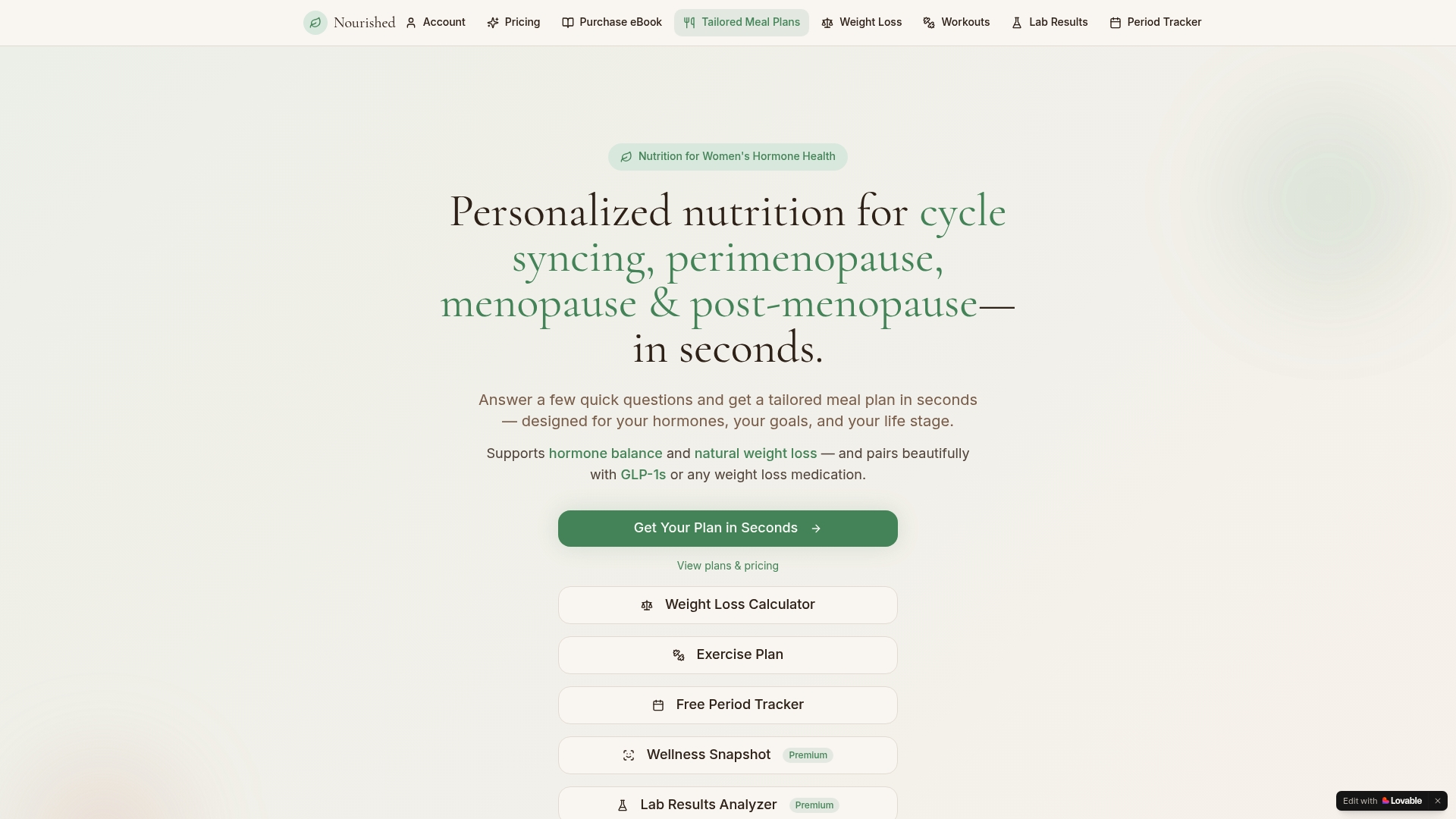
The platform generates AI-personalized meal plans calibrated to your menopause stage, activity level, and goals, with protein-first meal distribution built in from day one. As your needs shift, the plan adapts. You get a food tracker, AI nutrition chat for real-time questions, hormone-adaptive workout suggestions, and downloadable resources, all in one place. No macro spreadsheets, no starting from scratch every time your symptoms change.
Women who want an automated, evidence-informed route to menopause nutrition can get started with Nourished today, or explore the step-by-step tutorial to see exactly how the personalization works before committing.
Sources
- Protein and healthy aging — evidence review (PMC6125071)
- Dietary protein and older adults — review (PMC6483504)
- Nutrition and aging — menopause-relevant review (PMC8704126)
- Menopause diet: What to eat to help manage symptoms — Cleveland Clinic
- Nutrition and menopause — Academy of Nutrition and Dietetics (EatRight)
- Menopausia
This article is for general informational purposes only and is not a substitute for professional medical or dietary advice. Consult your primary care clinician or a registered dietitian nutritionist before making significant changes to your diet, especially if you have existing health conditions or take medications.