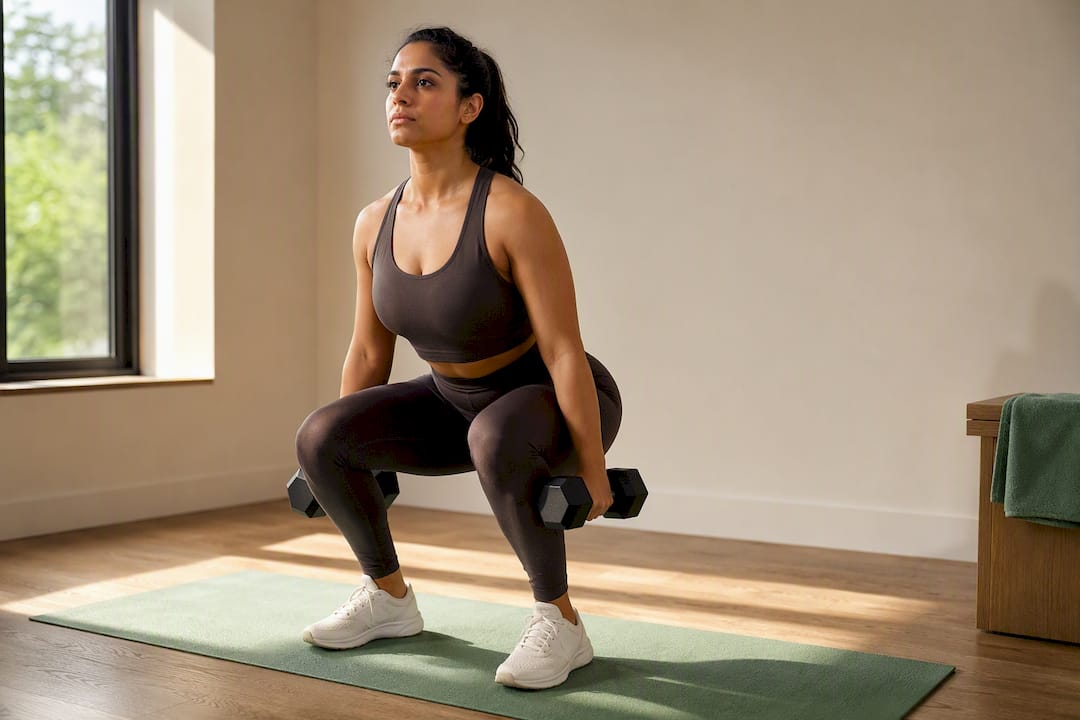
8 Week Evidence Backed PCOS Strength Training Plan
Nourished · September 9, 2026
8 Week Evidence Backed PCOS Strength Training Plan
Yes, resistance training is one of the most evidence-aligned tools available for managing PCOS symptoms, particularly insulin resistance and elevated androgens. A minimal effective starting point is a few strength sessions each week, built around compound lifts, plus regular walking or light cardio on other days. Check with a clinician first if you have joint issues, low baseline fitness, or another health condition, but most women with PCOS can start safely. The sample program below gives you the specifics.
TL;DR:
- Resistance training improves blood sugar regulation by increasing muscle mass, which enhances glucose uptake and insulin sensitivity in women with PCOS.
- Studies show modest but meaningful reductions in waist circumference, fasting glucose, testosterone, and cholesterol levels after 8 to 12 weeks of consistent strength training.
- Most effective programs include two to three moderate-intensity sessions weekly, focusing on compound lifts and progressing gradually over time.
- Small sample sizes and protocol variability mean personalized, flexible plans are preferable over rigid, one-size-fits-all routines.
- Motivation and adherence are critical; tracking strength progress and symptom improvements, rather than aesthetic goals, helps sustain long-term commitment.
Table of Contents
- Why Strength Training Helps PCOS: The Mechanisms Behind the Results
- What the Research Actually Shows (and Where It Falls Short)
- How to Build a PCOS Strength Training Program That Actually Works
- An 8-Week Starter Plan You Can Follow Today
- Staying Safe: Modifications, Screening, and When to Pause
- Fueling the Work: Nutrition and Recovery Basics
- Editor’s Take: Evidence First, Then Make It Usable
- Which Women With PCOS Benefit Most From Strength Training?
- Why Motivation Drops Off (and How to Keep It From Happening to You)
- How to Track Progress and Know When to Adjust
- What Gets in the Way (and What Actually Helps You Follow Through)
- Get a Strength and Nutrition Plan Built Around Your PCOS
- Key Studies and Guidelines Worth Reading
- Sources
Why Strength Training Helps PCOS: The Mechanisms Behind the Results
Muscle tissue works like a sponge for blood sugar. When you contract a muscle under load, it pulls glucose out of your bloodstream to fuel that contraction, and it keeps doing so for hours afterward as it replenishes glycogen. This matters enormously for PCOS, where insulin resistance sits at the center of the metabolic picture for a large share of women affected. Skeletal muscle is the body’s primary site for glucose disposal, and building more of it, or simply making the muscle you have work harder, directly improves how efficiently your body clears sugar from the blood, according to the National Institute of Diabetes and Digestive and Kidney Diseases.
That’s the mechanism. Here’s what it looks like in actual measured outcomes.
A scoping review of resistance training trials in women with PCOS found statistically significant improvements across several markers clinicians use to track the condition:
- Waist circumference decreased in multiple trials, a rough proxy for visceral fat, the type most tied to insulin resistance
- Fasting glucose and other glycemic markers improved
- Total testosterone dropped in several studies
- Sex-hormone binding globulin (SHBG), the protein that binds testosterone and controls how much stays biologically active, increased
What this means for you: lower testosterone plus higher SHBG usually translates to fewer androgen-driven symptoms, things like acne, excess facial or body hair, and scalp thinning, though the timeline for seeing those changes varies person to person.
An eight-week randomized controlled trial combining resistance and endurance training put numbers to this. Compared with a non-exercising control group, the training group saw significant drops in fasting insulin, HOMA-IR (a standard insulin resistance score), total testosterone, LDL, and total cholesterol, alongside a rise in QUICKI, another insulin-sensitivity index. Those are lab values a doctor could plausibly track over two months, not a vague promise of “feeling better.”
Here’s the honest interpretation of effect size: these aren’t dramatic, overnight transformations. HOMA-IR and testosterone shifted by amounts that are clinically meaningful but modest, the kind of change that might move someone from borderline insulin resistant into a healthier range over two months, not the kind that reverses PCOS outright. Muscle building and hormone shifts are slow, cumulative processes. Consistency over 8 to 12 weeks matters more than the intensity of any single workout.
What the Research Actually Shows (and Where It Falls Short)
The scoping review is the closest thing to a consensus summary on this topic, and it’s worth understanding both what it found and how it found it. Researchers pooled the available trials on resistance training in women with PCOS and found a consistent direction of effect: waist circumference, glycemic markers, testosterone, and SHBG all moved in favorable directions across most included studies. That consistency is reassuring. It’s also, by the reviewers’ own acknowledgment, built on a shaky foundation of small sample sizes and inconsistent study quality.
The 2025 combined-training trial adds more rigor to the picture. Over eight weeks, participants trained with resistance exercise at moderate intensity based on one-rep max estimates, paired with endurance work at moderate intensity based on heart rate reserve, according to the trial’s published protocol. That’s a fairly moderate, sustainable intensity range, not an extreme program requiring years of lifting experience. The results, drops in fasting insulin, HOMA-IR, and total testosterone, along with improved cholesterol markers, held up against a genuine control group, which strengthens confidence that the training itself, not just general lifestyle attention, drove the change.
Where does the evidence get shaky? A few places:
- Sample sizes remain small. Most PCOS exercise trials have relatively small participant numbers, which limits how confidently researchers can generalize findings to the broader population of women with PCOS.
- Protocols vary widely. Some trials test pure resistance training, others combine it with cardio, and intensity ranges shift from study to study, making it hard to pin down one “optimal dose.”
- PCOS itself isn’t one condition. Phenotypes differ (more on that below), and most trials don’t stratify results by phenotype, age, or baseline severity.
- Follow-up periods are short. Eight weeks tells you training works in the near term. It doesn’t tell you what happens at six months or two years.
Researchers studying this area have openly called for larger, better-powered trials to establish an optimal training “dose” for PCOS specifically. That’s not a knock against the existing evidence. It’s an honest acknowledgment that we have a strong directional signal and a moderate sample of solid mechanistic reasoning, but not yet the kind of large-scale, long-duration data that would let anyone hand you a guaranteed prescription.
The practical takeaway: the evidence supports resistance training as a legitimate PCOS management tool with real, measurable effects on insulin and androgen markers. It doesn’t yet support treating any single program, set count, or intensity number as gospel.
How to Build a PCOS Strength Training Program That Actually Works
Position statements on exercise and PCOS, including one from Exercise and Sport Science Australia, recommend muscle-strengthening activity on two non-consecutive days per week at minimum, layered on top of regular aerobic activity. That’s the floor. Most of the trials showing measurable metabolic change used three sessions weekly, so if your goal is symptom improvement rather than just general fitness, three is the better target.
Here’s how to structure it.
1. Set your weekly frequency. Aim for two to three resistance sessions per week, spaced with at least one rest or active-recovery day between sessions that hit the same muscle groups. Add two to three days of moderate aerobic activity, walking, cycling, swimming, on non-lifting days or after shorter lifting sessions. This combined structure mirrors what showed benefit in the combined-training RCT.
2. Pick your intensity. Trials in this space generally used moderate loads based on one-rep max (1RM), meaning you should pick a weight where you can manage multiple reps (around 8 to 15) before fatigue affects your form. If you don’t know your 1RM and don’t want to test it directly (a smart call for beginners), use rate of perceived exertion (RPE) instead: aim for a 6 to 8 out of 10, where the last two reps of a set feel genuinely hard but not maximal.
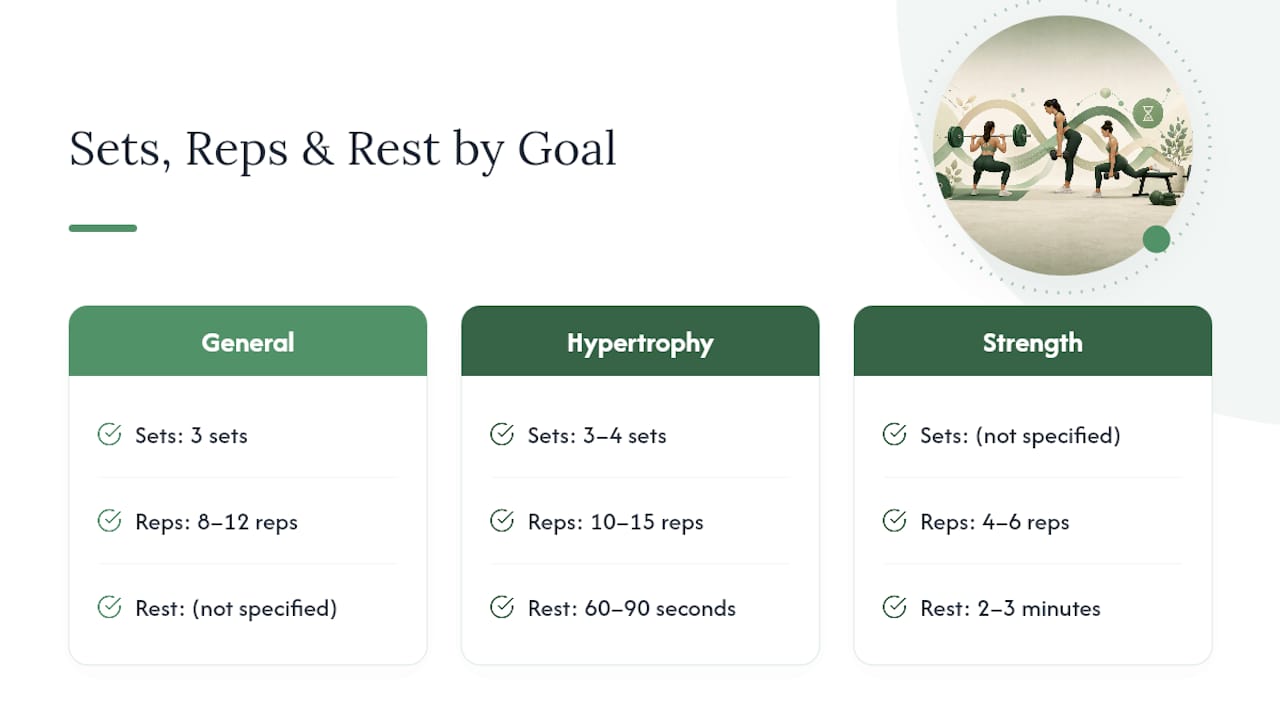
3. Choose your rep ranges by goal. For general strength and metabolic benefit, 3 sets of 8 to 12 reps per exercise is a reliable default. If building visible muscle (hypertrophy) is more of your priority, shift toward 3 to 4 sets of 10 to 15 reps with slightly shorter rest periods, around 60 to 90 seconds between sets. For pure strength gains, heavier loads with fewer reps (4 to 6) and longer rest (2 to 3 minutes) work better, though this matters less for symptom management specifically.
4. Build sessions around compound lifts. Compound, multijoint movements, squats, deadlifts, rows, presses, recruit more muscle mass per exercise than isolation moves, which means more glucose uptake and more hormonal signaling per minute in the gym. That’s why programs demonstrating benefit in PCOS research lean heavily on this movement pattern. Structure each session with two to three compound lifts first, then round out with one or two single-joint accessory exercises (bicep curls, lateral raises, calf raises) for muscle groups that need extra attention.
5. Progress deliberately. Progressive overload, gradually increasing weight, reps, or sets over time, is what actually drives the lean-mass and insulin-sensitivity gains researchers measure. A simple, sustainable rule: once you can complete all prescribed sets and reps with good form and an RPE below 7, add 2.5 to 5 pounds (or one resistance band level) the following week. If you stall for two consecutive weeks, hold the weight steady and add one more rep per set instead.
6. Respect recovery. Muscle adaptation happens between sessions, not during them. Leave at least 48 hours between sessions targeting the same muscle groups, and treat sleep as part of the program rather than an afterthought, since poor sleep blunts the same insulin-sensitivity gains you’re training for.
Pro Tip: If you’re new to lifting, spend your first two weeks with lighter loads and higher reps (12 to 15) purely to nail your form on squats, hip hinges, and pressing patterns. Rushing to add weight before your technique is solid is the single most common reason beginners get hurt or plateau early.
An 8-Week Starter Plan You Can Follow Today
This is a template, not a rigid prescription. Adjust loads to your own strength level and adjust rest days around your schedule, not the other way around.
The 8-week structure:
- Weeks 1 to 2: Learn the movements. Two sessions per week, lighter loads, RPE 5 to 6, focus entirely on form.
- Weeks 3 to 4: Add a third session. Begin progressive overload once form is consistent, RPE 6 to 7.
- Weeks 5 to 6: Increase load or reps weekly where possible. RPE 7 to 8. Add one interval-style aerobic session if energy allows.
- Weeks 7 to 8: Peak effort within this block. Reassess how weights feel, then plan whether to repeat this block at a higher baseline or shift toward a hypertrophy-focused rep range.
Session A (full body, compound emphasis):
- Goblet squat or bodyweight squat: 3 sets x 10 to 12 reps, 90 seconds rest
- Dumbbell or band row: 3 sets x 10 to 12 reps, 60 seconds rest
- Push-up (incline if needed) or dumbbell chest press: 3 sets x 8 to 12 reps, 90 seconds rest
- Glute bridge or hip thrust: 3 sets x 12 to 15 reps, 60 seconds rest
- Plank: 3 sets x 20 to 40 seconds
Session B (full body, posterior chain emphasis):
- Romanian deadlift (dumbbell or barbell): 3 sets x 8 to 10 reps, 90 seconds rest
- Standing overhead press (dumbbell or band): 3 sets x 10 to 12 reps, 60 seconds rest
- Reverse lunge: 3 sets x 10 reps per leg, 60 seconds rest
- Lat pulldown or band pulldown: 3 sets x 10 to 12 reps, 60 seconds rest
- Dead bug or bird dog: 3 sets x 10 reps per side
No-equipment or band-only swaps:
- Replace barbell squats with bodyweight squats, jump squats (lower reps), or Bulgarian split squats using a chair
- Replace rows with resistance band rows anchored to a door
- Replace overhead press with band presses or resistance-band pull-aparts
Short finisher option (5 to 8 minutes, add after any session):
- 30 seconds bodyweight squats, 30 seconds rest, repeat 4 rounds
- Or a brisk 10-minute walk if you’re short on time or energy
Retest your working weights or reps at the end of week 8. If squats that felt hard at RPE 8 in week 1 now feel like RPE 5 to 6, that’s your cue to either add load, add a fourth weekly session, or shift toward a new rep range depending on your goal.
Staying Safe: Modifications, Screening, and When to Pause
Most women with PCOS can start a resistance program without extensive medical workup, but a few situations call for a conversation with a clinician first, particularly if you’re pregnant, managing uncontrolled blood pressure or cardiovascular disease, or dealing with joint pain that hasn’t been evaluated.
Common modifications that keep training safe and sustainable:
- Low baseline fitness: Start with bodyweight or band-resisted movements before adding external load, and don’t feel obligated to hit three sessions weekly out of the gate. Two shorter sessions beat three sessions you can’t sustain.
- Joint pain (knees, hips, lower back): Swap high-impact movements like jump squats for controlled tempo squats, and use a box or bench to control depth on squats and lunges until pain-free range of motion is established.
- Disordered eating or body-image concerns: This deserves direct acknowledgment. PCOS carries a documented higher risk of disordered eating patterns, and a training program framed purely around “fixing” your body can backfire psychologically. Frame strength training around function and lab markers, not aesthetics, and consider working with a therapist alongside a trainer if body image is a significant stressor.
- Osteoporosis or low bone density: If bone health is a concern alongside PCOS, particularly relevant for women managing both conditions or navigating perimenopause, safe exercise adaptations for bone health can help you modify load and movement patterns without abandoning resistance training altogether.
Pro Tip: Sharp, localized pain during a lift (not general muscle fatigue) is your body telling you to stop that exercise for the day, not push through it. General muscle soreness 24 to 48 hours after a session is normal; joint pain during the movement itself is not.
Stop and seek medical guidance if you experience chest pain, dizziness, shortness of breath disproportionate to effort, or sharp joint pain that persists beyond a session. If you’re on medication that affects blood sugar or blood pressure, ask your prescribing clinician how exercise might interact with your dosing before ramping up intensity.
Fueling the Work: Nutrition and Recovery Basics
Training builds the stimulus. Nutrition and sleep determine how much of that stimulus actually turns into muscle and improved insulin sensitivity.
Protein needs sit higher for anyone doing regular resistance training than for a sedentary person, generally in the range most strength-training research points to for supporting muscle repair. Practically, that means prioritizing a protein source at each meal, eggs, poultry, fish, legumes, Greek yogurt, rather than treating protein as an afterthought. Timing matters less than people assume; getting adequate protein across the whole day matters more than hitting a narrow post-workout window.
Carbohydrate timing deserves a more nuanced take for PCOS specifically. You don’t need to fear carbohydrates to improve insulin sensitivity, that’s an outdated framing. What helps more is pairing carbohydrates with protein and fiber to blunt blood sugar spikes, and considering slightly larger carbohydrate portions around training sessions, when your muscles are primed to use that glucose for glycogen replenishment rather than storage.
A few recovery basics that directly affect how your body adapts to training:
- Sleep of roughly seven to nine hours supports the hormonal environment (growth hormone release, cortisol regulation) that muscle repair depends on
- Chronic stress elevates cortisol, which can work against the same insulin-sensitivity gains you’re training for
- Rest days aren’t optional. Under recovered muscle doesn’t just fail to grow, it can blunt the metabolic benefits you’re after
This is exactly the kind of individualized calculation that’s hard to nail down with generic advice, since protein needs, carbohydrate tolerance, and recovery capacity all shift depending on your specific phenotype, activity level, and even where you are in your cycle. Nourished builds personalized meal and workout plans that adjust to those factors rather than applying one blanket rule to everyone, and its research and references page lays out the evidence informing that approach. For the cycle-specific piece of this puzzle, protein needs shift across cycle phases, and understanding how your cycle affects workout performance can help explain why some weeks feel stronger than others.
Editor’s Take: Evidence First, Then Make It Usable
The research on strength training and PCOS is honest about its own limits, small samples, mixed protocols, short follow-up windows. What frustrates me is how that honesty gets lost the moment this topic hits generic fitness content, which either oversells resistance training as a cure or buries the actual, decent evidence under vague “just move more” advice.
The research supports something specific: resistance training at moderate intensity, two to three times weekly, measurably improves insulin markers and androgen levels in many women with PCOS. That’s not a cure and it’s not nothing.
Where conventional advice falls short is treating PCOS as one condition with one fix. It isn’t. Phenotype, baseline fitness, and life stage change what a smart program looks like, which is exactly why cookie-cutter plans underperform personalized ones.
Prioritize consistency over intensity for the first eight weeks. A woman doing three moderate sessions weekly for two months will see more benefit than someone doing five brutal sessions for two weeks and quitting. The programs I trust most, including the personalized approach Nourished takes with meal and workout plans, treat PCOS as individual biology, not a checklist.
— Brittany
Which Women With PCOS Benefit Most From Strength Training?
Not every woman with PCOS starts from the same baseline, and the research reflects that unevenly. Women with the classic phenotype, high androgens combined with irregular ovulation and polycystic ovarian morphology on ultrasound, tend to show the clearest insulin resistance on lab work, which means they often have the most room for measurable improvement from resistance training.
Women with more insulin-resistant presentations generally, regardless of phenotype label, tend to see the largest shifts in HOMA-IR and fasting insulin, simply because there’s more metabolic dysfunction to correct. Someone with milder insulin resistance may see smaller absolute changes on lab panels, even if she’s training just as hard.
Age and baseline fitness matter too. Women in their 20s and 30s with lower baseline activity levels often show faster early gains, both in strength and in metabolic markers, than women who are already active or who are managing PCOS alongside another condition like a thyroid disorder. That doesn’t mean older women or those with comorbidities won’t benefit. It means the timeline and magnitude of visible change may differ, and expecting identical results across very different starting points sets people up for disappointment.
Severity of symptoms plays a role in motivation as much as biology. Women with more disruptive symptoms, significant acne, hair loss, or menstrual irregularity, sometimes report noticing changes in energy and cycle regularity before lab markers shift, which can be a useful early signal that the program is working even before a follow-up blood panel confirms it.
Why Motivation Drops Off (and How to Keep It From Happening to You)
Adherence, not program design, is usually the real reason strength training fails to deliver results. You can have a perfect eight-week plan on paper and get nothing from it if you stop showing up in week three.
PCOS adds specific psychological friction that generic fitness advice ignores. Body-image concerns are common, and a training approach that frames every workout around weight loss or “fixing” your appearance can make the whole process feel punitive rather than empowering. Fatigue is another real barrier. Insulin resistance and hormonal fluctuation can leave you feeling low-energy on days when a workout feels like the last thing you can manage, and pushing through that without adjusting intensity often backfires into burnout or injury.
What actually helps: tying your motivation to something other than the scale. Track strength numbers, how many reps you can do, how heavy your squat feels, how your energy shifts across a week, rather than exclusively tracking weight. Symptom-based wins, better sleep, steadier energy, more regular cycles, tend to sustain motivation longer than aesthetic goals because they show up faster and feel more personally meaningful.
Social support and accountability structures, whether that’s a training partner, a coach, or a program that adjusts to how you’re actually feeling that week rather than a rigid one-size-fits-all schedule, measurably improve long-term adherence in lifestyle interventions generally. Flexibility beats perfection here. A program you can sustain at 80% effort for six months outperforms one you attempt at 100% for two weeks and abandon.
How to Track Progress and Know When to Adjust
Lab markers like HOMA-IR, fasting insulin, and testosterone are the gold standard for measuring internal change, but you likely won’t retest those more than every few months. In the meantime, track what you can observe weekly.
Keep a simple log of the weight, reps, and RPE for your main lifts each session. Progress here doesn’t have to mean adding weight every week, sometimes it means the same weight feels easier, or you complete an extra rep at the same RPE. Both count as real progress even if the number on the bar hasn’t moved.
Beyond the weight room, track cycle regularity, energy levels, sleep quality, and skin or hair symptoms on a simple weekly basis. These often shift before, and sometimes independent of, blood work, and they give you real-time feedback about whether your current program and recovery routine are working.
If you’re stalling on strength gains for more than two to three weeks despite consistent training, look first at recovery, sleep, protein intake, rest between sessions, before assuming the program itself needs an overhaul. If symptoms aren’t budging after a full 8 to 12 week block, that’s a reasonable point to revisit your plan with a clinician or trainer, and possibly request updated lab work to see whether the internal markers are shifting even if you don’t feel a dramatic difference yet.
What Gets in the Way (and What Actually Helps You Follow Through)
The biggest practical barrier for most women isn’t knowledge, it’s logistics. Gym access, cost, time, and simply not knowing which exercises to do can stall a program before it starts. Combine that with PCOS-specific fatigue and low motivation on harder symptom days, and it’s easy to see why so many well-intentioned starts fizzle out by week three.
Facilitators that consistently move the needle: having a specific, written plan rather than a vague intention to “exercise more,” removing decision fatigue by knowing exactly what to do when you show up. Home-based or band-only options remove the cost and access barrier entirely, which is part of why the no-equipment swaps earlier in this guide matter as much as the gym-based version. Short sessions (20 to 30 minutes) are far more sustainable than ambitious 60-minute workouts for someone already managing fatigue and a full schedule.
Support from a clinician, trainer, or nutrition program that understands PCOS specifically, rather than generic fitness advice, also reduces the trial-and-error phase that causes many women to quit before finding what works. Personalized programs that flex with your energy, cycle phase, and symptom pattern tend to outperform rigid ones precisely because they account for the reality that PCOS symptoms fluctuate week to week, not just program to program.
Get a Strength and Nutrition Plan Built Around Your PCOS
Generic fitness plans don’t account for insulin resistance, androgen levels, or how your energy shifts across the cycle, which is exactly why so many women with PCOS try, stall, and quit. Nourished builds personalized meal and workout plans that factor in PCOS specifically, adjusting protein targets, carbohydrate timing, and training recommendations to your actual hormonal picture rather than a generic template.
Personalized hormone-aware nutrition guidance, requiring no calorie counting, combined with workout support tailored to your goals and energy levels, helps ensure your strength program and meals work toward the same outcome instead of pulling in different directions. You can see exactly how the personalization works on the how Nourished works page before committing to anything.
If you’re managing PCOS alongside medication or planning a significantly more intense program than what’s outlined here, loop in your clinician first, particularly if lab monitoring is part of your care plan. Ready to build a plan around your own biology instead of guessing? Start with Nourished and get a personalized nutrition and workout plan designed for how your body actually works.
Key Studies and Guidelines Worth Reading
- The scoping review on resistance training and PCOS remains the most complete summary of trial-level evidence on waist circumference, glycemic markers, testosterone, and SHBG.
- The 2025 combined-training RCT offers the clearest single-trial evidence on fasting insulin, HOMA-IR, and lipid changes over an eight-week protocol.
- The Exercise and Sport Science Australia position statement sets the clinical benchmark for weekly frequency and the case for individualized prescription.
- The NIDDK overview of insulin resistance explains the muscle-glucose mechanism underlying why this training approach works at all.
This article is general information, not a substitute for advice from a qualified doctor. Consult a qualified healthcare professional about your own circumstances before acting on anything here.
Sources
- Time to Load Up–Resistance Training Can Improve the Health of Women with Polycystic Ovary Syndrome (PCOS): A Scoping Review
- Modulation of hormonal, metabolic, inflammatory and oxidative stress biomarkers in women with polycystic ovary syndrome following combined (resistant and endurance) training: a randomized controlled trial
- Exercise in the management of polycystic ovary syndrome: A position statement from Exercise and Sport Science Australia
- NIDDK — Prediabetes and insulin resistance overview