
8 Week Reverse Dieting for Women: Add 50–100 kcal Weekly, Hormone Aware
Nourished · September 5, 2026
8 Week Reverse Dieting for Women: Add 50–100 kcal Weekly, Hormone Aware
Reverse dieting works best for women who have spent months in a calorie deficit and now feel depleted, stalled, or unable to keep losing without burning out. The realistic outcome is finding a higher, sustainable maintenance intake and calmer hunger signals, not a metabolism “hack” or fast fat loss. Guidance from Precision Nutrition and Cleveland Clinic, paired with a hormone-aware approach like the one Nourished builds around, gives this method its practical backbone.
TL;DR:
- Reverse dieting may help women find a sustainable calorie intake and manage hunger, but it does not reliably boost metabolism or cause rapid fat loss.
- The typical process involves small weekly calorie increases based on a seven-day intake and weight trend, with caution against rapid jumps or neglecting protein.
- Evidence suggests all groups tend to regain weight, indicating reverse dieting’s main benefit is psychological and behavioral, not metabolic.
- Hormonal factors in midlife women require slower increases and longer holds, and addressing issues like sleep and stress is crucial for success.
- Consistency over three to four weeks and professional monitoring for symptoms are essential, as results vary widely depending on individual body responses.
Table of Contents
- What Is Reverse Dieting and How Does It Work?
- Does Reverse Dieting Actually Work?
- How to Reverse Diet: A Step-by-Step Protocol
- What Should You Track While Reverse Dieting?
- Reverse Dieting Through Perimenopause and Midlife
- What Does an 8-Week Reverse Diet Actually Look Like?
- A Coach’s Honest Take on Reverse Dieting
- How Nourished Makes Reverse Dieting Easier to Get Right
- Sources
What Is Reverse Dieting and How Does It Work?
Reverse dieting means adding calories back gradually after a stretch of restriction, instead of jumping straight to an estimated maintenance number. The goal is to land on a sustainable intake without the rapid fat regain that often follows a crash diet.
Most practitioner protocols follow the same basic shape:
- Track intake for seven days to get a real baseline, not a guess.
- Add small increases in calories each week, such as in the range often recommended by practitioners, based on how depleted or stalled you are.
- Continue this gradual increase for several weeks, potentially a few months for women coming off long, aggressive diets.
- Reassess weekly using weight trends, not single-day readings.
Healthline’s breakdown of reverse dieting describes this same weekly-increment structure, and it’s become the default starting point most coaches use before customizing further.
Does Reverse Dieting Actually Work?
The evidence is thinner than the internet buzz suggests. A 2025 randomized preliminary analysis of 49 participants compared gradual reverse dieting against an immediate jump to estimated maintenance and against unrestricted, ad libitum eating.
The result: no statistically significant difference in weight regain between the three strategies (p = 0.053), according to the PMC study. Every group regained some weight during the follow-up period.
That doesn’t mean reverse dieting is pointless. It means its main benefit may be psychological and behavioral, not metabolic. Cleveland Clinic’s registered dietitians are direct about this: reverse dieting doesn’t reliably “boost” your metabolism, but it does help you find a maintenance level and manage hunger more comfortably than an abrupt calorie jump.
Why do outcomes vary so much between women?
- Sample sizes in the existing research are small, so individual results swing widely.
- Starting deficit severity, diet duration, and training history all change how a body responds.
- Hormonal status, especially around perimenopause, isn’t isolated in most current trials.
- Adherence and sleep quality affect results as much as the calorie math itself.
Treat reverse dieting as a structured, lower-stress way to exit a diet, not a proven metabolic upgrade.
How to Reverse Diet: A Step-by-Step Protocol
Here’s a practical sequence for building your own progression:
- Establish your baseline. Track food intake and weigh yourself daily for seven days. Use the seven-day average calorie intake and the seven-day average weight, not a single number.
- Choose your pace. Go with +50 kcal/week if you’re older, less active, or only mildly under-eating. Choose +100 kcal/week if you were in a steep, long deficit and activity is high.
- Prioritize protein. Keep protein between 1.3 and 3 g/kg of bodyweight, per Precision Nutrition’s guidance, and bias new calories toward carbohydrates around training sessions, with a modest bump in fats to support hormone production.
- Train with intent. Lift with progressive overload two to four times a week. Taper excessive cardio, since added calories should rebuild capacity, not just fuel more mileage.
- Set your holding rule. If the scale climbs faster than expected for more than one week, hold your current intake for a week before adding more.
Pro Tip: Weigh yourself at the same time each morning, after using the bathroom and before eating. A single reading means nothing. The seven-day trend is the only number worth reacting to.
What Should You Track While Reverse Dieting?
Four things matter more than the scale alone: seven-day average weight, body measurements (waist, hips, thighs), progress photos, and workout performance like reps, load, or endurance.
Expect an early bump of 1 to 3 pounds in the first one to two weeks. That’s typically glycogen and water retention as carbohydrate intake rises, not new fat, according to midlife-focused reverse dieting guidance.
Use this decision rule: if your average weight gain exceeds 0.5 pounds per week for three consecutive weeks, pause your calorie increases and hold steady until the trend flattens.
Talk to a clinician if you notice missed or irregular periods, persistent fatigue, hair thinning, or a stall that doesn’t respond to holding calories for several weeks. Those symptoms deserve a professional look, not another spreadsheet adjustment.
Reverse Dieting Through Perimenopause and Midlife
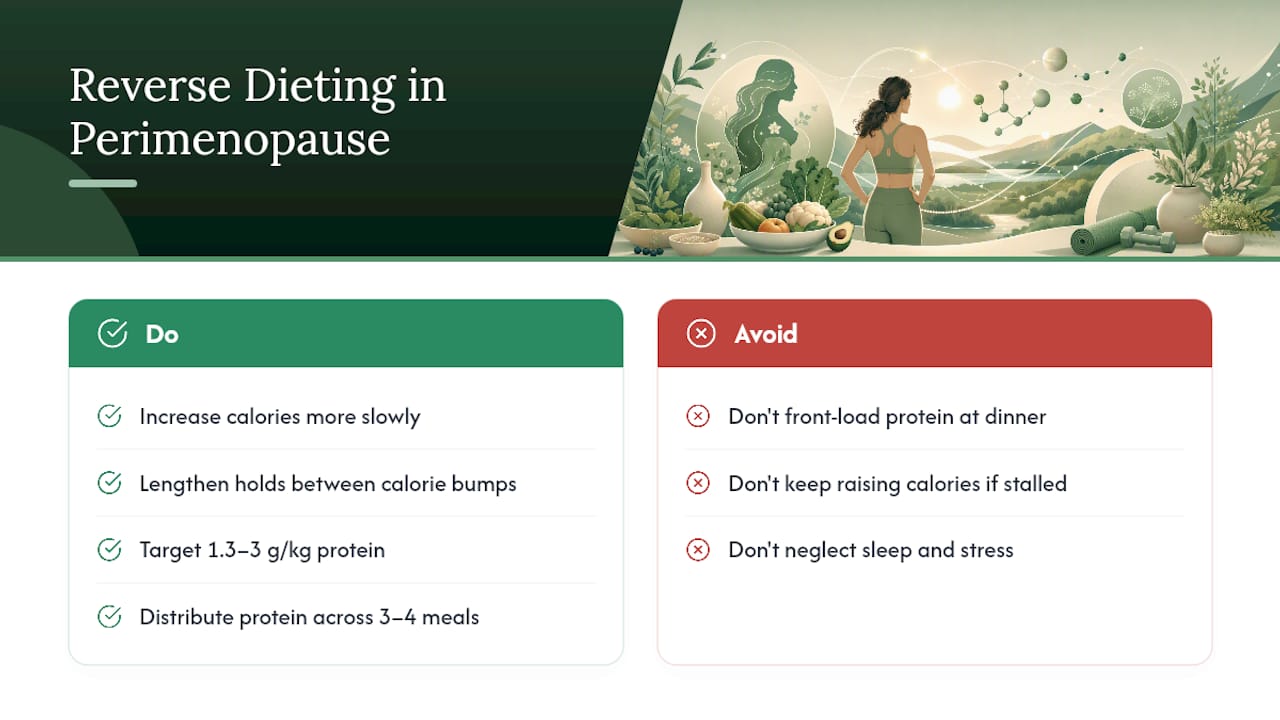
Hormones change the math. Declining estrogen affects how the body handles carbohydrates and fat storage, which is one reason midlife women often need slower increases and longer holds between calorie bumps than they’d need in their twenties.
Protein needs don’t shrink with age, they arguably matter more. The same 1.3 to 3 g/kg range applies, but distribution across three or four meals helps preserve muscle better than front-loading it at dinner. Nourished’s guide to protein in perimenopause walks through why timing matters as much as the total gram count.
If progress stalls for eight to twelve weeks despite consistent holds and honest tracking, it’s worth raising thyroid function with your doctor. Chronic under-eating can sometimes unmask a sluggish thyroid in midlife women, and a simple panel can rule that in or out before you keep guessing.
Pro Tip: Sleep and stress aren’t side notes here. Poor sleep alone can blunt the results of an otherwise well-run reverse diet by keeping cortisol elevated and appetite regulation off balance.
What Does an 8-Week Reverse Diet Actually Look Like?
Picture two women starting at 1,600 calories a day.
With slower weekly calorie increases, one might reach a moderate increase by about two months, suitable for someone older, less active, or coming off a milder deficit.
With faster weekly increases, another might reach a higher calorie intake in the same period, suited to someone who trained hard and underwent a longer, more aggressive diet.
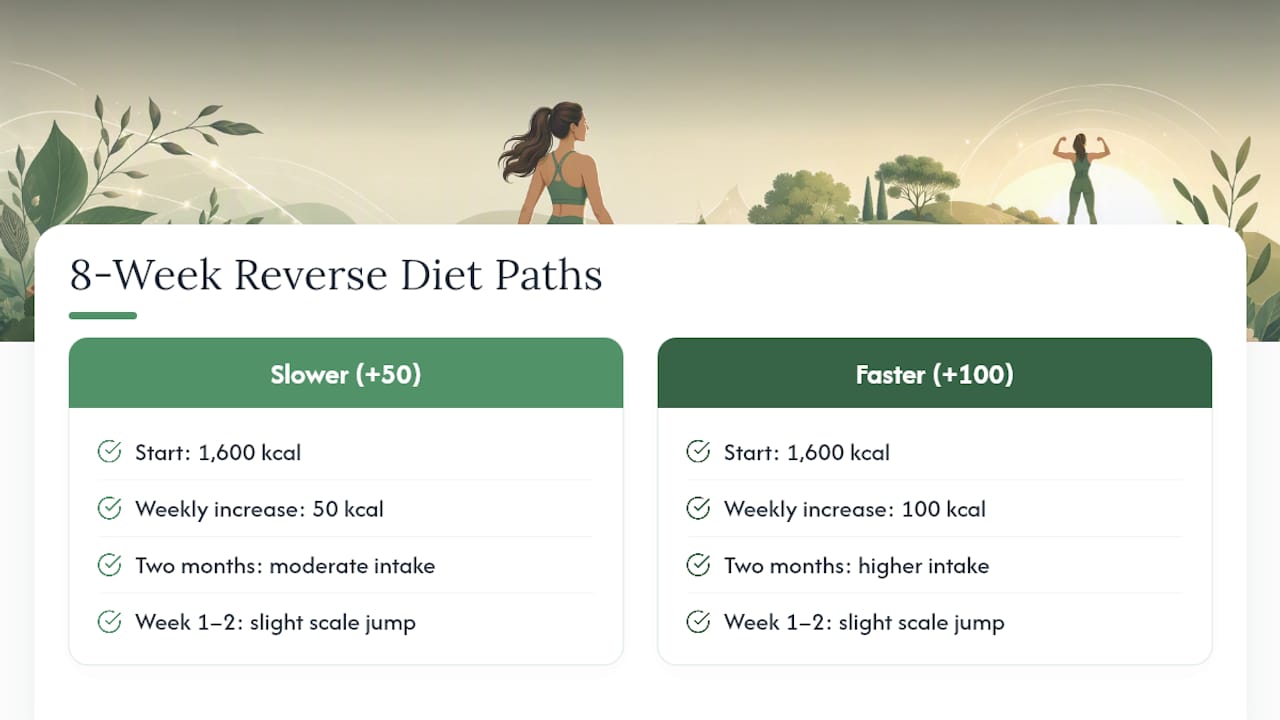
In practice, 50 calories looks like adding a tablespoon of nut butter or half a slice of bread. A hundred calories looks like a small serving of Greek yogurt with berries, or an extra ounce of chicken with dinner. Expect the scale to jump slightly in week one from water and glycogen, described earlier, before it settles into a real trend by week three or four.
A Coach’s Honest Take on Reverse Dieting
Reverse dieting isn’t complicated, but women make the same three mistakes constantly: increasing calories too fast because the scale hasn’t budged in three days, ignoring protein while adding calories back, and quitting the moment week one shows a small gain.
Here’s the fix: stick to the plan for at least three to four weeks before judging it, track protein as closely as total calories, and treat any concerning symptom, like a missed period or persistent exhaustion, as a reason to call a clinician, not a reason to Google harder.
The women who do this well aren’t the most disciplined. They’re the ones who stopped expecting a straight line.
— Brittany
How Nourished Makes Reverse Dieting Easier to Get Right
Reverse dieting asks you to track intake, adjust protein, and factor in where you are in your cycle, all while your hormones are shifting the rules underneath you. Personalized meal and workout plans that adjust automatically for menstrual cycle phase, perimenopause, or menopause apply calorie increases to your actual hormonal picture instead of a generic template. There’s no manual calorie counting involved. AI customization can handle pacing, protein targets, and training adjustments based on individual stage and preferences.
If you want a cycle-aware starting point before committing to a plan, try the free period and cycle tracker or walk through how Nourished works to see how the plans adapt week to week.
Sources
- The effects of reverse dieting on mitigating weight regain after a caloric deficit: a preliminary analysis (PMC)
- Does Reverse Dieting Work? (Cleveland Clinic)
- Reverse dieting: Can you really get better results by eating more? (Precision Nutrition)
- Reverse dieting: What It Is and How to Do It (Healthline)
This article is general information, not a substitute for advice from a qualified doctor. Consult a qualified healthcare professional about your own circumstances before acting on anything here.