Seed Cycling for Women: Adds Lignans and Omega 3s, What Science Says
Nourished · September 1, 2026
Seed Cycling for Women: Adds Lignans and Omega 3s, What Science Says
Seed cycling means rotating flax and pumpkin seeds in the first half of your cycle, then swapping to sesame and sunflower seeds in the second half, based on the idea that different seeds support estrogen and progesterone at different times. The nutrients involved (lignans, zinc, vitamin E) are genuinely useful for hormone health, but no clinical trial has proven that timing seeds to your cycle changes your hormones. It’s a low-risk habit worth trying alongside a balanced diet, not a treatment for a diagnosed hormonal condition.
TL;DR:
- The evidence supporting seed cycling’s effect on hormones is limited to small studies and anecdotal reports, with no clinical trials confirming its efficacy.
- Proper implementation involves grinding seeds fresh every few days and adjusting for irregular cycles by using bleeding signals rather than fixed days.
- Nutrients in seeds support general reproductive health but do not have proven capabilities to significantly alter hormonal levels when timed according to the protocol.
- Seed cycling offers nutritional benefits and behavioral structure, but should not replace medical evaluation for hormonal or fertility issues.
- Incorporating seed cycling into a balanced diet can improve menstrual comfort and regularity, mainly through consistent micronutrient intake rather than hormonal regulation.
Table of Contents
- What is seed cycling and what’s the typical schedule?
- How do you actually do seed cycling?
- What does the science actually say about seed cycling?
- What benefits can you realistically expect?
- What are the risks and how do you store seeds properly?
- Does seed cycling work with irregular cycles or PCOS?
- When should you see a doctor, and how do you know if it’s helping?
- What we tell clients about seed cycling
- Where Nourished fits if you want this built into your meals
- Sources
What is seed cycling and what’s the typical schedule?
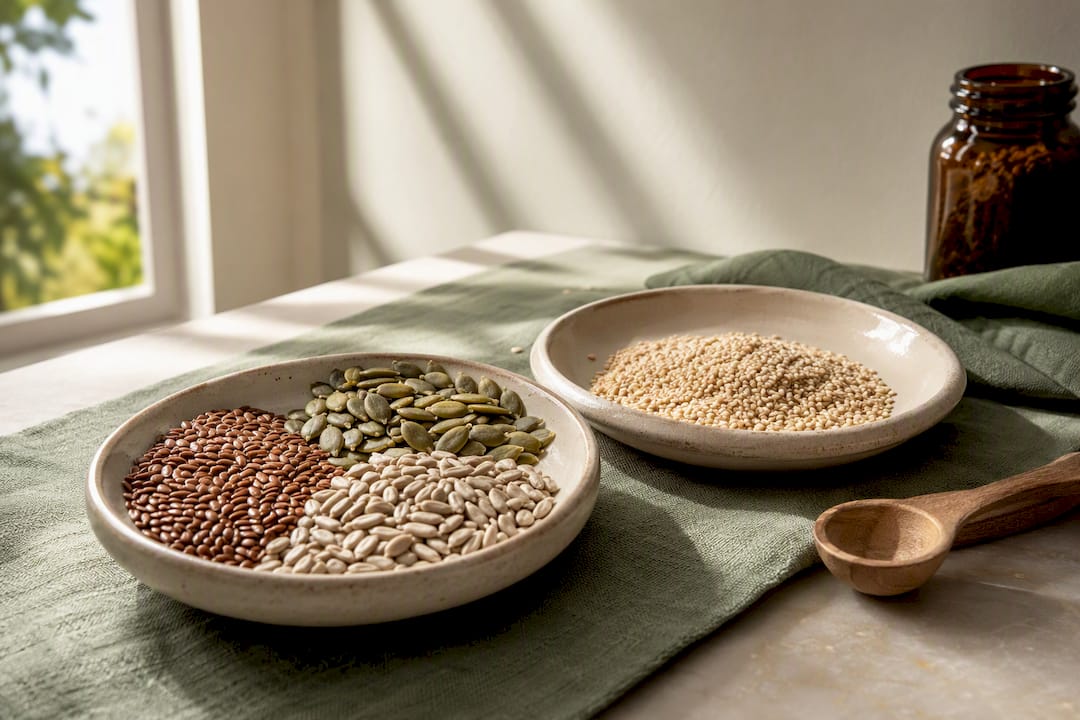
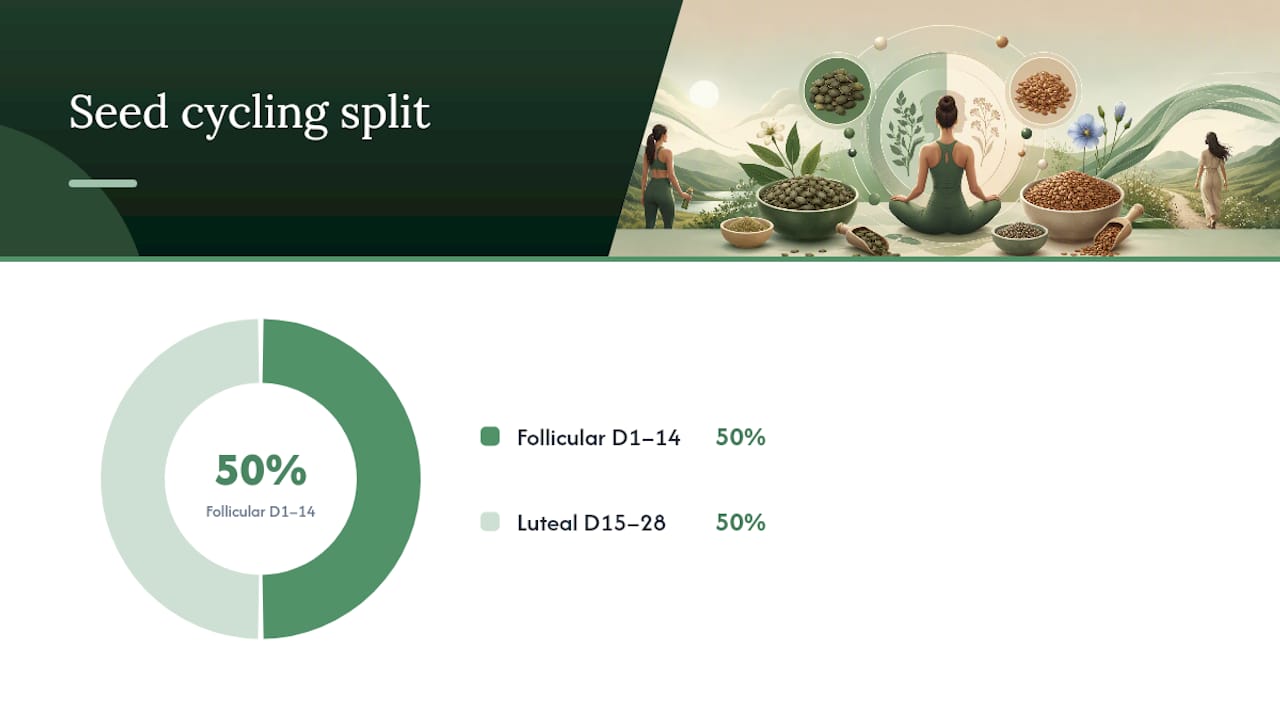
Seed cycling follows your cycle’s two main phases. During the follicular phase (roughly days 1 through 14, counting from the first day of your period), you eat ground flaxseed and pumpkin seeds. Once you shift into the luteal phase (day 15 through the start of your next period), you switch to ground sunflower and sesame seeds. Most guides recommend about one tablespoon of each seed per day, split however works for your meals.
Each seed earns its spot for a specific nutritional reason:
- Flaxseed: rich in lignans and omega-3 fatty acids, both tied to estrogen metabolism.
- Pumpkin seeds: deliver zinc and magnesium, minerals involved in progesterone production.
- Sunflower seeds: provide vitamin E and selenium, which support the luteal phase and thyroid function.
- Sesame seeds: contain lignans and calcium, echoing flax’s phytoestrogen content during the second half of the cycle.
The logic behind pairing flax and pumpkin with rising estrogen, then sesame and sunflower with the progesterone-dominant phase, comes from proposed lignan mechanisms rather than direct trials on the full protocol. Plant lignans convert into compounds that weakly bind estrogen receptors, which is plausible biology. Whether that weak effect actually shifts your cycle is a separate question, and one the research hasn’t settled yet.
How do you actually do seed cycling?
Starting is simpler than most guides make it sound. Here’s a basic 28-day framework to work from:
- Mark day one. The first day of full menstrual flow is day one of your cycle.
- Days 1 through 14: grind one tablespoon each of flaxseed and pumpkin seeds daily, stirred into breakfast or a smoothie.
- Ovulation (roughly midcycle): no change needed, just continue the follicular seeds through day 14.
- Days 15 through 28 (or until your next period starts): switch to one tablespoon each of ground sunflower and sesame seeds.
- Repeat each cycle, adjusting the switch date if your cycle runs longer or shorter than 28 days.
Grinding matters more than most people realize. Whole seeds often pass through digestion largely intact, so their lignans and minerals never get absorbed. A cheap coffee grinder or small food processor works fine. Sprinkle the ground seeds into oatmeal, yogurt, smoothies, or salads. If a full tablespoon of each seed causes bloating right away, start with half and build up over a week or two.
Pro Tip: Grind only a few days’ worth of seeds at a time. Ground flax and sunflower seeds oxidize fast once their oil is exposed to air, which degrades the omega-3 content you’re trying to get in the first place.
What does the science actually say about seed cycling?
Here’s the honest picture: solid evidence for the full seed cycling protocol, timed rotation and all, doesn’t exist. What exists is a patchwork of smaller, more limited sources.
A PMC case report documented a woman with polycystic ovary syndrome who used a flax, pumpkin, sunflower, and sesame rotation alongside a fertility intervention and saw a positive outcome. That’s compelling as a story, but a single case report can’t tell you whether the seeds caused the result or simply coincided with other treatment changes. Separately, some flaxseed-specific research has shown modest improvements in cycle regularity or PCOS markers in small trials, but those studies test flaxseed alone, not the cycling schedule.
The mechanism proponents point to is real biology: lignans from flax and sesame do convert to compounds that interact weakly with estrogen receptors. Zinc and vitamin E genuinely support reproductive tissue function. The leap that hasn’t been proven is that eating these nutrients on a strict two-week rotation produces a different hormonal outcome than eating them consistently every day.
The limitations worth sitting with:
- Most supporting studies involve a few dozen participants at most.
- Trial durations run a few months, not the years needed to confirm lasting hormonal change.
- Diet and lifestyle changes often happen alongside seed cycling, muddying which factor produced any improvement.
Healthline’s review of the evidence reaches a similar conclusion: the underlying nutrients have some research support, but the timing protocol itself remains unproven. That’s a meaningfully different claim than “seed cycling doesn’t work,” and it’s the distinction most articles on this topic skip.
What benefits can you realistically expect?
Where seed cycling delivers is nutrition, plain and simple. You’re adding fiber, omega-3 fatty acids, zinc, vitamin E, selenium, and lignans to your daily intake, and these nutrients support general reproductive and metabolic health regardless of when in your cycle you eat them.
Some people report real improvements once they start:
- Less bloating, often from added fiber slowing digestion and stabilizing blood sugar.
- Slightly milder PMS symptoms, which may track with more consistent micronutrient intake.
- Small shifts in cycle regularity over a few months, though this varies widely by individual.
Practitioners who work with patients on this often frame it less as a hormonal fix and more as a structured habit that improves overall diet consistency. Following a repeatable schedule tends to reduce decision fatigue around meals, which alone can improve how balanced your diet looks over a month. That’s a legitimate benefit. It’s just a behavioral one, not proof the seeds are resetting your hormones on cue.
What are the risks and how do you store seeds properly?
Seeds are food, not medicine, but a few practical issues trip people up.
- Digestive upset: jumping straight to two tablespoons of ground seeds daily can cause gas and bloating from the sudden fiber load. Start with half a tablespoon of each seed and increase gradually.
- Allergies: sesame is a recognized major allergen; treat any new seed introduction cautiously if you have a history of food allergies.
- Medication interactions: flaxseed’s omega-3 content and fiber can interact with blood thinners and may affect absorption of other medications. Talk to your doctor if you’re on anticoagulants or hormone-sensitive treatments.
- Oxidation: ground seeds lose freshness fast once their oils are exposed to air, which reduces their nutrient value over time.
Pro Tip: Store ground seeds in small, opaque, airtight containers in the fridge or freezer, not in a bowl on the counter. Grinding a fresh batch every three to four days keeps the omega-3s from breaking down before you eat them.
Does seed cycling work with irregular cycles or PCOS?
A 28-day calendar assumes a textbook cycle, which plenty of women don’t have. If your cycle is irregular, anchor the switch to actual bleeding instead of a fixed date: start flax and pumpkin the day your period begins, and switch to sesame and sunflower roughly two weeks later, adjusting as your body signals ovulation.
For very unpredictable cycles or amenorrhea, some practitioners suggest using the lunar cycle as a structuring tool, switching seeds around the new and full moon. This isn’t backed by evidence. It’s simply a consistent 14 and 14 day split when your body isn’t giving you a clear signal to follow.
If you have PCOS or you’re in perimenopause, seed cycling can sit alongside medical care as nutritional support. It shouldn’t replace evaluation for the underlying condition.
When should you see a doctor, and how do you know if it’s helping?
See a clinician if you’re skipping periods for months, dealing with unusually heavy or painful cycles, struggling with infertility, or noticing new, severe symptoms. Seed cycling is not a substitute for that evaluation.
To judge whether it’s helping you personally, track a few basics across two or three cycles: cycle length, flow intensity, PMS severity, mood swings, and any ovulation signs like cervical mucus changes. One cycle of data is noise. A pattern across several months is signal.
What we tell clients about seed cycling
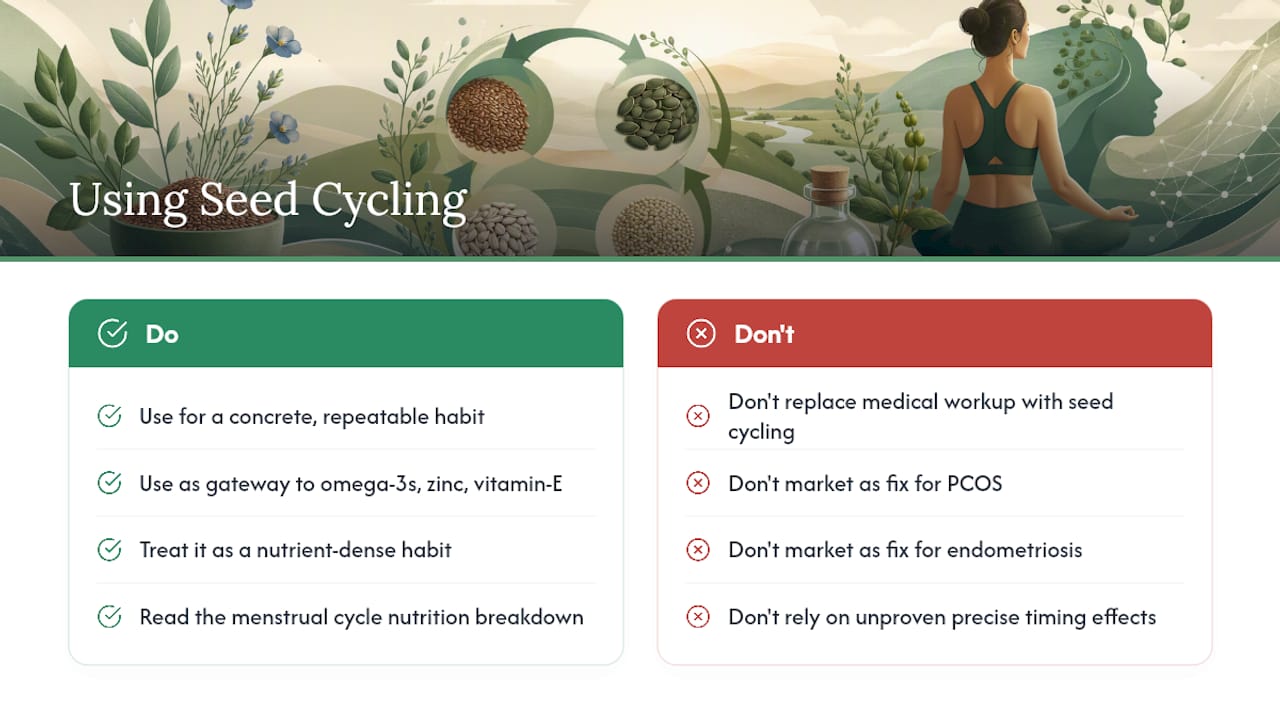
Seed cycling earns its popularity honestly: it gives people a concrete, repeatable habit instead of vague advice to “eat better for your hormones.” That structure is the real value, more than any precise timing effect the lignans might produce. What frustrates me is how often it gets marketed as a fix for diagnosed conditions like PCOS or endometriosis, when the honest read of the evidence is that it’s a nutrient-dense habit with a plausible but unproven mechanism.
Use it as a gateway to consistent intake of omega-3s, zinc, and vitamin E, supported by hormone precursor foods for anti-aging, not as a replacement for a workup when your cycle is genuinely off. The menstrual cycle nutrition breakdown covers how food choices map to each phase in more depth if you want to build on this.
— Brittany
Where Nourished fits if you want this built into your meals
Grinding seeds and remembering which phase you’re in is manageable for a week. Keeping it up for months, alongside everything else on your plate, is where most people quietly drop the habit. Nourished builds seed cycling and phase-specific nutrition directly into personalized meal plans, so the flax-and-pumpkin or sesame-and-sunflower swap happens automatically based on where you are in your cycle, not on your memory.
You get meal plans generated around your actual cycle data, recipes that already incorporate the right seeds for the phase you’re in, and no calorie counting to layer on top. Nourished’s free period and cycle tracker is a good starting point if you just want to log symptoms while you experiment with seed cycling on your own. If you’re ready for a plan that does the phase matching for you, see how Nourished works and get a personalized meal plan generated in minutes.
Sources
- Seed cycling for hormonal balance: What the research says — Medical News Today
- What Is Seed Cycling? Effects on Hormones and Menopause — Healthline
- Seed Cycling and Hormonal Balance: A Case Study of Successful Fertility Intervention in Polycystic Ovarian Syndrome — PMC
- Lignans — Linus Pauling Institute, Oregon State University