Strength Training in Perimenopause: A Practical Muscle Plan
Nourished · August 17, 2026
Strength Training in Perimenopause: A Practical Muscle Plan
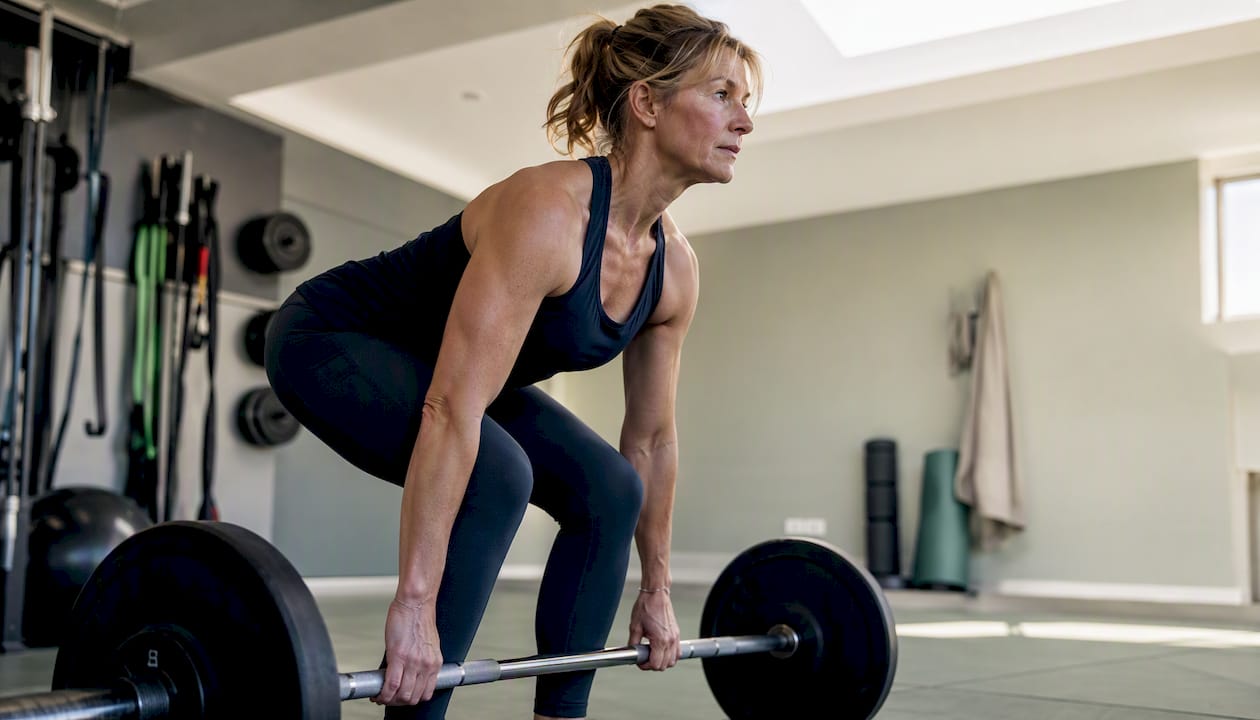
If you’re in perimenopause and wondering whether to keep chasing cardio or pick up a barbell, the science has an answer: lift weights. Structured resistance training two to four times a week, with progressive overload, is the most effective single strategy for preserving muscle and protecting bone during this transition. The Stanford Lifestyle Medicine program recommends lifting near failure in the 4 to 6 rep range for 3 to 5 sets to build real strength, not just tone. The caveat: progress gradually, especially if you’re new to lifting or have joint issues, and get medical clearance if you have osteoporosis, a recent fracture, or uncontrolled cardiac risk.
Here’s what to do this week:
- Pick a starting weight or resistance band where the last 2 reps of a set feel genuinely hard, not easy.
- Schedule two to four 45 minute sessions on your calendar like you would a work meeting.
- Aim for roughly 25 to 30 grams of protein per meal to support the muscles you’re about to build.
Key Takeaways
Structured resistance training two to four times weekly, with progressive overload and adequate protein, is the most effective way to preserve muscle and protect bone during perimenopause.
| Point | Details |
|---|---|
| Train with purpose | Aim for 2–4 sessions weekly, prioritizing compound lifts like squats and deadlifts before accessory work. |
| Use progressive overload | Add small amounts of weight or reps every 1–2 weeks once sets feel manageable at the top of your range. |
| Hit protein targets | Eat 25–35 grams of protein per meal across 3–4 meals to support the muscle you’re building. |
| Protect your bones | Combine resistance training with calcium, vitamin D, and gradual (not rapid) weight loss. |
| Get support if needed | Seek medical clearance for osteoporosis, recent fractures, or cardiac risk before starting a loaded program. |
| Simplify nutrition planning | Nourished offers hormone-phase meal plans and AI workout templates to pair with your strength training routine. |
Table of Contents
- Why Strength Training Perimenopause Programs Actually Work
- How Should You Structure a Perimenopause Strength Routine?
- What Does a Sample Perimenopause Workout Plan Look Like?
- Which Exercises Should You Prioritize?
- Does Strength Training Really Protect Your Bones?
- What Should You Eat to Support Strength Training?
- How Do Sleep and Stress Affect Your Training Results?
- How Long Until You See Results From Strength Training?
- Consistency Beats Intensity Every Time
- How Nourished Supports Your Strength Training Goals
- Frequently Asked Questions
- Sources
Why Strength Training Perimenopause Programs Actually Work
Estrogen decline during perimenopause accelerates muscle loss and bone turnover, but resistance training pushes back against both. A University of Exeter trial found that a 12-week supervised resistance program produced measurable strength and functional gains in women in their late 40s and 50s, with peri- and postmenopausal participants improving at comparable rates. Estrogen decline doesn’t blunt your ability to adapt.
Muscle isn’t the only tissue paying attention. Mechanical loading, the actual force your bones absorb when you squat or deadlift, signals your skeleton to maintain or build density. That’s a meaningfully different pathway than what walking or cycling provides, which is why lifting earns a specific place in a perimenopause fitness plan rather than just supplementing your cardio.
A 2025 evidence synthesis reinforces the numbers: moderate to high intensity resistance training performed multiple times weekly improves muscle mass, strength, and bone mineral density in midlife women. Higher training volumes tend to produce larger hypertrophy gains, which matters if your goal includes visible body composition change, not just strength on paper.
The benefits extend past muscle and bone:
- Better insulin sensitivity and metabolic flexibility, which can offset the fat redistribution many women notice in perimenopause.
- Improved mood and sleep quality, tied to the same neuromuscular and hormonal systems affected by training.
- Reduced joint pain and improved balance, both of which lower fall and injury risk as you age.
Resistance training also functions as one of the strongest non-pharmacological tools available during the menopause transition, working alongside hormone therapy rather than competing with it, according to a recent commentary on training as a midlife strategy.
How Should You Structure a Perimenopause Strength Routine?
Numbers matter more than motivation here. A vague “lift some weights” plan rarely produces results; a structured one does.
RPE stands for “rate of perceived exertion,” a 1 to 10 scale where 10 means you couldn’t do another rep. It’s a more useful gauge than a fixed percentage of your max, since your capacity shifts week to week with sleep and hormones. Progression should follow simple rules: add a small amount of weight when you hit the top of your rep range with room to spare, or add a rep before you add load.
A typical session runs 40 to 60 minutes: 5 to 10 minutes warming up, compound lifts first while you’re fresh, accessory or isolation work after, then a short cool-down. Compound movements like squats and deadlifts recruit far more muscle mass than isolation exercises, so they belong at the front of your workout, not the end.
Periodizing around your cycle and symptoms matters too. The UHealth Collective’s exercise guidance recommends 2 to 4 strength sessions weekly alongside brisk walking or intervals for added metabolic benefit.
What Does a Sample Perimenopause Workout Plan Look Like?
You don’t need a complicated split to get strong; check this basic strength training step by step guide for foundational coaching tips. Two templates cover most situations, whether you’re brand new to lifting or already comfortable in the weight room.
3-day beginner template
Day 1, full body: Goblet squat 3x8, dumbbell row 3x10, chest press 3x10, glute bridge 3x12, plank 3x30 seconds.
Day 2, full body: Romanian deadlift 3x8, seated shoulder press 3x10, lat pulldown 3x10, walking lunge 3x10 per leg, dead bug 3x10 per side.
Day 3, full body: Leg press or split squat 3x10, cable row 3x10, incline push-up or bench press 3x10, farmer’s carry 3x30 seconds, side plank 3x20 seconds per side.
Progress by adding weight every 1 to 2 weeks once you can complete all sets at the top of the rep range with good form.
4-day intermediate template
Day 1, lower body strength: Back squat 4x5, Romanian deadlift 3x8, walking lunge 3x10.
Day 2, upper body push/pull: Bench press 4x6, bent-over row 4x6, overhead press 3x8, lat pulldown 3x10.
Day 3, lower body hypertrophy: Bulgarian split squat 3x10, hip thrust 3x12, leg curl 3x12.
Day 4, upper body accessory: Incline dumbbell press 3x10, cable row 3x12, lateral raise 3x15, biceps and triceps superset 3x12.
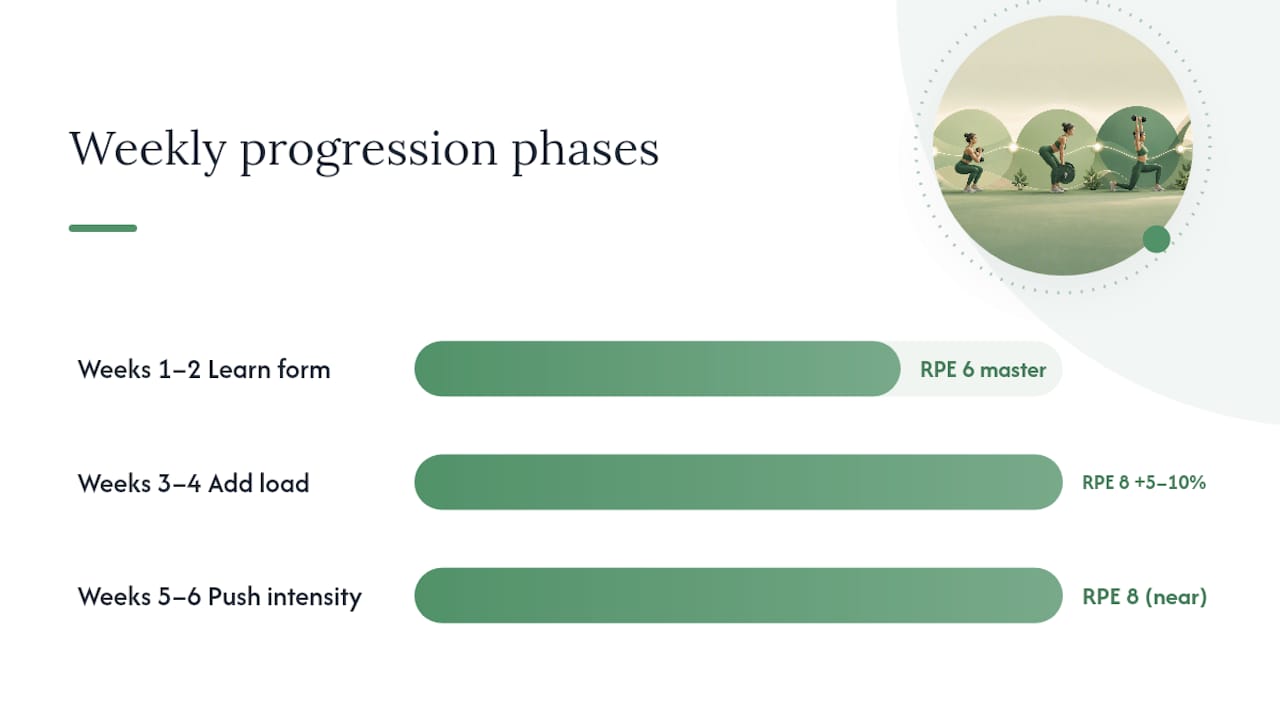
| Week | Focus | Progression Cue |
|---|---|---|
| 1–2 | Learn form, moderate load | RPE 6, master technique before adding weight |
| 3–4 | Add load or reps | RPE 8, increase weight 5–10% or add 1–2 reps |
| 5–6 | Push intensity | RPE 8, approach near-failure on main lifts |
| 8 | Deload or test | Drop volume 30–40%, then retest a lift or rep max |
If your knees or shoulders complain, swap back squats for box squats or leg presses, and trade barbell overhead presses for landmine presses, which put less strain on the shoulder joint. Limited equipment isn’t a dealbreaker: resistance bands and bodyweight movements like split squats and push-ups can replicate most of this volume. On weeks when hot flashes or poor sleep tank your energy, cut your planned sets by a third rather than skipping the session entirely. Showing up at 70% beats not showing up at all.
Which Exercises Should You Prioritize?
Not every exercise earns equal space in your program. Five movement patterns cover almost everything your body needs during perimenopause:
- Squat pattern (goblet squat, back squat, leg press): builds quad and glute strength, the muscles most responsible for functional independence as you age.
- Hinge pattern (deadlift, Romanian deadlift, hip thrust): strengthens the posterior chain and directly loads the hip and spine, key sites for bone density loss.
- Horizontal push and pull (bench press, push-up, dumbbell row): maintains upper-body strength for everyday tasks like carrying groceries or moving furniture.
- Vertical push and pull (overhead press, lat pulldown): protects shoulder mobility and counters the forward-hunched posture common with desk work.
- Loaded carries (farmer’s carry, suitcase carry): build grip strength and core stability, both strong predictors of functional longevity.
If a joint is irritated, don’t stop training that pattern entirely, regress it. Swap a barbell back squat for a box squat or split-stance squat, which reduces range of motion and joint stress while still loading the muscle. Bands and machines offer more joint stability than free weights, making them useful when you’re managing tendon irritation or working around a flare-up.
When recovery is limited, three tools let you keep training without overloading a cranky joint: slow the tempo down (a 3 second lowering phase builds strength with less weight), reduce range of motion temporarily, or substitute an isometric hold, like a wall sit instead of a squat, to maintain strength with zero impact.
Pro Tip: After a flare-up or a break from training, don’t jump back to your previous top weight. Rushing this step is the most common way midlife lifters reinjure themselves.
Does Strength Training Really Protect Your Bones?
Yes, and the mechanism is straightforward: bone responds to mechanical stress the same way muscle does. When you load a bone through resistance training, especially impact-based movements like squats, deadlifts, and jumping variations, it triggers a remodeling response that helps maintain density. According to Mayo Clinic’s guidance on weightlifting and bone health, combining resistance training with adequate calcium, vitamin D, and gradual progression gives you the best defense against the bone density loss that accelerates in perimenopause.
Before you load up a barbell, run through this quick safety checklist:
- Have you had a fracture in the past two years, or a diagnosis of osteoporosis? Get clearance from your doctor before starting a loaded program.
- Do you have uncontrolled high blood pressure or a known cardiac condition? Ask about safe intensity ranges first.
- Do you experience dizziness or lightheadedness with exertion? This needs evaluation before you add resistance work.
Certain symptoms during a workout are not something to push through. Sudden joint collapse, chest pain, or pain that persists and worsens after a session are signs to stop immediately and seek medical evaluation. These aren’t “walk it off” situations.
One more caution: avoid rapid weight loss while building a strength habit. Mayo Clinic notes that bones respond poorly to fast, aggressive calorie deficits, since your body pulls resources from bone and muscle when energy intake drops too sharply. Slow and steady protects the very tissue you’re trying to strengthen.
What Should You Eat to Support Strength Training?
Training stimulates muscle growth, but nutrition is what actually builds it. Aim for roughly 25 to 35 grams of protein per meal, spread across three to four meals daily, rather than loading it all into dinner. This steady distribution keeps muscle protein synthesis active throughout the day instead of spiking once. Nourished’s guide on why protein matters in perimenopause breaks down practical ways to hit these targets without obsessive tracking.
Calcium and vitamin D deserve equal attention alongside protein. Dairy, fortified plant milks, leafy greens, and canned fish with bones (like sardines) are practical calcium sources; vitamin D comes primarily from sunlight exposure and fortified foods, though many women in perimenopause find their levels run low and benefit from a supplement after checking blood levels with a clinician.
Rapid deficits sabotage both. If you’re tracking intake or navigating a plateau, resources like Nourished’s explainer on weight-loss plateaus walk through why slower, steadier changes tend to stick.
- Protein: 25 to 35 grams per meal, 3 to 4 meals per day.
- Calcium: dairy, fortified alternatives, leafy greens, canned fish with bones.
- Vitamin D: sunlight, fortified foods, or a supplement if bloodwork shows a deficiency.
- Weight loss pace: no faster than 1% of body weight weekly if you’re in a deficit.
Personalized meal plans that adapt to your hormonal phase, rather than a generic macro target, make it easier to hit these numbers consistently without counting every gram yourself.
How Do Sleep and Stress Affect Your Training Results?
Recovery is where the actual adaptation happens, not the workout itself. Poor sleep and elevated stress both raise cortisol and blunt the muscle-building response to your training sessions, which means the same workout can produce very different results depending on how rested you are going in.
On low-energy days, don’t force the plan. This single adjustment prevents the two-steps-forward-one-step-back cycle that derails a lot of women’s consistency.
A few habits make recovery work in your favor:
- Space your hardest sessions at least 48 hours apart to let muscle tissue repair.
- Add 10 to 15 minutes of mobility work or a walk on rest days to promote blood flow without adding fatigue.
- Eat a protein-containing snack or meal within an hour or two of finishing a session.
Sleep quality directly affects muscle recovery, and consistency beats intensity over the long run. A simple weekly schedule, the same two or four days blocked off regardless of what else is happening, does more for results than an aggressive plan you abandon after three weeks. Training with a friend or joining a small group class also makes it far easier to stick with a routine when motivation dips, which it will.
How Long Until You See Results From Strength Training?
Patience pays here, and knowing the timeline keeps you from quitting right before things click. Early neuromuscular improvements, meaning your nervous system gets better at recruiting muscle fibers, show up in 2 to 6 weeks. That’s why you often feel stronger on a lift before you look any different.
Visible strength gains and early muscle growth typically appear between 8 and 12 weeks of consistent training. Bone density changes move far slower, often taking many months to a couple of years to register on a scan, so don’t expect a bone density test to reflect two months of lifting.
Track three categories to see real progress:
- Strength: the weight or reps you can complete on a key lift, like your squat or deadlift, checked every 2 to 4 weeks.
- Function: a simple test like how many times you can sit and stand from a chair in 30 seconds, or how far you can carry a moderately heavy load.
- Wellbeing: sleep quality and hot flash frequency, both of which often improve alongside consistent training.
Retest every 2 to 4 weeks rather than every session. Day-to-day fluctuation from hormones and sleep will otherwise make you think you’re not progressing when you actually are.
Consistency Beats Intensity Every Time
The biggest misconception I see about strength training in perimenopause is that it needs to be extreme to work. It doesn’t. What moves the needle is showing up twice a week for months, not crushing yourself once and needing five days to recover. Women who treat this as a slow rebuild, not a sprint, are the ones still lifting a year later with real strength and bone density to show for it.
Give your body room to adapt. Some weeks you’ll hit every planned set; other weeks, sleep or symptoms will mean scaling back, and that’s not failure, that’s the plan working as intended. If you want the nutrition side handled for you so you’re not guessing at protein targets on top of everything else, Nourished’s personalized plans exist for exactly that.
How Nourished Supports Your Strength Training Goals
Nourished takes the guesswork out of eating for muscle and bone by building meal plans around your actual hormonal phase, not a generic calorie target. Instead of manually calculating protein grams every day, you get automated meal templates that hit your targets, paired with AI-generated workout structures that adapt to your energy and recovery needs week to week.
Say you’re following the 4-day intermediate template above: Nourished’s system can generate meals timed around your training days, front-loading protein on lifting days and adjusting portions on rest days, without you tracking a single macro by hand. For readers managing perimenopause symptoms on top of a training schedule, that kind of automatic adjustment saves real mental energy. If you want to see how the plans work before committing, try Nourished’s tutorial walkthrough or head to Nourished’s homepage to start building a plan around your own hormonal profile.
Frequently Asked Questions
How many days a week should I strength train during perimenopause? Two to four sessions weekly is the range most clinical guidance supports, with two as a practical minimum for maintaining strength and bone benefits.
Can strength training help with hot flashes and mood swings? Training won’t eliminate hot flashes, but consistent resistance work is linked to improved sleep and mood regulation, which can make symptom days more manageable.
Is it safe to start lifting heavy weights if I’ve never trained before? Yes, with a gradual start. Begin with lighter loads focused on form, then increase weight over several weeks as your technique and confidence improve.
Do I need to avoid cardio and only do strength training in perimenopause? No. Pairing 2 to 4 strength sessions with walking or interval training weekly supports both metabolic and cardiovascular health alongside muscle and bone goals.
How much protein do I actually need during perimenopause? Most guidance points to roughly 25 to 35 grams per meal across three to four meals daily, adjusted for body size and activity level.
This article is general information, not a substitute for advice from a qualified doctor. Consult a qualified healthcare professional about your own circumstances before acting on anything here.
Sources
- Strength Training During Perimenopause – Lifestyle Medicine
- First-of-its-kind study shows resistance training can improve physical function during menopause — University of Exeter
- Perimenopause, menopause and … weightlifting? Expert explains value for bone health — Mayo Clinic News Network
- How to Exercise Effectively in Perimenopause and Menopause | UHealth Collective
- Resistance training review (2025) — DOI 10.12775/qs.2025.47.66781