
Top Nutrition Trackers for Muscle Preservation in Women
Nourished · August 3, 2026
Top Nutrition Trackers for Muscle Preservation in Women
For women who want to hold onto lean mass through weight change, hormonal shifts, or life-stage transitions, the best tracker approach combines a single daily protein target, strength-session habit support, cycle-phase signals, and body-composition monitoring. Generic calorie counters miss the point entirely.
What the right tracker must log:
- Daily protein grams and per-meal distribution (not just total calories)
- Resistance-training sessions, at least 2–3 times per week, with simple performance notes
- Cycle phase and symptoms, so harder sessions fall on stronger days
- Hydration, iron, vitamin D, and omega-3 intake
- Body-composition trend, not just scale weight
Nourished is the recommended option for women who want all of that in one place, with AI-driven hormone-adaptive plans and data you can share with a clinician.
Table of Contents
- Why muscle preservation looks different for women
- What metrics actually predict muscle-preservation success
- What features should you look for in a tracker?
- Sample daily targets and a simple training template by life stage
- How to implement a tracker and see real results
- Key Takeaways
- What most women get wrong about muscle-preservation tracking
- Nourished brings hormone-adaptive tracking together in one place
- Useful sources and further reading
Why muscle preservation looks different for women
Hormones change everything about how your body holds muscle. Estrogen supports muscle protein synthesis, so when levels drop during perimenopause or menopause, the window for muscle loss widens fast. Appetite shifts, recovery slows, and the protein amount that worked at 35 may no longer be enough at 48.
Resistance training 2–3 times per week is the most evidence-backed countermeasure across all life stages. Even one set of moderate repetitions per major muscle group, twice a week, builds and maintains strength without requiring hours in a gym. The training frequency matters; the volume does not need to be extreme.
Nutrition beyond protein matters just as much. Six additional nutrients — carbohydrates for glycogen, magnesium, iron, omega-3s, vitamin D, and water — each play a direct role in muscle repair, inflammation control, and preservation. An anti-inflammatory eating pattern treats food as a hormone signal, not just a calorie source. That framing changes what you log and why.

Women on GLP-1 medications face a specific risk: rapid weight loss from appetite suppression can include a meaningful share of lean mass, with trial data showing lean-mass loss can account for up to roughly a quarter of total weight lost. Resistance training and adequate protein are the primary countermeasures. A tracker that doesn’t account for this leaves a real gap.

Pro Tip: Log cycle phase alongside your nutrition and training data for at least four weeks. You’ll start to see which days your strength sessions feel harder and which feel easier. Scheduling heavier lifts in your follicular phase (days 1–14) and lighter recovery work in the luteal phase is one of the most underused muscle-preservation strategies.
What metrics actually predict muscle-preservation success
The six metrics that matter most, in order of predictive value:
- Daily protein grams and timing: total intake and how it’s distributed across meals (aim for roughly equal portions rather than one large hit)
- Resistance-training frequency and performance: sessions per week plus a simple weekly strength check (load, reps, or a standard movement)
- Body-composition trend: lean mass percentage over time, not just weight
- Cycle phase and symptoms: to contextualize energy, appetite, and recovery data
- Sleep and energy levels: both affect muscle-protein synthesis and training quality
- Hydration and key micronutrients: dehydration is linked to greater muscle protein breakdown, and iron or vitamin D deficiency compounds fatigue
Capturing these doesn’t require a complex setup. Quick protein logging at each meal, a one-line strength note after each session, and a weekly body-composition entry (smart scale or manual circumference) cover the core. For women on weight-loss medication, apps that offer medication-aware features and nutrient breakdowns add another layer of usefulness.
Lab and supplement logging can be valuable, but it should be optional and stored securely. Health data at this level is sensitive.
Pro Tip: Track one standard movement weekly — say, how many bodyweight squats you can do with good form, or the load on a goblet squat. If that number holds or climbs over 8–12 weeks, your muscle-preservation plan is working, even if the scale hasn’t moved.
What features should you look for in a tracker?
The features that actually move the needle connect nutrition to strength habits and hormonal context. Here’s what to prioritize:
- Automated protein target: a single daily number, not a macro percentage you have to calculate yourself
- Strength-session habit support: reminders, 2–3x/week scheduling templates, and a simple way to log performance
- Cycle-phase-aware meal plans: targets that shift with your hormonal phase, not a static daily goal
- Hydration and micronutrient tracking: iron, vitamin D, and omega-3s at minimum
- Body-composition trend visualization: lean mass over time, not just weight
- Clinician data export: so you can share progress with a dietitian, trainer, or physician
- Privacy controls: granular settings for who sees your health and cycle data
On cost: most trackers offer a free tier covering basic food logging, but AI personalization, phase-adaptive meal plans, lab tracking, and coach support typically sit behind a paid subscription. Premium tiers for nutrition apps generally cost a moderate monthly fee, with annual plans offering savings. The question isn’t whether premium features are worth paying for in general; it’s whether the specific features you need (AI phase-adaptive plans, clinician export) are available at the tier you’re considering.
Cross-platform availability matters too. iOS, Android, and web access means you’re not locked to one device. Low-friction logging on low-appetite days — a real issue for women on GLP-1s or in perimenopause — is a practical usability requirement, not a nice extra.
Sample daily targets and a simple training template by life stage
The right targets shift with your life stage. Here’s a practical starting point:
| Life Stage | Protein/Day | Protein Per Meal | Resistance Sessions/Week | Hydration Cue |
|---|---|---|---|---|
| Regular cycling years | — | — | 2–3x | — |
| Perimenopause | — | 35 g | 2–3x | — |
| Menopause/post-menopause | — | — | 3x, include bone-loading | — |
A simple one-week training template for any life stage: two full-body resistance sessions (Monday and Thursday work well), one lighter mobility or walking session mid-week, and rest or gentle movement on remaining days. Progress by adding one rep or a small amount of load every two weeks, not every session. For women in the luteal phase or early perimenopause, swapping one strength session for a lower-intensity circuit on high-fatigue days protects adherence without sacrificing the weekly habit.
For low-appetite days, high-protein, low-volume options — Greek yogurt, cottage cheese, eggs, protein shakes — should be saved as “staples” in your tracker. The goal on those days is hitting protein, not hitting calories. Understanding why protein matters in perimenopause specifically can help you set realistic targets for that transition.
The role of protein in muscle building goes beyond total grams — timing and distribution across meals affects how well your body actually uses it.
How to implement a tracker and see real results
Expect measurable strength improvements in 8–12 weeks with consistent 2–3x/week resistance work and protein targets met. Body-composition shifts typically follow after 8–16 weeks and should be read alongside strength and symptom data, not against the scale alone.
Setup checklist:
- Record a baseline: a simple strength test (reps at a standard movement) and a body-composition or circumference measurement
- Set your protein target using the life-stage table above
- Schedule 2–3 strength sessions per week directly in the app
- Sync any wearables or smart scale
- Turn on cycle and symptom logging from day one
What to expect at each checkpoint:
- Week 2: Logging habits are forming; protein targets may feel high — use staple meals
- Week 6: Strength metrics should show early improvement; energy and sleep data become meaningful
- Week 12: Measurable strength gains are the primary signal; lean mass trend should be visible if body-composition tracking is in place
Strength is the leading indicator. If your weekly performance metric is climbing, muscle preservation is working, even when the scale is flat or moving slowly. Body recomposition — losing fat while maintaining or gaining lean mass — often looks like no change on a scale for weeks, which is exactly why performance tracking matters.
On cost: if AI phase-adaptive plans and clinician export are features you’ll use, a premium subscription is worth evaluating. If you primarily need protein logging and strength reminders, a free or lower-cost tier may cover your needs.
Key Takeaways
Hormone-adaptive nutrition tracking paired with consistent resistance training is the most evidence-backed approach for women who want to preserve lean mass across any life stage.
| Point | Details |
|---|---|
| Protein targets by life stage | Aim for a protein intake that increases with life stage, distributed evenly across meals in moderate portions. |
| Resistance training frequency | Train multiple times per week; even one set of moderate repetitions per major muscle group twice weekly preserves strength. |
| Strength as the leading signal | Track weekly performance (load or reps) — strength gains in 8–12 weeks confirm muscle preservation before the scale changes. |
| Micronutrients and hydration | Log iron, vitamin D, omega-3s, and water daily; dehydration alone increases muscle protein breakdown. |
| Nourished for hormone-adaptive tracking | Nourished offers cycle-phase meal plans, a single protein target, strength-session habit support, and clinician data export in one platform. |
What most women get wrong about muscle-preservation tracking
Most women I work with start tracking calories and stop there. The scale becomes the only metric, and when it doesn’t move the way they expected, they assume the plan isn’t working. But strength gains in the first 8–12 weeks are the real signal — and they’re invisible on a scale.
The other gap I see constantly: treating protein as the whole story. Harvard Health’s guidance on six muscle-supporting nutrients is a useful corrective. Iron deficiency tanks energy and training quality. Vitamin D affects muscle function directly. Omega-3s reduce the inflammation that slows recovery. A tracker that only shows you protein and calories is leaving out half the picture.
The hormone-adaptive angle isn’t a wellness trend. It’s a practical response to the fact that estrogen, progesterone, and cortisol all affect muscle-protein synthesis, appetite, and recovery. Tracking cycle phase alongside nutrition and training data gives you context that makes the numbers meaningful. Without it, you’re interpreting data without the key variable.
For women navigating perimenopause or menopause, the stakes are higher because the window for muscle loss is wider. Consistent resistance training and targeted nutrition don’t just preserve lean mass — they protect bone density, reduce fatigue, and support long-term function in ways that no amount of cardio replicates.
Nourished brings hormone-adaptive tracking together in one place
Most nutrition apps track what you eat. Nourished tracks what your body needs — and adjusts for where you are in your cycle, your life stage, and your goals.
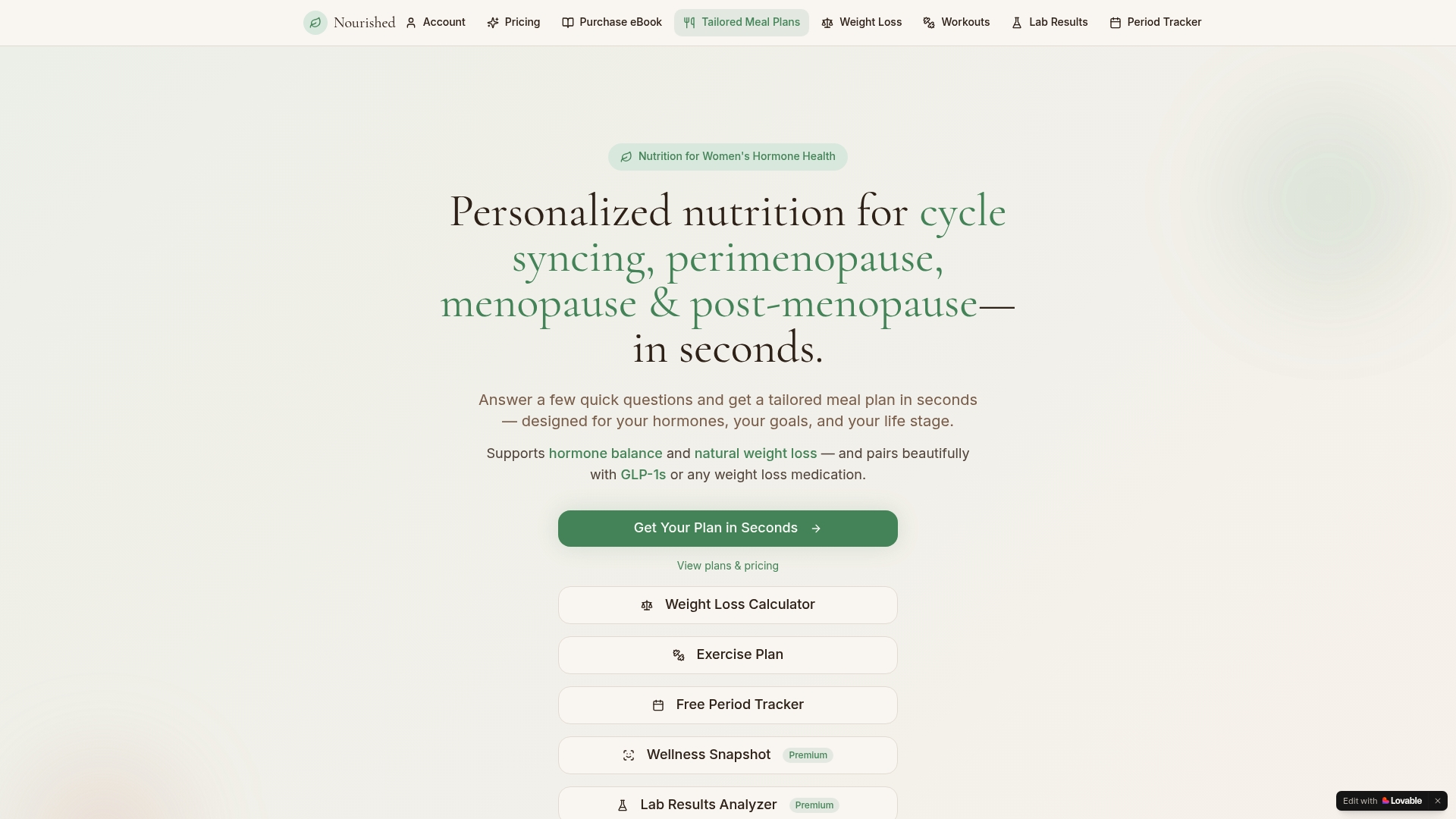
The platform delivers AI-personalized meal plans that shift with your hormonal phase, a single daily protein target with low-friction logging, cycle and symptom tracking, hormone-adaptive workout plans, and data you can share with a clinician. For women on GLP-1 medications or navigating perimenopause, the low-volume, high-protein meal suggestions on low-appetite days are a practical feature that generic trackers don’t offer.
Pricing is subscription-based with tiered monthly and yearly plans, plus one-time eBook options. The free period and cycle tracker is the lowest-friction way to start — try it, see how phase-aware tracking feels, and upgrade when you’re ready for AI meal and workout personalization. The full tutorial walks through setup in minutes. Every recommendation is backed by evidence you can review on Nourished’s research and references page.
Useful sources and further reading
- Harvard Health: Beyond Protein — 6 Other Nutrients That Help Prevent Muscle Loss — covers carbohydrates, magnesium, iron, omega-3s, vitamin D, and hydration for muscle preservation
- Mayo Clinic: Strength Training — Get Stronger, Leaner, Healthier — evidence-based guidance on resistance-training frequency and session design
- Academy of Nutrition and Dietetics (EatRight): Resistance Train to Prevent Muscle Loss — registered-dietitian perspective on moderate-intensity resistance training and nutrition
- Everyday Health: Best Food Tracking Apps for GLP-1 Users — practical overview of medication-aware tracker features
- Preserve GLP-1 Tracker — context on lean-mass loss during rapid weight change and habit-support features in trackers
- Nourished Research & References — curated evidence base supporting hormone-adaptive nutrition and cycle-tracking recommendations
This article is general information, not medical or dietary advice. Confirm targets and any medication-related decisions with a registered dietitian or your healthcare provider.