
Metabolic Adaptation Explained: What It Means for Weight Loss
Nourished · August 10, 2026
Metabolic Adaptation Explained: What It Means for Weight Loss
Metabolic adaptation is an energy-saving response that lowers how many calories your body burns beyond what weight loss alone would predict. Technically called adaptive thermogenesis, it’s the gap between the resting metabolic rate (RMR) you’d expect based on your new, smaller body and the RMR you actually measure. That gap is real, it’s well-documented, and it makes weight loss harder than the math suggests. The good news: for most people, it’s a temporary, regulated response, not permanent “metabolic damage.”
If you’re dieting and things have stalled, metabolic adaptation is worth understanding. Here’s what it typically means in practice:
- Slower weight loss than your calorie math predicts, even when you’re sticking to your plan
- Increased hunger driven by hormonal shifts (lower leptin, higher ghrelin) that make staying on track harder
- Less spontaneous movement (reduced non-exercise activity thermogenesis, or NEAT), often unconscious, that quietly erases hundreds of calories per day
- Fatigue and lower energy as your body downshifts its output to conserve fuel
A longitudinal study in premenopausal women found an average metabolic adaptation of about −46 kcal/day after weight loss, and larger adaptation predicted a longer time to reach weight loss goals, even after controlling for adherence. That’s a modest average, but the individual range is wide, which matters more than the mean.
Key Takeaways
Metabolic adaptation is a regulated, largely reversible response to calorie restriction, not permanent damage, and its magnitude depends heavily on when it’s measured and how aggressively you’ve been dieting.
| Point | Details |
|---|---|
| Adaptation is measurable but variable | Average RMR adaptation runs roughly −46 to −92 kcal/day in studies, but individual range spans approximately −700 to +750 kcal/day. |
| Timing changes the numbers significantly | Adaptation measured during active restriction is notably larger than after a period of weight stabilization, with the effect often substantially reduced or absent at long-term follow-up. |
| NEAT is the biggest behavioral lever | Spontaneous movement reductions of 200–400 kcal/day often exceed RMR changes; protecting daily activity is a primary countermeasure. |
| Diet breaks and resistance training work | Planned maintenance phases and lifting preserve lean mass, reduce the famine signal, and partially reverse adaptation between dieting phases. |
| Nourished aligns your plan with your hormones | Cycle-aware meal planning and phase-specific workout guidance help schedule diet breaks and protein targets around your hormonal biology. |
Table of Contents
- What metabolic adaptation actually means and what it is not
- How researchers measure metabolic adaptation so you can interpret study claims
- The biology: hormones, nervous system, and behavioral drivers behind the slowdown
- What the research shows: key trials and what each finding means for real people
- How to recognize whether you might be experiencing metabolic adaptation
- Evidence-based ways to minimize or reverse metabolic adaptation
- How long adaptation lasts and realistic recovery timelines
- Common myths and where scientists still disagree
- A concise action plan: what to do next and when to seek professional help
- How hormone-aware, personalized nutrition supports recovery from metabolic adaptation
- Why the “permanent damage” framing does real harm
- Personalized, hormone-aware plans that work with your metabolism
- Sources
What metabolic adaptation actually means and what it is not
The metabolic adaptation definition comes down to one distinction: the drop in energy expenditure that exceeds what you’d expect from losing fat and muscle mass. Lose 20 pounds and your body burns fewer calories partly because it’s smaller. That’s normal and predictable. Metabolic adaptation is the extra reduction on top of that.
A few terms worth knowing:
- Adaptive thermogenesis: The umbrella term for the coordinated downward adjustment in energy output during or after calorie restriction. It includes changes in RMR, the thermic effect of food, and NEAT.
- RMR vs. predicted RMR: Resting metabolic rate is the calories you burn at rest. Predicted RMR is what a validated equation (like the Mifflin-St Jeor formula) estimates based on your height, weight, age, and sex. Adaptation is the difference between the two, measured vs. predicted, after accounting for body composition.
- Total energy expenditure (TEE): All calories burned in a day, including RMR, activity, and digestion. Adaptation affects TEE through multiple channels simultaneously.
- NEAT: Non-exercise activity thermogenesis, the calories burned through fidgeting, walking, posture, and every movement that isn’t formal exercise. NEAT reductions of 200–400 kcal/day are a major component of the total adaptive response.
- “Set point” theory: A popular but imprecise concept suggesting the body defends a fixed weight. Adaptation is real, but “set point” overstates the rigidity of the system.
- “Metabolic damage”: A common phrase implying permanent, structural harm to metabolism. The evidence doesn’t support it. Adaptation is a regulated, signal-driven response, not tissue damage.
Studies report a wide range of individual adaptation values, from roughly −700 to +750 kcal/day, according to large-scale analyses. Population averages look modest; individual experiences can be dramatically different. That variability is exactly why a one-size-fits-all calorie target often fails.
How researchers measure metabolic adaptation so you can interpret study claims
Understanding how adaptation is measured helps you read study headlines without being misled.
Indirect calorimetry is the gold standard for measuring RMR in a clinical or research setting. You breathe into a mask or canopy for 20–30 minutes while at rest, and the device measures oxygen consumption and carbon dioxide production to calculate calorie burn. It’s accurate to within a few percent when done correctly, which is why it’s used in metabolic research.
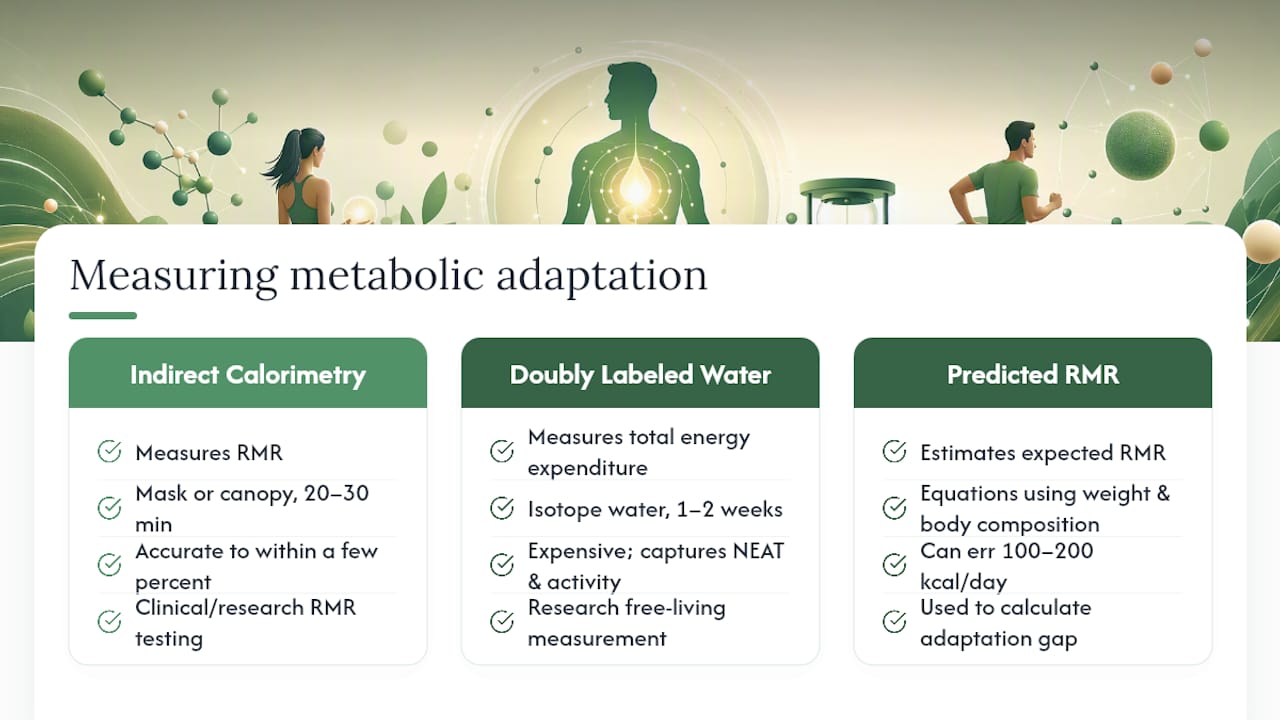
Doubly labeled water (DLW) measures total energy expenditure over 1–2 weeks in free-living conditions. Participants drink water with stable isotopes; the rate at which the isotopes disappear from urine reflects total calorie burn. It’s expensive and used mainly in research, but it captures NEAT and all other activity that indirect calorimetry misses.
Predicted-RMR models are equations that estimate what RMR should be given body weight, fat mass, and fat-free mass. Researchers subtract measured RMR from predicted RMR to calculate the adaptation gap. The problem: most standard equations were built on average populations and can be off by 100–200 kcal/day even without any adaptation, which is why body-composition-adjusted predictions matter.
Timing is the most underappreciated variable in this literature. Research shows that adaptation measured during active calorie restriction looks much larger than adaptation measured after a period of weight stabilization. One analysis found RMR adaptation of approximately 90–110 kcal/day during negative energy balance, which dropped to roughly half after about four weeks of weight stabilization and was often absent at one-year follow-up. When you see a headline claiming “metabolism drops by X calories,” check whether the measurement was taken mid-diet or after stabilization. The answer changes the interpretation entirely.
Pro Tip: If you’re considering a clinical RMR test, ask whether the facility uses indirect calorimetry (not a handheld device or bioelectrical impedance), whether you’ll fast for at least 4 hours beforehand, and whether the technician will compare your result to a body-composition-adjusted prediction rather than a generic height/weight formula. Those three details separate a useful measurement from a number that tells you very little.
The biology: hormones, nervous system, and behavioral drivers behind the slowdown
Metabolic adaptation isn’t one thing. It’s a coordinated set of signals that all push in the same direction, and they reinforce each other.
The core hormonal and physiological mechanisms:
- Leptin decline: Fat cells produce leptin in proportion to fat mass. As fat stores shrink, leptin drops sharply, signaling the hypothalamus to reduce energy output and increase appetite. Leptin is essentially the body’s fuel-gauge hormone.
- T3 reduction: The active thyroid hormone triiodothyronine (T3) tends to fall during calorie restriction, slowing cellular metabolism. This is one reason people feel cold and sluggish during prolonged dieting.
- Sympathetic nervous system downshift: The sympathetic nervous system normally drives calorie burn through heat production (thermogenesis) and organ activity. Calorie restriction dials this down, reducing baseline energy output.
- Increased muscle efficiency: After weight loss, muscles perform the same mechanical work using fewer calories. This sounds like an improvement, but it means your body gets more mileage per calorie, which works against a deficit.
Appetite hormones compound the problem. Ghrelin (the hunger hormone) rises after weight loss. Peptide YY (PYY) and GLP-1, which signal fullness, tend to fall. The net effect is that you feel hungrier and less satisfied at the same time, which is a difficult combination to sustain behaviorally.
Then there’s NEAT. This is where the numbers get striking. Reductions in spontaneous movement can account for 200–400 kcal/day of the total adaptive response. People fidget less, sit more, take fewer steps, and shift posture less often, usually without noticing. A precision nutrition review confirms that these hormonal and autonomic changes are coordinated and that individualized approaches can help manage the variability in how strongly any one person responds.

Picture a typical scenario: someone cuts calories by 500 per day, loses 15 pounds over three months, and then hits a wall. Their RMR has dropped somewhat from losing mass, but on top of that, leptin is lower, T3 has dipped, their muscles burn slightly less per rep, and they’re walking 1,500 fewer steps per day without realizing it. The deficit that worked in month one is now functionally much smaller.
What the research shows: key trials and what each finding means for real people
The foundational work comes from Rosenbaum and Leibel at Columbia, who showed in controlled studies that a 10% weight reduction produces a fall in total energy expenditure roughly 15% greater than predicted from body composition changes alone. That excess drop is the adaptation signal. Their work established that the body actively defends against weight loss through multiple simultaneous mechanisms.
The Biggest Loser follow-up study (Fothergill et al.) drew wide attention by showing that contestants who lost dramatic amounts of weight had persistently lower RMR six years later, even those who had regained weight. The study is real and the findings are sobering, but context matters: the participants underwent extreme, rapid weight loss under unusual conditions, and the study had a small sample. It doesn’t represent what happens with moderate, well-managed weight loss.
More recent and methodologically careful work tells a more nuanced story:
The LED trial found that for every 50 kcal/day increase in adaptation, participants lost approximately 0.5 kg less weight and fat mass, even after adjusting for adherence and physical activity. That’s a meaningful effect on outcomes, not just a statistical curiosity.
The premenopausal women study adds another layer: adaptation predicted how long it took to reach weight goals, not just whether weight was lost. Each 10 kcal/day of adaptation was associated with roughly one additional day to goal in model estimates, per the Wiley/Obesity analysis. Interindividual variation in that same dataset ranged from approximately −700 to +750 kcal/day, which means averages genuinely obscure what’s happening at the individual level.
How to recognize whether you might be experiencing metabolic adaptation
No one can self-diagnose metabolic adaptation with certainty, but certain patterns make it worth considering.
Practical signals that suggest adaptation may be a factor:
- A sustained plateau of three or more weeks despite a verified calorie deficit and consistent adherence
- Progress that’s slower than expected given your body composition changes (e.g., losing muscle but not fat, or losing less than the math predicts)
- Disproportionate hunger and fatigue that worsens over time rather than stabilizing
- Feeling cold more than usual, especially at rest, which can reflect reduced sympathetic tone and lower T3
- Noticeable drop in daily movement such as less desire to walk, take stairs, or engage in casual activity
The limits of self-assessment are real. The most common reasons for a plateau are not metabolic adaptation but rather calorie tracking errors, unlogged intake, or gradual reductions in activity. Studies consistently show that people underestimate food intake by a meaningful margin, sometimes substantially. Before concluding that your metabolism has slowed, it’s worth ruling out the simpler explanations.
Formal RMR testing via indirect calorimetry can confirm whether your measured metabolic rate is meaningfully below what your body composition predicts. It’s available at some university medical centers, metabolic clinics, and sports performance labs. It won’t tell you why adaptation occurred, but it tells you whether the gap is real and how large it is.
Pro Tip: Before booking an RMR test, spend two weeks using a food scale and a detailed tracking app to log every meal. Then compare your actual intake to your expected deficit. If the numbers don’t add up, tracking error is the more likely culprit. Formal testing makes the most sense when you’ve already ruled out adherence issues.
Evidence-based ways to minimize or reverse metabolic adaptation
The strategies that work are the ones that reduce the intensity of the “famine signal” your body is responding to.
Avoid extreme, prolonged deficits. The deeper and longer the restriction, the stronger the adaptive response. Practitioner guidance consistently recommends keeping deficits moderate (roughly 300–500 kcal/day for most people) rather than aggressive, and avoiding continuous restriction that stretches for months without a break.
Schedule diet breaks and maintenance phases. Planned periods at maintenance calories, typically one to two weeks, allow leptin to recover, reduce the sympathetic downshift, and give NEAT a chance to rebound. This is probably the most underused tactic in weight management. Shifting from continuous dieting to planned maintenance phases can prevent deeper adaptation and support long-term adherence better than grinding through a stall.
Prioritize resistance training. Lifting weights preserves lean mass during a deficit, which protects RMR. It also signals to the body that muscle is needed, partially counteracting the efficiency adaptations that reduce calorie burn per unit of effort. For women specifically, resistance training is one of the most evidence-consistent strategies for maintaining metabolic rate during weight loss. Practical resources on muscle preservation during a deficit can help structure this effectively.
Keep protein high. Protein has the highest thermic effect of any macronutrient (roughly 20–30% of its calories are burned during digestion) and is the strongest dietary signal for preserving lean mass. Higher protein intakes during a deficit consistently reduce the proportion of weight lost as muscle.
Protect your NEAT deliberately. Set step goals, take walking breaks, and track daily movement. Since NEAT reductions are largely unconscious, making activity intentional is the only reliable countermeasure.
Address sleep and stress. Chronic sleep deprivation elevates cortisol, suppresses leptin, and raises ghrelin, amplifying the hormonal environment that drives adaptation. Seven to nine hours of sleep is not a luxury during a weight-loss phase; it’s a metabolic variable.
For complex cases, referral to an obesity medicine specialist or a metabolic clinic is appropriate when adaptation appears severe, when weight regain is rapid despite reasonable intake, or when thyroid or other endocrine issues are suspected.
Pro Tip: The single most impactful, underused tactic is a two-week maintenance phase every 8–12 weeks of dieting. Eat at your estimated maintenance calories, keep training, and don’t treat it as failure. Research shows adaptation is often substantially reduced after just a few weeks of weight stabilization, which means your next dieting phase starts from a better metabolic baseline.
How long adaptation lasts and realistic recovery timelines
The timeline for adaptation depends heavily on when you measure it and what you do after stopping the deficit.
The clearest evidence on timing comes from the stabilization research: adaptation measured during active negative energy balance runs approximately 90–110 kcal/day at the RMR level, and that figure is roughly halved after about four weeks of weight stabilization. At one-year follow-up in some cohorts, the adaptation was no longer detectable. This is encouraging, but it comes with a condition: the weight has to stay stable. Regaining weight rapidly doesn’t reverse adaptation in a controlled way; it just adds mass back without necessarily restoring the hormonal environment that preceded the deficit.
Several factors influence how long recovery takes:
- Deficit severity: More aggressive restriction drives deeper adaptation that takes longer to reverse.
- Total weight lost: Larger losses mean more leptin decline and more time for hormonal recovery.
- Age and hormonal status: Perimenopause and menopause alter the hormonal baseline, which can affect how quickly leptin and thyroid markers recover. Age-related metabolic changes interact with adaptation in ways that make individualized timelines important.
- Prior dieting history: Repeated cycles of restriction and regain may affect the speed of recovery, though the evidence here is less definitive.
- Resistance training: Maintaining or building lean mass during recovery accelerates the return of RMR toward predicted values.
For most people who lost weight gradually and stabilize at their new weight, the bulk of measurable RMR adaptation resolves within weeks to a few months. The behavioral components, particularly NEAT, tend to recover more slowly and may require deliberate effort to restore.
Common myths and where scientists still disagree
Myth: Metabolic adaptation is permanent damage. This is the most persistent misconception in popular diet culture. The evidence says otherwise. Researchers are clear that adaptive thermogenesis is a regulated, signal-driven response, not structural damage to metabolic tissue. The body is responding to a perceived energy shortage, not breaking down. When the energy shortage resolves, the signals reverse.
Myth: Everyone experiences significant adaptation. The interindividual range is enormous. Some people show minimal measurable adaptation; others show substantial effects. Population averages don’t predict individual experience.
Myth: Adaptation explains most weight regain. The relationship between adaptation and long-term regain is more complicated than this. Some studies find that adaptation predicts slower loss but not necessarily greater regain. Behavioral factors, including appetite changes and reduced NEAT, likely matter more for regain than RMR changes alone.
Where scientists genuinely disagree:
- Measurement timing: Whether adaptation measured during active restriction reflects a real long-term metabolic shift or a transient state is still debated. The stabilization data suggests it’s largely transient, but not all researchers agree on the clinical cutoff.
- Clinical relevance of small RMR differences: A 46–92 kcal/day average adaptation is statistically significant but modest in absolute terms. Whether it meaningfully changes clinical outcomes for most patients is an open question.
- Prediction of weight regain: Some analyses link larger adaptation to faster regain; others don’t find a consistent effect after controlling for behavioral variables.
- Hormonal contributors in women: The role of estrogen, progesterone, and cycle phase in modulating the magnitude of adaptation is an active area of research with limited definitive data so far.
A concise action plan: what to do next and when to seek professional help
If you suspect metabolic adaptation is affecting your progress, work through this in order:
- Verify your tracking. Use a food scale for two weeks and log everything, including cooking oils, sauces, and drinks. Tracking error is more common than metabolic adaptation and should be ruled out first.
- Check sleep and stress. Aim for 7–9 hours per night. If you’re chronically under-slept or highly stressed, address that before adjusting calories.
- Add or prioritize resistance training. Three sessions per week targeting major muscle groups is a reasonable starting point for most women.
- Increase protein intake. A target of 0.7–1.0 grams per pound of body weight per day is a commonly used range during a deficit; adjust based on your activity level and goals.
- Schedule a maintenance phase. If you’ve been in a deficit for more than 8–10 weeks, take 1–2 weeks at maintenance calories before continuing.
- Reassess progress after the maintenance phase. If weight loss resumes at a reasonable rate, adaptation was likely a factor and the break helped. If not, formal testing may be warranted.
Seek formal RMR testing (indirect calorimetry) when you’ve ruled out tracking errors, have been at a stable weight for at least two weeks, and still see a significant gap between expected and actual progress. Consult an obesity medicine specialist or endocrinologist when thyroid symptoms are present, when weight regain is rapid and unexplained, or when you’re on medications that affect metabolism.
Pro Tip: Time your maintenance phase to start right after a particularly demanding week of training or a stressful period. Your body is already primed to respond to increased intake, and the psychological relief of eating more tends to improve adherence when you return to a deficit.
How hormone-aware, personalized nutrition supports recovery from metabolic adaptation
Metabolic adaptation doesn’t happen in a hormonal vacuum, and for women, that matters more than most generic diet advice acknowledges.
Hormonal phases directly affect energy and appetite:
- Follicular phase (days 1–14 of the menstrual cycle): estrogen is rising, insulin sensitivity tends to be higher, and many women report better energy and lower appetite. This is often a good window for a modest deficit.
- Luteal phase (days 15–28): progesterone rises, resting metabolic rate increases slightly (by roughly 100–300 kcal/day in some estimates), but so does appetite and carbohydrate craving. Trying to maintain the same deficit here often backfires.
- Perimenopause and menopause: estrogen decline affects leptin sensitivity, fat distribution, and the hormonal recovery signals that help reverse adaptation. The same stabilization strategies work, but the timeline and intensity may need adjustment.
Personalization matters because adaptation magnitude varies so widely between individuals. A plan that accounts for your cycle phase, hormonal status, protein targets, and resistance training schedule is more likely to minimize adaptation than a static calorie target applied uniformly across the month.
Specific ways hormone-aware planning integrates with the adaptation strategies above:
- Scheduling diet breaks or maintenance phases to align with the luteal phase, when appetite is naturally higher, makes them easier to sustain and more hormonally appropriate.
- Timing higher-protein meals and resistance training sessions around follicular-phase energy peaks can improve muscle preservation and reduce the lean-mass loss that drives RMR decline.
- Tracking cycle phases alongside food intake helps identify patterns in hunger and fatigue that might otherwise be misread as adaptation when they’re actually hormonal fluctuations.
Understanding how hormonal weight interacts with energy balance is a useful starting point for women who want to connect these concepts to their own experience. Nourished offers cycle tracking, AI-powered meal planning, and phase-specific workout guidance built around exactly this kind of personalization, tools designed to work with your hormonal biology rather than against it.
Why the “permanent damage” framing does real harm
The “metabolic damage” narrative isn’t just scientifically inaccurate. It’s actively counterproductive for the women who hear it most.
When someone is told their metabolism is permanently broken, the logical conclusion is that effort is pointless. Why bother with resistance training, protein targets, or diet breaks if the damage is done? That framing leads to giving up on the strategies that actually work, which are the same strategies that reverse adaptation.
The research is consistent: adaptation is a regulated response to a perceived energy shortage. Remove the shortage signal, give the body time to stabilize, keep the muscle you have, and the hormonal environment shifts back. It’s not fast, and it’s not linear, but it’s not permanent either.
What I find most striking in the evidence is how much of the adaptation story is behavioral rather than purely metabolic. The NEAT reductions, the unconscious slowing of movement, the appetite changes that make adherence harder: these are the mechanisms that do the most damage to long-term outcomes, and they’re also the most responsive to deliberate intervention. Resistance training, step goals, protein targets, and planned maintenance phases aren’t just nice additions to a diet plan. They’re the direct countermeasures to the specific signals driving adaptation.
For women navigating perimenopause or managing conditions like PCOS, the hormonal layer adds complexity that generic advice doesn’t address. That’s where personalized, cycle-aware planning earns its keep, not as a luxury, but as a practical tool for working with the biology rather than fighting it.
Personalized, hormone-aware plans that work with your metabolism
Metabolic adaptation is real, but it’s manageable, especially when your nutrition plan accounts for the hormonal variables that generic calorie targets ignore.
Nourished builds personalized meal plans and workout guidance around your cycle phase, life stage, and specific hormonal needs, whether you’re navigating perimenopause, managing PCOS, or simply trying to lose weight without the plateau cycle that comes from one-size-fits-all restriction. The platform uses AI to adjust your plan as your needs change, with cycle tracking, phase-specific nutrition timing, and protein targets built in from the start. No calorie counting, no static targets that ignore your luteal phase appetite, and no guesswork about when to schedule a maintenance break.
This article is general information and not a substitute for medical care. If you’re experiencing significant metabolic symptoms or suspect an endocrine issue, consult a clinician. For readers ready to try a hormone-aware approach, explore Nourished or see how the platform works before committing.
Sources
- Metabolic adaptation delays time to reach weight loss goals
- Metabolic adaptation delays time to reach weight loss goals (Wiley/Obesity DOI entry)
- Metabolic adaptation (StrongerByScience)
- Metabolic adaptation (Metabolic Science)
- Does your body really fight against weight loss? This scientist explains why the research says no