
Why Carbohydrates Fuel Strength Workouts
Nourished · August 24, 2026
Why Carbohydrates Fuel Strength Workouts
Yes: carbohydrates are the fastest available fuel your muscles can convert into ATP, which is why they power the reps that separate a good set from a great one. A meta-analysis on carbohydrate feeding and resistance exercise found a small but reliable boost in total training volume when lifters ate carbs beforehand, with the effect growing stronger in sessions past 45 to 60 minutes or after long fasts. The practical takeaway is simple:
- If your session runs long or you’re training fasted, eat a small carbohydrate snack beforehand.
- If your workouts are short and glycogen stores are already topped off, the effect matters less.
Quick fact: Sessions lasting more than 45 minutes, or those done after 8+ hours without food, show the clearest performance benefit from carbohydrate intake before training.
Key Takeaways
Carbohydrates fuel strength workouts because they’re the fastest substrate your muscles can convert to ATP, and even a small daily shortfall measurably reduces training volume over time.
| Point | Details |
|---|---|
| Carbs drive fast-twitch output | Anaerobic glycolysis, powered by carbohydrate, is the primary pathway fueling the reps beyond the first one or two in a heavy set. |
| Evidence supports a real, modest effect | Meta-analysis data show a small but reliable volume boost from acute carb feeding, strongest in sessions over 45 to 60 minutes. |
| Daily targets run 4 to 7 g/kg | Expert panel guidance places most strength trainees in this range, higher for especially heavy training blocks. |
| Timing beats type | Total carbohydrate amount and workout timing matter more for performance than whether the source is simple or complex. |
| Hormones change carb needs | Cycle phase and life stage shift carb tolerance and appetite, which is why personalized timing outperforms static rules. |
Table of Contents
- Why Carbohydrates Fuel Strength Workouts at the Muscle Level
- What the Research Says About Carbs and Lifting Performance
- How Much Carbohydrate You Need and When to Eat It
- Real Food and Drink Options That Hit Your Numbers
- When Low-Carb Training Makes Sense (and When It Backfires)
- How Hormones and Life Stage Change Your Carb Needs
- Get Personalized Carb and Workout Guidance
- The Real Problem Isn’t Carbs, It’s How They’re Prescribed
- Frequently Asked Questions
- Sources
Why Carbohydrates Fuel Strength Workouts at the Muscle Level
Your body runs on two carbohydrate reserves during a lifting session: blood glucose circulating in real time, and muscle glycogen stored inside the muscle fibers themselves. Blood glucose acts like cash in your pocket. Glycogen is the savings account you draw from once that cash runs low, especially during sets that push you close to failure.
Heavy strength training relies overwhelmingly on fast-twitch (Type II) muscle fibers, and those fibers are built almost entirely around anaerobic glycolysis, the process that breaks down glucose without oxygen to regenerate ATP at speed. Fat oxidation, by contrast, is a slow-burning process better suited to walking or steady cardio. It simply cannot regenerate ATP fast enough to keep up with a heavy squat or a max-effort deadlift pull. That’s the physiological reason carbohydrates, not fat, are the practical fuel choice once intensity climbs.

How much glycogen do you actually burn?
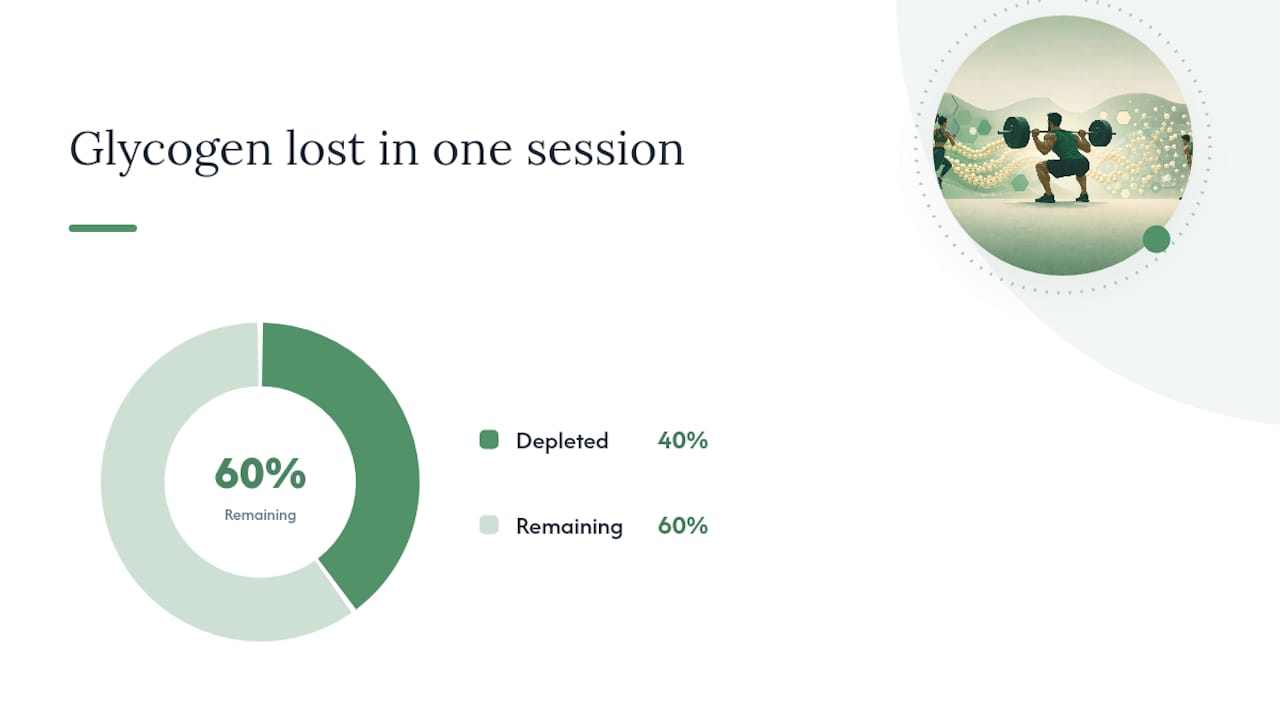
A single heavy strength session can deplete muscle glycogen by roughly 40%, depending on volume and how close each set is taken to failure. Your muscles typically store enough glycogen to support around 90 minutes of vigorous exercise, but that number shrinks fast under high-volume programming, multiple working sets per muscle group, or back-to-back training days without adequate refueling.
Here’s what depletion actually feels like in the gym:
- Rep speed slows on the last two sets of a compound lift.
- Bar velocity drops noticeably on sets four and five of a five-set squat protocol.
- Perceived effort spikes even though the weight on the bar hasn’t changed.
- Grip and technique start to break down before the target muscle group actually fatigues.
That last point matters more than most lifters realize. Central fatigue, the nervous system’s reluctance to keep pushing, often shows up before the muscle itself has technically failed, and low glycogen availability is one of the drivers behind that mental fog partway through a heavy session.
Quick fact: Practitioner guidance from sports nutrition brands notes that intense strength sessions can burn through up to 40% of stored muscle glycogen in a single workout, which is why fueling matters even for sessions under an hour.
It’s worth separating two related but distinct fuel pathways here. The phosphocreatine system covers the first few seconds of a maximal effort, the kind of burst you use on a single heavy rep. Glycolysis, powered by carbohydrate, takes over almost immediately after and covers everything from the second rep through the end of a demanding set. For anyone doing sets in the 6 to 15 rep range, which describes the overwhelming majority of hypertrophy and strength programming, glycolysis is doing most of the metabolic heavy lifting. Starve that pathway of glucose and glycogen, and the muscle has no fast way to keep producing ATP once the phosphocreatine system taps out.
What the Research Says About Carbs and Lifting Performance
The strongest evidence for carbohydrate’s role in resistance training comes from pooled analyses rather than any single study, and the picture they paint is consistent even if the effect size is modest. A systematic review of carbohydrate intake and resistance training performance found that studies across different designs and populations tend to support recommending carbohydrate intake specifically to optimize strength training output, not just endurance performance.
The more recent meta-analysis on acute carbohydrate feeding pooled resistance-training trials and reported a small but statistically meaningful increase in total session volume, with standardized mean differences in the range of 0.25 to 0.38. That’s not a dramatic number on its face. But translated into gym terms, it often means the difference between grinding out that last rep on your final set or racking the bar early.
Carbohydrate is the indispensable substrate for high-intensity physical performance, and expert panels recommend the majority of an athlete’s calories come from high-quality carbohydrate sources rather than treating carbs as optional or secondary to protein.
That framing comes from an expert panel report on high-quality carbohydrates and physical performance, which lays out daily intake ranges alongside the physiological reasoning behind them. The panel’s consensus lands squarely on carbohydrate as the primary fuel for anything approaching high intensity, with daily targets commonly falling between 5 and 7 grams per kilogram of body weight for moderate to heavy training, climbing toward 8 to 12 g/kg for athletes in especially demanding training blocks.
Two moderators show up repeatedly across this research: session length and fasting status. Effects are clearer in workouts running longer than 45 to 60 minutes, and they’re more pronounced in lifters who trained without eating beforehand. Short, well-fed sessions show a smaller measurable benefit, which tracks with the physiology: if glycogen stores are already full and the workout is brief, there’s less room for supplemental carbs to move the needle.
| Evidence source | Type | Key finding |
|---|---|---|
| PMC systematic review | Systematic review | Supports recommending carbohydrate intake specifically for resistance training performance |
| Expert panel report | Consensus panel | Carbohydrate is the primary substrate for high-intensity work; 5–7 g/kg daily is a common target |
The limitation worth flagging honestly: individual response varies. Training goal matters too, since someone chasing pure strength peaks may respond differently than someone in a high-volume hypertrophy block. None of this research suggests carbohydrate timing is a magic lever, only that it’s a consistent, evidence-backed one.
How Much Carbohydrate You Need and When to Eat It
Daily carbohydrate needs for strength trainees generally fall in the 4 to 7 grams per kilogram of body weight range, based on guidance from practitioner-facing sports nutrition resources, with the higher end reserved for lifters doing especially heavy volume or training multiple times per day. A 70 kilogram lifter training hard four to five days a week would land somewhere around 280 to 490 grams of carbohydrate daily, adjusted up or down based on total training load and individual tolerance.
Timing breaks into three practical windows:
- One to three hours before training. Eat a meal or snack containing 30 to 60 grams of carbohydrate to top off blood glucose and give glycogen stores a boost before you touch a bar. Pair it with a modest amount of protein and keep fat and fiber lower than usual, since both slow digestion and can leave you sluggish mid-set.
- During sessions longer than 60 minutes. Aim for 30 to 60 grams of carbohydrate per hour, typically through a sports drink, diluted juice, or a gel between exercises. This matters more for long powerlifting or bodybuilding sessions with extended rest periods than for quick 40-minute circuits.
- Within 30 minutes to two hours post-workout. If you’re training the same muscle group again within 8 to 24 hours, prioritize rapid glycogen resynthesis. Expert panel guidance on high-quality carbohydrates recommends roughly 0.5 to 0.6 grams per kilogram of body weight every 30 minutes for two to four hours to accelerate that early repletion window. If your next session is a full day or more away, total carbohydrate intake over the following 24 hours matters more than hitting that immediate post-workout number precisely.
Quick fact: Athletes retraining the same muscle group within a day benefit from roughly 0.5 to 0.6 g/kg of fast-digesting carbohydrate every 30 minutes for two to four hours after finishing.
One nuance that trips people up: carbohydrate type matters less than most fitness content implies. Some expert commentary specifically notes that manipulating glycemic index around training produces inconsistent performance effects, and that total carbohydrate amount and timing outweigh glycemic index as the drivers of performance outcomes. A banana and a handful of jelly beans will do roughly the same job pre-workout if the total gram count matches.
Real Food and Drink Options That Hit Your Numbers
Translating grams per kilogram into an actual plate is where most people get stuck, so here’s what those numbers look like on real food.

Quick pre-workout snacks that land in the 30 to 60 gram range include a medium banana with a tablespoon of honey, two slices of toast with jam, a cup of cooked oats, or a small bagel. During longer sessions, a standard sports drink delivers roughly 14 grams of carbohydrate per 8 ounces, while an energy gel typically packs 20 to 25 grams in a single pouch, making it easy to hit that 30 to 60 gram per hour target without overloading your stomach mid-set.
For daily whole-food sources that build toward your total g/kg target, common serving sizes include:
- Cooked white rice: roughly 45 grams of carbohydrate per cup
- Baked potato (medium, with skin): roughly 37 grams
- Cooked pasta: roughly 43 grams per cup
- Rolled oats: roughly 27 grams per half-cup dry
- Whole fruit (apple, orange, banana): 20 to 30 grams each
A 70 kilogram lifter aiming for the middle of that range might structure a day around a big bowl of oats at breakfast, rice or potatoes with lunch and dinner, and a piece of fruit or two as snacks, without ever touching a calculator mid-meal. If you’re managing appetite changes from GLP-1 medication, carb-forward snacks built for that context can help you still hit your training fuel needs in smaller, more manageable portions.
When Low-Carb Training Makes Sense (and When It Backfires)
“Train-low” is a real strategy in sports science, not just a diet trend. The idea is to deliberately do some training sessions with low glycogen availability to push specific cellular adaptations, particularly ones tied to mitochondrial density and fat oxidation efficiency. It has a legitimate place in some endurance-focused periodization plans.
For strength training, the tradeoffs look different, and mostly unfavorable. Carbohydrate restriction commonly reduces the total volume and intensity a lifter can sustain in a session, which matters enormously for strength and hypertrophy goals that depend on progressive overload over time. A study or two showing an interesting metabolic adaptation doesn’t outweigh the reality that most strength gains come from consistently doing more work over months, not from occasional glycogen-depleted sessions.
Some situations where a lower-carb approach gets used intentionally:
- A short deload week where volume is deliberately reduced anyway
- An isolated, low-stakes accessory session, not a main lift day
- A specific body-composition phase where a coach is deliberately trading some performance for other goals, with monitoring in place
Pro Tip: Never schedule a low-carb day before your heaviest compound lift of the week. Save any intentional carb restriction for accessory or recovery-focused sessions where a small drop in intensity costs you the least.
The practical rule: if you’re chasing strength or muscle growth, protect your carbohydrate intake around your hardest sessions and experiment with restriction, if at all, only on lower-stakes days, with clear monitoring of how it affects your lifts.
How Hormones and Life Stage Change Your Carb Needs
Carbohydrate tolerance and appetite shift across the menstrual cycle, and that shift is not minor. Estrogen and progesterone fluctuations affect insulin sensitivity, energy expenditure, and even how readily your body taps into stored glycogen versus fat during exercise. Many women notice they can handle higher carbohydrate loads and train harder during the follicular phase, while the luteal phase often brings higher resting energy needs and shifting appetite that a flat, one-size-fits-all carb target ignores entirely.
Perimenopause and menopause add another layer. Declining estrogen affects insulin sensitivity and can change how the body partitions carbohydrate between muscle glycogen storage and fat storage, which is part of why generic sports nutrition advice, built mostly on research in young men, often fits awkwardly for women navigating these transitions.
Nourished builds carbohydrate timing and portion guidance around this reality instead of ignoring it. Its AI-powered meal plans adjust carb amounts and timing to where you are in your cycle or life stage, without asking you to count calories or follow a rigid template that doesn’t account for hormonal shifts. That means:
- Pre-workout snack portions that shift alongside your cycle phase, not a static number regardless of the day
- Meal timing suggestions that account for how cycle phase affects training capacity
- Adjusted guidance for women in perimenopause managing both strength training goals and shifting energy needs
If you want to test this rather than take it on faith, the practical next step is straightforward: track two or three weeks of training volume and perceived energy against your cycle phase using Nourished’s period tracker, then compare how your lifts feel on higher-carb versus lower-carb training days. The pattern usually shows up faster than people expect.
| What to track | Why it matters |
|---|---|
| Training volume (sets x reps x load) | Reveals whether carb timing is actually affecting your output, not just how you feel |
| Perceived energy pre/post workout | Flags days where fueling, not fatigue, is the real limiter |
| Cycle phase | Connects hormonal shifts to real changes in carb tolerance and recovery |
Get Personalized Carb and Workout Guidance
Generic “eat more carbs” advice ignores that your needs on day 3 of your cycle look nothing like your needs on day 24, and a plan that doesn’t adjust for that is working against your biology instead of with it. Nourished builds meal and workout plans that adapt to your hormonal patterns automatically, whether you’re cycle syncing, managing perimenopause symptoms, or navigating post-menopause changes, without asking you to restrict or calculate anything manually.
The platform generates a personalized plan immediately once you input your training schedule and cycle information, mapping carbohydrate timing and portions to your actual physiology rather than a generic athlete profile. You can see exactly how the process works before committing, and current plan options make it easy to start with a structure built specifically around fueling your training instead of fighting it.
The Real Problem Isn’t Carbs, It’s How They’re Prescribed
Most strength training advice treats carbohydrate needs as a fixed number you calculate once and never revisit. That’s the part worth pushing back on. The research is clear that carbs are the dominant fuel for high-intensity lifting, but the evidence also shows meaningful variability between individuals, and almost none of the foundational studies account for menstrual cycle or hormonal life stage at all.
That gap matters more than most articles admit. A woman in her luteal phase or navigating perimenopause isn’t failing at nutrition if a generic 6 g/kg target feels wrong some weeks and fine others. Her physiology is shifting, and the guidance should shift with it.
If there’s one place to start, it’s tracking rather than guessing: watch how your training volume and energy respond to carb timing across a few weeks, ideally against your own cycle data. The number on paper matters less than what your body does with it on a given day.
Frequently Asked Questions
Do carbs actually help with weight lifting, or is that mostly a myth for endurance athletes? Carbohydrates genuinely help with weight lifting. The meta-analysis on acute carbohydrate feeding found a measurable, if modest, increase in resistance training volume, and the effect isn’t limited to endurance work.
What are the best carbs for strength training? Total amount and timing matter more than the specific type. Whole grains, potatoes, rice, and fruit work well for daily needs, while fast-digesting options like sports drinks or gels suit the middle of a long session.
How do carbohydrates support muscle recovery after a strength workout? Carbohydrates refill depleted glycogen stores after training, and pairing them with protein supports the recovery and rebuilding process. Rapid resynthesis matters most when you’re training the same muscles again within 8 to 24 hours.
Can I strength train effectively on a low-carb diet? You can, but expect reduced training volume and intensity, especially in longer or higher-effort sessions. Low-carb approaches fit better on lower-stakes accessory days than on your heaviest lifting sessions.
How many carbs should I eat before a strength workout? Most guidance points to 30 to 60 grams one to three hours before training, adjusted based on session length and personal digestion tolerance.
Sources
- An Updated Meta-analysis on The Ergogenic Effects of Acute Carbohydrate Feeding on Resistance Exercise Performance: Ergogenic effects of carbohydrate ingestion on resistance training performance | SportRxiv
- The Effect of Carbohydrate Intake on Strength and Resistance Training Performance: A Systematic Review - PMC
- Carbohydrates and exercise - British Heart Foundation
- How to Fuel Strength Training: Carbs, Protein & Hydration | Gatorade