
Yes, Estrogen Protects Muscle Mass. Here's How.
Nourished · August 25, 2026
Yes, Estrogen Protects Muscle Mass. Here’s How.
Estrogen helps preserve muscle mass by supporting tissue repair, protecting mitochondrial function, and stabilizing muscle cell membranes. When estrogen drops during perimenopause and menopause, those protections weaken, and muscle loss can accelerate.
The mechanisms come down to three things: estrogen keeps satellite cells active for repair, shields mitochondria from oxidative stress, and helps stabilize membranes around muscle fibers. Lose enough estrogen, and all three start to slip.
You don’t have to wait for a diagnosis to act on this. Start here:
- Begin (or restart) progressive resistance training, two to four sessions a week.
- Check that you’re eating enough protein, spread across the day, not just at dinner.
- If you’re worried about the pace of change, book time with a clinician to discuss whether hormone therapy makes sense for you.
Key Takeaways
Estrogen protects muscle mass by supporting satellite cell repair, mitochondrial function, and membrane stability, and its decline accelerates muscle loss unless training and nutrition compensate.
| Point | Details |
|---|---|
| Mechanism drives the effect | Estrogen supports satellite cells, mitochondria, and membrane stability, the biological basis for muscle protection. |
| Human evidence is mixed but promising | Systematic reviews show lower muscle mass in postmenopausal women, with HT effects varying by dose and timing. |
| Timing shapes HT benefit | Starting hormone therapy closer to menopause onset is linked to greater muscle gains in trial data. |
| Training remains the strongest lever | Resistance training two to four times weekly can mimic or amplify estrogen’s muscle-protective effects. |
| Personalized plans outperform generic advice | Nourished adjusts meal and workout plans to your hormonal stage, supporting the protein timing and training approach the evidence favors. |
This article is general information, not a substitute for advice from a qualified doctor. Consult a qualified healthcare professional about your own circumstances before acting on anything here.
Table of Contents
- How Estrogen Protects Muscle: Receptors, Repair, and Mitochondria
- What Human Studies Show About Estrogen and Muscle Loss
- How to Preserve Muscle Mass During Hormonal Change
- Hormone Therapy and Muscle: Timing and Trade-Offs
- Estrogen Deficiency’s Impact Across Different Life Stages
- Muscle Loss Patterns: Men vs. Women and the Estrogen Factor
- How Estrogen Interacts With Testosterone and Growth Hormone
- Side Effects and Open Questions About Estrogen’s Role
- Building a Hormone-Aware Muscle Plan That Actually Fits Your Life
- Nourished Builds Hormone-Aware Plans Around Your Muscle Goals
- Sources
How Estrogen Protects Muscle: Receptors, Repair, and Mitochondria
Muscle tissue is packed with estrogen receptors, specifically ER-alpha, ER-beta, and a membrane-bound receptor called GPER. These receptors don’t just sit there. They trigger two kinds of signaling: genomic (slower, affecting gene expression over hours or days) and non-genomic (fast, affecting cell function within minutes). That dual system is part of why estrogen’s effects on muscle show up both immediately after exercise and over months of training.
Here’s the sequence of what estrogen actually does inside muscle tissue:
- Activates satellite cells. These are the stem cells responsible for muscle repair and growth. Estrogen modulates their number and function, which is part of how muscle rebuilds itself after training stress or everyday wear.
- Stabilizes cell membranes. Estrogen has antioxidant properties that reduce the membrane damage exercise naturally causes, meaning less breakdown to repair in the first place.
- Protects mitochondria. Muscle mitochondria rely on estrogen signaling to maintain energy output. When estrogen falls, mitochondrial bioenergetics suffer, which can show up as fatigue that seems disproportionate to your effort.
- Coordinates repair signaling. Estrogen functions as a kind of crosstalk regulator between the pathways that manage muscle repair and protein turnover. When it drops, that coordination gets sloppier, which is one reason recovery slows and injury risk creeps up during the menopause transition.
At the molecular level, estrogen deficiency has been linked to higher levels of proteolytic markers like FOXO3A and MuRF-1, alongside lower levels of anabolic markers like MyoD and myogenin, in mechanistic and animal research. Estrogen treatment can reverse those shifts, which is a big part of the biological case for why hormone status matters for muscle health.
Pro Tip: If your workouts suddenly feel harder to recover from and nothing else in your routine changed, don’t assume you’re just “out of shape.” Fluctuating estrogen can genuinely blunt recovery speed, so adjust training volume before you assume motivation is the problem.
What Human Studies Show About Estrogen and Muscle Loss
Animal models paint a clean picture: cut estrogen, lose muscle function. Human data is messier, and you deserve to know why before you make decisions based on it.
A systematic review of estrogen and skeletal muscle aging found that postmenopausal women generally show lower muscle mass and strength than premenopausal women. That part is consistent. What’s less consistent is how estrogen therapy affects those outcomes. Some studies show real benefit; others show none. The review describes the overall evidence on estrogen therapy as mixed, though many recent analyses lean toward a modest positive effect.
One trial cuts through some of that noise. A 12-week randomized controlled trial testing transdermal estrogen combined with resistance training in early postmenopausal women found greater increases in quadriceps cross-sectional area and whole-body fat-free mass compared with resistance training plus a placebo. Training alone worked. Training plus transdermal estrogen worked better.
Why the mixed results elsewhere? A few variables explain most of it:
- Formulation and route (oral vs. transdermal) change how estrogen behaves metabolically.
- Timing relative to menopause onset affects whether benefits show up at all.
- Participant age and baseline exercise status shift how much room there is for improvement.
- Dose matters, and studies rarely standardize it the same way.
None of this means the evidence is weak. It means the effect is real but context-dependent, which is exactly why a personalized approach beats a one-size-fits-all protocol.
How to Preserve Muscle Mass During Hormonal Change
Whether or not you pursue hormone therapy, the training and nutrition fundamentals stay the same, and they matter more, not less, once estrogen starts declining.
- Train with progressive overload, two to four times a week. Prioritize compound movements: squats, deadlifts, rows, presses. Gradually increase weight or reps over time rather than staying at a comfortable plateau. Resistance training can partially mimic or amplify estrogen’s effects on muscle, which is exactly why it becomes non-negotiable once hormone levels shift.
- Hit your protein target daily. Aim for roughly 1.2 to 1.6 grams per kilogram of body weight depending on activity level, with 20 to 40 grams per meal. Spreading protein across the day matters more than cramming it into one meal, and leucine-rich sources (eggs, dairy, poultry, fish) do the heaviest lifting for muscle protein synthesis.
- Protect recovery like it’s part of training, not an afterthought, following guidelines on menopause bone loss to support both muscle and bone health. Sleep, mobility work, and tendon-friendly loading (slow eccentrics, gradual progression) reduce injury risk. Inflammation management through diet and pacing matters more here than it did in your 20s.
- If you’re not using HT, lean harder into training. Exercise won’t fully replace estrogen’s biological effects, but it’s the single most controllable lever you have, and the evidence shows it works on its own.
Pro Tip: If you’re new to structured lifting, don’t start with isolation exercises. Compound lifts recruit more muscle mass per session, which matters most when your recovery capacity is already under pressure from hormonal shifts.
Starter checklist for this week: schedule two strength sessions, calculate your daily protein target, and track per-meal protein timing for three days to see where the gaps are.
Hormone Therapy and Muscle: Timing and Trade-Offs
Timing shapes how much benefit hormone therapy delivers. Research on estrogen’s mechanisms in skeletal muscle points to a window of opportunity: starting HT closer to menopause onset tends to produce clearer muscle benefits than starting years later.
Delivery route matters too. Transdermal estrogen, the form used in the 12-week resistance training trial that showed muscle gains, behaves differently metabolically than oral estrogen, partly because it bypasses first-pass liver metabolism.
None of this makes HT a universal answer:
- Benefits vary by dose, formulation, and individual health history.
- Contraindications exist for certain cardiovascular and cancer risk profiles.
- Population studies show associations with lean mass retention, not guarantees.
This is a risk-benefit conversation, not a blanket recommendation, and it has to happen with someone who knows your history.
When to See a Clinician About Muscle Loss
Rapid, unexplained muscle loss, new falls, or a sharp decline in daily function are red flags worth addressing quickly, not waiting out.
Bring your medication list, a rough exercise history, a timeline of symptoms, and any prior labs or DEXA scans. Worth asking directly: What strength benefit is realistic here? What’s the timing consideration for me specifically? How will we monitor progress? What are the alternatives if HT isn’t right for me?
Estrogen Deficiency’s Impact Across Different Life Stages
Muscle loss related to estrogen doesn’t switch on overnight at menopause. It builds in stages, and knowing where you sit in that timeline changes what actions make sense.
During the perimenopause transition, estrogen fluctuates unpredictably rather than dropping in a straight line. Muscle strength and recovery capacity can feel inconsistent week to week, which often gets misread as deconditioning rather than hormonal variability. This is typically the best window to build a training base, since some estrogen protection is still present.

Once you reach early postmenopause, estrogen settles at a consistently lower level. This is the stage where the 12-week transdermal estrogen trial showed the clearest combined benefit of hormone therapy and resistance training, and it lines up with the window-of-opportunity concept: intervention closer to this point tends to pay off more than intervention delayed by a decade.
In late postmenopause, years past the final period, the systematic review evidence on estrogen and skeletal muscle aging shows muscle mass and strength deficits become more entrenched. Training still works at this stage. It just takes a more deliberate, consistent effort to produce the same gains that came more easily earlier on.
The practical takeaway: earlier action tends to compound. Waiting until muscle loss is already noticeable doesn’t close the door on intervention, but it does mean working harder to get back to the same place.
Muscle Loss Patterns: Men vs. Women and the Estrogen Factor
Men and women lose muscle differently with age, and estrogen is a big part of the explanation.
Men experience gradual, roughly linear muscle decline starting in their 30s, driven mostly by slowly falling testosterone. Women follow a different curve entirely: relatively stable muscle mass through the reproductive years, then a steeper drop-off around the menopause transition, when estrogen falls sharply rather than gradually.
That difference in slope matters. A man’s muscle loss trajectory is a slow, predictable slide. A woman’s often looks more like a plateau followed by a drop, concentrated in a handful of years around menopause. This is consistent with systematic review findings showing postmenopausal women have measurably lower muscle mass and strength than premenopausal women, a gap that’s harder to find in men at equivalent ages.
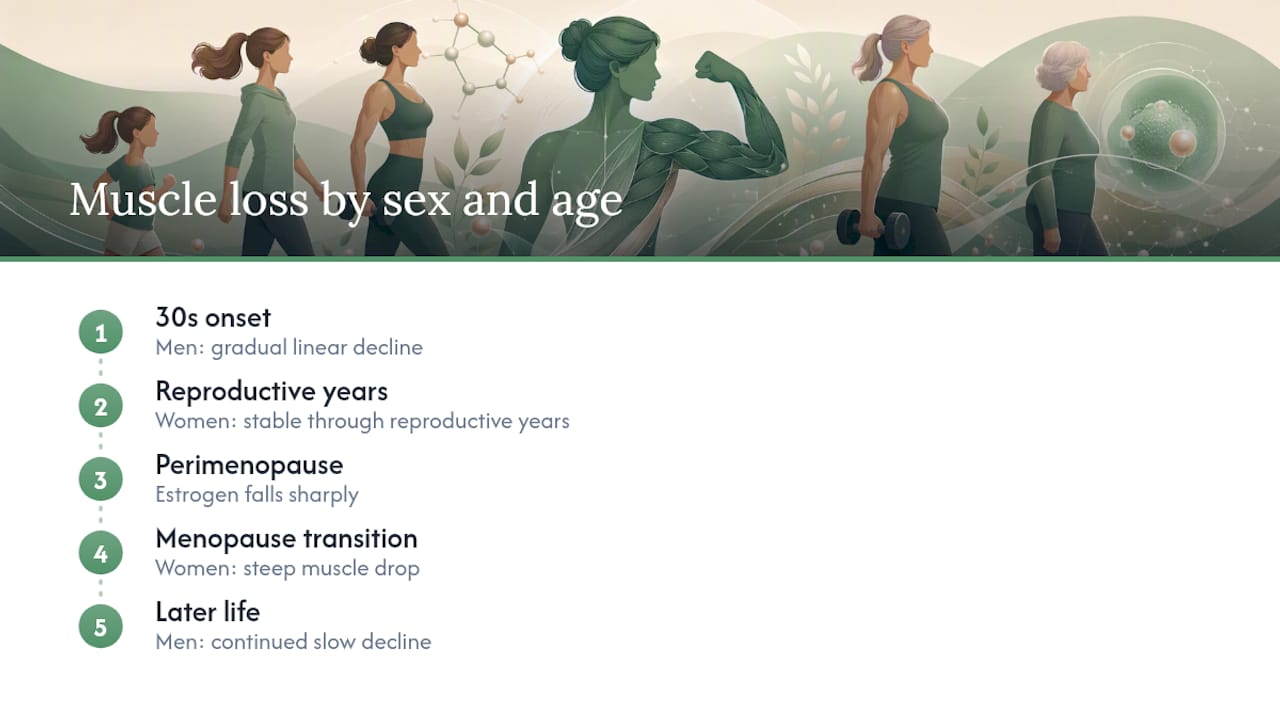
It also helps explain why generic “aging and muscle loss” advice, often built around research on men, doesn’t fully transfer to women. The timing, pace, and hormonal driver are different enough that a woman navigating perimenopause needs a plan built around her actual hormonal trajectory, not a scaled-down version of advice designed for steady, linear testosterone decline. This is part of why cycle-aware and menopause-stage-aware training approaches exist as a distinct category rather than a subset of general fitness advice.
How Estrogen Interacts With Testosterone and Growth Hormone
Estrogen doesn’t work alone. Muscle maintenance depends on a small network of hormones, and estrogen’s decline changes how the others behave too.
Testosterone, present in women at much lower levels than in men but still biologically active, contributes to muscle protein synthesis. Some research suggests estrogen and testosterone have overlapping and occasionally synergistic effects on muscle tissue, meaning the loss of one can partly compound the effects of low levels in the other, even when testosterone itself hasn’t dropped dramatically.
Growth hormone and its downstream partner, insulin-like growth factor 1 (IGF-1), also decline with age and interact with estrogen signaling in muscle repair pathways. Estrogen appears to support some of the same anabolic signaling that growth hormone and IGF-1 drive, which means falling estrogen doesn’t just remove one protective factor. It can reduce the effectiveness of a broader hormonal support system for muscle repair and growth.
This is part of why a narrow focus on “just fix estrogen” oversimplifies the picture. The mechanistic research on estrogen’s role in skeletal muscle frames it as one node in a signaling network, not an isolated switch. Practical implication: nutrition and training that support overall hormonal health, adequate protein for IGF-1 signaling, resistance training for testosterone and growth hormone response, tend to reinforce whatever estrogen is doing, rather than working against it.
Side Effects and Open Questions About Estrogen’s Role
Estrogen’s role in muscle preservation isn’t a settled, tidy story, and pretending otherwise does readers a disservice.
The biggest controversy isn’t whether estrogen matters for muscle. It’s how much hormone therapy alone can be expected to do, and for whom. The systematic review evidence is explicit that human trial results are mixed, not uniformly positive. Some of that inconsistency likely comes from real biological variation between women; some of it comes from studies using different formulations, doses, and durations that aren’t directly comparable.
There’s also a risk side to this conversation that gets glossed over in enthusiastic framing of HT as a muscle-preservation tool. Hormone therapy carries contraindications for certain cardiovascular and cancer risk profiles, and it isn’t appropriate for every woman regardless of how her muscle mass is trending. Treating HT as a fitness supplement rather than a medical decision with real trade-offs misrepresents what the research actually supports.
A subtler issue: it’s tempting to attribute all midlife muscle loss to estrogen and treat hormone therapy as the fix. But training status, protein intake, sleep, and general activity level are independent variables that matter enormously, with or without HT. The 12-week RCT that got attention for showing HT plus training beat training alone also showed that training alone still produced real gains. Estrogen amplifies a good program. It doesn’t substitute for one.
Building a Hormone-Aware Muscle Plan That Actually Fits Your Life
Most advice on estrogen and muscle stops at “lift weights and eat protein,” which is true but incomplete. The harder, more useful question is how training, nutrition, and clinical input fit together for your specific hormonal stage, not a generic 35-year-old’s stage or a generic 55-year-old’s stage.
A woman in early perimenopause with irregular cycles needs different programming than one three years past her final period. Protein needs shift with activity level and muscle status, not just age. And the HT conversation only makes sense once training and nutrition basics are already in place, since resistance training’s effects on muscle are large enough to change what “benefit from HT” even looks like on top of them.
The pattern worth noticing across the research: modest, consistent changes, two structured training sessions weekly, a protein target hit most days, adequate sleep, tend to move the needle faster than people expect within a few months. That’s a more realistic outcome than a dramatic transformation, and it’s also a more sustainable one.
— Brittany
Nourished Builds Hormone-Aware Plans Around Your Muscle Goals
Most muscle-preservation advice treats every woman’s hormonal stage as identical, which is exactly the gap Nourished is built to close. Nourished generates personalized meal and workout plans based on where you actually are, perimenopause, menopause, or post-menopause, rather than a generic macro target and a generic workout split.
That specificity matters for the mechanics covered above. Protein timing and dose need to shift with activity and hormone stage, and Nourished’s AI customization adjusts meal plans accordingly, without calorie counting or restrictive dieting. Its cycle-and-phase-aware workout plans are built to complement the resistance training approach the research supports, adjusting intensity and recovery emphasis to your hormonal stage rather than applying one static program indefinitely.
If you want to see how your own hormonal stage should shape your nutrition and training, start with the free period and cycle tracker to map where you are, or explore how Nourished’s plans work before choosing a plan.
Sources
- Research progress on the correlation between estrogen and estrogen receptor on postmenopausal sarcopenia
- Mechanisms of estrogen influence on skeletal muscle: mass, regeneration, and mitochondrial function
- The role of estrogen in female skeletal muscle aging: A systematic review
- Estrogen replacement and skeletal muscle: mechanisms and population health