
Why Protein Needs Vary Across Your Cycle Phases
Nourished · August 12, 2026
Why Protein Needs Vary Across Your Cycle Phases
Yes, protein needs do shift across the menstrual cycle, and the luteal phase is where the clearest signal appears. The effect is real but modest: most human studies report a small increase in protein needs during the luteal phase, not a dramatic overhaul of your diet. For most premenopausal women, the highest-value move is still hitting a consistent daily protein target and spacing it across meals. A small, optional luteal-phase bump is a reasonable refinement once you have reliable cycle tracking in place.
The short answer: Protein needs are slightly higher in the luteal phase due to increased amino-acid oxidation and appetite. The difference is small enough that consistent daily intake matters more than phase-by-phase precision for most women.
Key points before you read further:
- The luteal-phase increase in protein intake observed in studies is statistically significant in some comparisons but clinically modest.
- Accurate phase identification, not calendar counting, is a prerequisite before making any phase-based changes.
- Individual variability is large; what works for one woman may be unnecessary for another.
Key Takeaways
Protein needs are slightly but measurably higher in the luteal phase, and the most effective strategy is a consistent daily baseline with a small, optional luteal adjustment guided by accurate cycle tracking.
| Point | Details |
|---|---|
| Luteal-phase increase is real but small | Studies report roughly 3–5 g/day more protein in the luteal phase, not a major dietary overhaul. |
| Baseline protein target | Aim for 1.2–1.6 g/kg/day as your daily foundation before considering any phase-based adjustment. |
| Accurate tracking comes first | Ovulation varies between day 7 and day 21; use LH kits or BBT to confirm your luteal phase before adjusting intake. |
| Appetite signals are reliable guides | The 509-cycle cohort showed women naturally eat more protein in the luteal phase; working with that signal is often enough. |
| Nourished personalizes the approach | Nourished builds cycle-phase protein targets into AI-generated meal plans, with optional luteal adjustments and a free cycle tracker. |
Table of Contents
- What human studies actually show about protein and cycle phases
- How estrogen and progesterone drive changes in protein metabolism
- Translating the evidence into food: protein targets by phase
- How to reliably identify your cycle phase before adjusting protein
- When phase-based protein adjustments are not the right starting point
- What the current evidence does not yet answer
- How Nourished applies this evidence in a personalized plan
- A practical perspective on phase-aware protein
- Nourished makes phase-aware protein practical
- Key studies and resources to read next
- Sources
What human studies actually show about protein and cycle phases
The most direct dietary evidence comes from a prospective cohort tracking 509 menstrual cycles in healthy premenopausal women. Total protein, animal protein, and the percentage of energy from protein were all highest in the mid-luteal phase. Mean protein intake was somewhat higher in mid-luteal compared with other phases of the cycle. That difference was statistically significant (P = 0.03 for total protein), and food cravings also spiked in the same window.
What the data shows: A 509-cycle prospective study found mid-luteal protein intake averaged ~65 g/day versus ~61–62 g/day in other phases — a real but modest difference that women appear to self-select through increased appetite.
Tracer-based work adds a mechanistic layer. An indicator amino acid oxidation (IAAO) study found a higher lysine requirement in the luteal phase compared with the follicular phase: 37.7 mg/kg/day versus 35.0 mg/kg/day (P = 0.025). Higher F¹³CO₂ excretion in the luteal phase confirmed greater amino-acid oxidation. The sample was small and repeated-measures, so the finding is directionally useful rather than definitive.
Earlier nitrogen-balance work reinforced the same pattern. Urinary nitrogen excretion fluctuates across the cycle, and studies that fail to account for cycle phase introduce extra variability into protein requirement estimates. This is partly why older protein requirement data for women has been inconsistent.
Methodological limits worth knowing:
- The IAAO tracer studies use small samples; the lysine finding should be replicated in larger cohorts before being treated as a firm requirement.
- Dietary-recall cohorts rely on self-report, which introduces recall bias; food frequency questionnaires are less precise than multiple 24-hour recalls.
- Phase verification methods vary widely across studies: some confirm ovulation with serum hormones, others rely on calendar counting, which is unreliable.
- Outcomes are heterogeneous: some studies measure intake, others measure oxidation, others measure nitrogen balance. Comparing across them requires caution.
A systematic review of protein requirements in premenopausal female athletes found the evidence on menstrual-phase effects to be limited and inconsistent, concluding that current data does not support firm phase-based protein changes for most women.
How estrogen and progesterone drive changes in protein metabolism
The hormonal shifts across a 28-day cycle are not subtle. Estradiol rises through the follicular phase, peaks at ovulation, then drops and rises again modestly in the luteal phase. Progesterone, nearly absent in the follicular phase, climbs sharply after ovulation and stays elevated through the mid-to-late luteal phase before falling if pregnancy does not occur. These two hormones pull protein metabolism in different directions.
The core mechanism: Rising progesterone in the luteal phase increases resting metabolic rate and appears to accelerate amino-acid catabolism, while estradiol may have a mild protein-sparing effect. The net result is a small but measurable increase in amino-acid oxidation.
Progesterone is catabolic in the context of protein. It raises resting metabolic rate (RMR) by a small but consistent margin in the luteal phase, and it appears to promote amino-acid oxidation rather than incorporation into muscle protein. Estradiol, by contrast, tends to support protein synthesis and may reduce muscle protein breakdown. In the follicular phase, when estradiol is dominant and progesterone is low, the metabolic environment is relatively anabolic. The luteal phase flips that balance.
The downstream effects extend beyond simple hormone levels. Metabolomics data show coordinated shifts in substrate utilization in the luteal phase, including increased lipid oxidation and amino-acid variation patterns that suggest the body is drawing on multiple fuel sources simultaneously. RMR variance also increases, meaning energy needs are less predictable in this phase.
Three integrated systems amplify inter-individual variability:
- HPA axis reactivity: Cortisol patterns interact with progesterone signaling and can further increase protein catabolism, especially in women under chronic stress.
- Autonomic tone: Luteal-phase shifts in autonomic balance affect gut motility and nutrient absorption, which can change how efficiently dietary protein is used.
- Gut microbiota: Emerging evidence suggests the microbiome responds to estrogen and progesterone fluctuations, potentially affecting amino-acid metabolism and short-chain fatty acid production.
The flow looks like this: progesterone rises → RMR increases → amino-acid oxidation accelerates → dietary protein requirement edges up slightly → appetite signals increase to compensate. For many women, that last step, the appetite increase, naturally closes the gap without any deliberate dietary change.
An integrative review of menstrual cycle nutrient metabolism describes these as small-to-moderate, coordinated changes that justify cycle-aware nutrition strategies, while cautioning against rigid phase-based rules that ignore individual variation.
Translating the evidence into food: protein targets by phase
Start with your baseline. For most premenopausal women, the practical daily protein range supported by sports-nutrition and clinical guidance generally falls within a moderate range of protein intake. A systematic review of premenopausal female athletes places estimated average requirements (EARs) within this range across exercise types. For a woman of average weight, that translates to a moderate amount of daily protein intake. Sedentary women can work with the lower end; active women should target the upper end or slightly above.
Distribution across meals matters as much as the daily total. Spreading protein across three to four eating occasions, aiming for roughly 25–40 g per meal, maximizes muscle protein synthesis signaling compared with eating the same total in one or two large meals.
Follicular phase (days 1–13 approximately, post-menstruation to ovulation):
- Estradiol is rising; the metabolic environment is relatively anabolic.
- Stick to your baseline protein target; no adjustment needed.
- Meal examples: Greek yogurt parfait with berries (20 g protein), grilled salmon with quinoa and roasted vegetables (35 g), lentil soup with a side of cottage cheese (28 g).
Ovulatory phase (roughly days 12–16, confirmed by LH surge):
- Estradiol peaks; energy and strength often feel highest here.
- Maintain baseline intake; this is a good window for higher-intensity training if that is part of your routine.
- Meal examples: eggs and smoked salmon on whole-grain toast (30 g), chicken stir-fry with edamame (38 g).
Luteal phase (post-ovulation through the day before menstruation):
- Progesterone dominates; amino-acid oxidation increases; appetite rises.
- An optional small increase above your baseline is consistent with what studies observe. For a 64 kg woman at 1.4 g/kg/day (90 g baseline), that means targeting 93–95 g/day.
- Whole-food sources that also address common luteal-phase cravings: grass-fed beef, turkey, eggs, full-fat dairy, legumes, and edamame.
- Meal examples: turkey and white bean chili (40 g protein), cottage cheese with walnuts and a drizzle of honey as an evening snack (18 g), baked chicken thighs with sweet potato and spinach (36 g).
The Cleveland Clinic’s cycle-syncing guidance recommends listening to appetite signals in the luteal phase and including satisfying, protein-rich foods rather than fighting cravings with restriction. That aligns with what the dietary-recall data shows: women naturally eat more protein in the luteal phase when they are not restricting.
For practical high-protein meal ideas that work well in the luteal phase, Bell’s Protein Pantry’s high-protein brunch recipes offer whole-food combinations that are easy to build into a weekly rotation.
Pro Tip: If luteal-phase cravings push you toward processed carbohydrates, add a protein-first snack before the craving peaks: two hard-boiled eggs or a small bowl of edamame (both around 12–13 g protein) taken mid-afternoon can blunt the drive for sweets without rigid restriction.
How to reliably identify your cycle phase before adjusting protein
Phase-based nutrition only works if you know which phase you are actually in. Assuming ovulation happens on day 14 is a common mistake in cycle-aware nutrition planning because ovulation timing varies widely across different women and cycles, meaning a calendar-only approach can mistime the luteal phase by a week or more.
Why this matters: If you are eating for the luteal phase when you are still in the follicular phase, you are adding calories and protein without the physiological signal that justifies it. Accurate phase verification is not optional; it is the foundation of the whole strategy.
Practical tracking options, from least to most precise:
- Validated period-tracking apps (with ovulation algorithms): a reasonable starting point for women with regular cycles; pair with at least one objective marker.
- Basal body temperature (BBT): a sustained rise of roughly 0.2°C after ovulation confirms the luteal phase has started; requires consistent morning measurement before getting out of bed.
- LH test kits (ovulation predictor kits): detect the LH surge 24–36 hours before ovulation; highly practical and inexpensive; the most accessible objective marker for most women.
- Cervical mucus observation: egg-white consistency signals the fertile window; useful as a secondary confirmation alongside BBT or LH testing.
- Serum hormone testing (estradiol, progesterone, LH): the gold standard for phase verification; typically used in clinical or research settings, or when cycle irregularity makes other methods unreliable.
For women who prefer a physical record alongside digital tracking, a dedicated period-tracker planner can help log BBT, symptoms, and food patterns in one place, which is particularly useful when you are correlating protein intake with how you feel across phases.
The GSSI sports-science synthesis specifically flags ovulation variability as a reason why phase-based nutrition research is hard to standardize, and why individual tracking is more reliable than population-level day-count assumptions.
A reasonable tracking cadence: use an LH kit for two to three cycles to establish your personal ovulation window, then layer in BBT or a validated app for ongoing monitoring. Once you have two to three cycles of data, you will know whether your luteal phase is 10 days or 16 days, which changes the practical window for any protein adjustment.
Nourished’s free cycle tracker lets you log cycle data and phase symptoms in one place, making it easier to connect your tracking data to meal plan adjustments.
When phase-based protein adjustments are not the right starting point
For most healthy premenopausal women, modest luteal-phase protein tweaks are low-risk and potentially useful. But several clinical situations call for individualized support from a registered dietitian (RD) or physician before experimenting with phase-based changes.
See an RD or clinician first if you have:
- PCOS: Insulin resistance, androgen excess, and irregular cycles change the hormonal context entirely; standard cycle-phase assumptions may not apply.
- Hypothalamic amenorrhea or irregular cycles: If you are not ovulating reliably, there is no consistent luteal phase to target; the priority is restoring energy availability.
- A history of disordered eating: Rigid phase-based rules can reinforce restrictive or obsessive patterns; a flexible, non-prescriptive approach supervised by an RD is safer.
- High training loads (competitive athletes): Sports-nutrition needs at high volumes exceed what phase-based tweaks address; energy availability and total protein targets take precedence.
- Recent pregnancy, postpartum, or breastfeeding: Protein requirements are elevated and hormonally distinct from a typical premenopausal cycle.
- Fertility treatment or hormonal contraception: Exogenous hormones alter the endogenous cycle entirely; phase-based nutrition based on natural cycle phases does not apply.
- Metabolic conditions (type 2 diabetes, thyroid disorders): These affect protein metabolism independently of cycle phase and require coordinated medical nutrition therapy.
What an RD will typically assess: menstrual history and cycle regularity, current energy availability (especially in active women), lab markers (ferritin, vitamin D, thyroid panel, fasting glucose), training load, and dietary patterns. Bring a three-to-five day food log, your cycle-tracking data for the past two to three months, and any relevant lab work to a first appointment.
For women navigating the transition into perimenopause, where cycle regularity begins to shift, protein needs in perimenopause require a different framework than the premenopausal cycle-phase model described here.
What the current evidence does not yet answer
The honest summary: the signal is real, the magnitude is small, and the research still has significant gaps.
Chief limitations across study types:
- Dietary-recall studies depend on self-report; recall bias systematically underestimates intake and cannot confirm whether observed differences reflect true physiological need or simply appetite-driven behavior.
- IAAO tracer studies have used very small samples; the lysine-requirement finding needs replication in larger, more diverse cohorts before it can anchor clinical recommendations.
- Phase verification is inconsistent across studies: some confirm ovulation with serum hormones, others use calendar counting, making cross-study comparisons unreliable.
- Most studies have not separated the effects of cycle phase from confounders like training load, sleep quality, and stress.
Specific research gaps:
- Phase-verified exercise trials across different performance types (endurance, strength, team sports) in women with confirmed ovulation are almost entirely absent.
- The effect of hormonal contraception on protein metabolism across the “cycle” is poorly studied; most research excludes contraceptive users, leaving a large population without applicable data.
- Long-term clinical outcomes of phase-based protein adjustments, including effects on body composition, muscle mass, and menstrual health, have not been studied in controlled trials.
- Registered trials such as NCT06268678 suggest the field is actively working to fill these gaps, but results are pending.
The integrative review of menstrual cycle nutrient metabolism calls explicitly for better phase verification standards in future studies and more consistent outcome measures. Until those trials exist, the practical guidance in this article reflects the best available evidence, not a settled consensus.
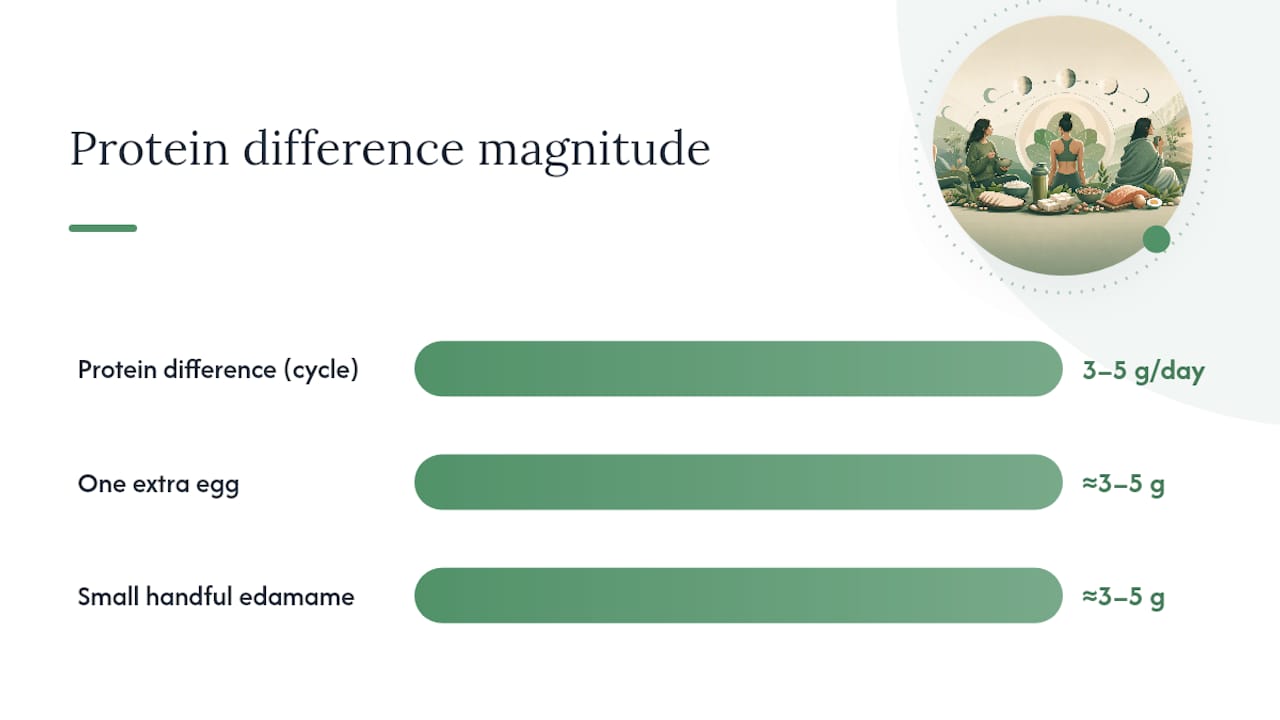
Small measured differences may also lack clinical importance for many women. A 3–5 g/day difference in protein intake is roughly equivalent to one extra egg or a small handful of edamame. For women already meeting their baseline targets, this is not a meaningful intervention.
How Nourished applies this evidence in a personalized plan
Translating cycle-phase protein research into a daily meal plan requires more than knowing the science. It requires knowing your cycle, your baseline protein needs, your food preferences, and your life stage. That is where a personalized, cycle-aware platform adds practical value.
Nourished operationalizes the evidence in a few specific ways:
- Baseline protein targets are calculated from user inputs (weight, activity level, health goals) and aligned with the 1.2–1.6 g/kg/day range supported by current sports-nutrition and clinical guidance.
- Cycle-tracking integration allows users to log period start dates, ovulation symptoms, and phase transitions; the platform uses this data to time meal plan adjustments rather than relying on calendar-day assumptions.
- Luteal-phase meal adjustments are optional and evidence-aligned: the platform can suggest slightly higher-protein meal options in the luteal phase if the user opts in, without imposing rigid rules.
- AI meal personalization accounts for food preferences, dietary restrictions, and hormonal health goals simultaneously, so phase-aware protein guidance does not conflict with other nutritional priorities.
- Research transparency: Nourished’s research and references page links to the primary studies underlying its recommendations, so users can evaluate the evidence themselves.
The approach is deliberately non-dogmatic. Phase-aware nutrition is treated as one input among several, not a mandatory protocol. Women with irregular cycles, PCOS, or perimenopause-related changes can use the platform’s other personalization features without needing a textbook-perfect 28-day cycle.
A practical perspective on phase-aware protein
The evidence for luteal-phase protein increases is real, but it is easy to overstate. A 3–5 g/day difference is not a dietary transformation; it is one egg. What the research actually supports is something more useful than a rigid phase protocol: it supports paying attention to your body’s signals, because those signals often reflect genuine physiological shifts.
The women in the dietary-recall cohort were not following a phase-based nutrition plan. They were eating more protein in the luteal phase because they were hungrier. That appetite increase is not a failure of willpower; it is a coordinated hormonal response. Working with it, rather than against it, is the practical takeaway.
Where I think the cycle-syncing conversation goes wrong is in the precision theater: color-coded meal plans, strict gram targets for each of four phases, and the implication that deviating from the protocol undermines your hormonal health. The science does not support that level of rigidity. What it supports is a consistency-first approach, a solid daily protein baseline, even distribution across meals, and a modest, optional luteal adjustment if you find it helpful.
Track your cycle accurately. Hit your baseline. Let appetite guide small adjustments in the luteal phase. That is the whole protocol.
Nourished makes phase-aware protein practical
Knowing the science is one thing. Applying it across a real cycle, with real food, and a real schedule, is where most women get stuck. Nourished gives you a personalized meal plan built around your hormone health, your cycle phase, and your protein targets, without calorie counting or rigid rules.

Getting started takes three steps:
- Complete the onboarding at Nourished: enter your health goals, dietary preferences, and life stage to generate your first personalized meal plan immediately.
- Connect your cycle data using Nourished’s free period and cycle tracker to log phase transitions and let the platform time your luteal-phase meal suggestions accurately.
- Follow the tutorial at Nourished’s how-it-works page to set up phase-aware meal preferences and explore the AI nutrition chat for real-time guidance.
Your next cycle is a good place to start.
Key studies and resources to read next
The sources below represent the primary evidence base for this article and the most useful clinical resources for further reading.
- Changes in macronutrient, micronutrient, and food group intakes throughout the menstrual cycle in healthy, premenopausal women — Gorczyca et al.; 509-cycle prospective dietary-recall cohort; the strongest observational evidence for luteal-phase protein increases.
- An Overview of the Impact of the Menstrual Cycle on Nutrient Metabolism: An Integrative Perspective — integrative review synthesizing energy expenditure, substrate use, and protein turnover across phases.
- Protein Requirements of Pre-Menopausal Female Athletes: Systematic Literature Review — systematic review; EARs 1.2–1.6 g/kg/day; limited evidence for firm phase-based changes.
- Muscle protein metabolism and protein requirements for female athletes: aligning science with sex-specific needs (GSSI) — sports-science synthesis; quantifies the ~3–5 g/day magnitude and argues for consistency-first approach.
- Nutrition and Exercise Throughout Your Menstrual Cycle (Cleveland Clinic) — practical clinical resource for patients; accessible summary of cycle-aware nutrition principles.
- Menstrual cycle metabolism and metabolomics (PMC8566643) — metabolomics and RMR data showing luteal-phase substrate shifts and energy expenditure variance.
- Nourished Research and References — curated reference page linking primary studies and methodology notes behind Nourished’s recommendations.
This article provides general nutrition information and is not a substitute for personalized medical or dietary advice. Consult a registered dietitian or physician before making significant changes to your diet, especially if you have a medical condition or irregular cycles.
Sources
- Changes in macronutrient, micronutrient, and food group intakes throughout the menstrual cycle in healthy, premenopausal women
- An Overview of the Impact of the Menstrual Cycle on Nutrient Metabolism: An Integrative Perspective