Why Strength Training Supports Medication Results
Nourished · August 22, 2026
Why Strength Training Supports Medication Results
Resistance training changes what your medications have to work with. Building and preserving muscle improves insulin signaling, increases blood flow, supports bone density, and shifts your resting metabolic rate, all of which alter how drugs like GLP-1 receptor agonists, metformin, statins, and blood pressure medications perform in your body. The two interventions work on different axes: medication changes hormonal signaling, while resistance training changes structural and metabolic capacity. Together they tend to outperform either one alone.
Two things to do this week: ask your prescriber whether your current medications and planned training intensity are compatible, and start with two or three short resistance sessions (20 to 30 minutes, full body) rather than waiting for a “perfect” program.
Talk to your clinician about: the exact medication names and doses you’re taking, any new muscle soreness or dizziness, and how many days per week you plan to train.
- Clinical data show 26% to 40% of weight lost on GLP-1 receptor agonists can be lean tissue without a counteracting strength routine.
- The American Heart Association recognizes resistance training as comparable to some antihypertensive effects for blood pressure.
- Protein targets in successful protocols cluster around 1.2 to 1.7 grams per kilogram of body weight daily.
Pro Tip: Bring your medication list to your first few training sessions if you’re working with a coach or trainer. Knowing you’re on metformin or a beta-blocker changes how they’ll structure your warm-up and rest periods.
Key Takeaways
Resistance training preserves lean tissue, improves insulin sensitivity, and produces blood pressure and bone density effects that meaningfully change how several major medication classes perform.
| Point | Details |
|---|---|
| Lean tissue preservation matters most | Up to 40% of weight lost on GLP-1 drugs can be muscle without resistance training as a countermeasure. |
| Metformin and statins interact differently | Metformin can blunt hypertrophy in older adults; combined statin therapy appeared to restore that response in trial data. |
| Blood pressure effects overlap with medication | Resistance training lowers systolic BP by a few millimeters of mercury, similar to some low-dose antihypertensive effects. |
| Protein and frequency drive results | Target 1.2 to 1.7 g/kg of protein daily with 2 to 5 resistance sessions per week, adjusted to your medication and life stage. |
| Personalized plans close the gap | Nourished builds protein and training targets around your specific medication status and hormonal stage. |
Table of Contents
- How Resistance Training Changes the Way Medications Work
- What Clinical Evidence Shows About Training and Medication Outcomes
- When Exercise Changes How Your Medication Behaves
- How to Combine Strength Training with Medication Safely
- How Nourished Turns This Research Into Real Programs
- Get a Plan That Accounts for Your Medication and Your Hormones
- Frequently Asked Questions
- Sources
How Resistance Training Changes the Way Medications Work
Muscle tissue is not passive. Every time you load a muscle against resistance, you trigger a cascade that touches nearly every system your medications are trying to influence.
Start with muscle protein synthesis. Mechanical loading from resistance training activates the mTOR pathway, which drives the body to repair and build muscle fiber. More muscle mass means a higher resting metabolic rate, which matters enormously for anyone on a weight-loss medication trying to avoid the rebound that follows lean-tissue loss.
Blood flow and capillary density shift too. Trained muscle develops more capillaries, and that changes how quickly and evenly drugs distribute through tissue, a factor that touches a medication’s volume of distribution and, in some cases, how consistently it reaches its target.

Insulin signaling improves with training independent of weight change. Resistance exercise increases GLUT4 transporter expression in muscle cells, so glucose moves into cells more efficiently even before any change on the scale. This is a big reason resistance training and metformin often get discussed together: both push glucose disposal in the same direction, though not always through compatible mechanisms.
Inflammation markers shift as well. Regular training nudges macrophages toward an anti-inflammatory profile over time, which matters for anyone managing a metabolic condition where chronic low-grade inflammation is part of the problem.
Bone remodeling responds to mechanical stress directly. Osteoblasts, the cells that build bone, respond to the load placed on them, which is why resistance training shows up again and again in bone density research alongside osteoporosis medications.
Here’s the sequence in practice: you lift, your muscle fibers experience micro-tension, your body responds with protein synthesis and new capillary growth, your cells become more insulin-sensitive, and your bones respond to the load by adding density. Medication effects intersect at nearly every one of those steps.
- Muscle mass and protein turnover: mechanical loading signals the body to build tissue, offsetting drug-driven catabolism.
- Capillary density: better blood flow to muscle can influence how medications distribute and act.
- Insulin signaling: GLUT4 activation improves glucose disposal independent of weight loss.
- Inflammation: training shifts immune signaling toward a less inflammatory state over time.
- Bone remodeling: load-bearing exercise stimulates osteoblast activity.
More muscle means a higher resting metabolic rate, which means less risk of the rapid weight regain that so often follows when medication-driven weight loss isn’t paired with resistance work.
Pro Tip: Think of each mechanism as a lever. More muscle pulls your metabolic rate up. Better capillary density pulls drug delivery toward consistency. Better insulin sensitivity pulls your glucose numbers down. You’re not just “exercising,” you’re adjusting the terrain your medication operates on.
What Clinical Evidence Shows About Training and Medication Outcomes
The clearest evidence comes from four medication categories, and the effect sizes vary quite a bit by drug class.
GLP-1 receptor agonists (semaglutide, sold as Wegovy and Ozempic; liraglutide, sold as Saxenda; tirzepatide, sold as Zepbound and Mounjaro) suppress appetite so effectively that patients often lose significant lean tissue along with fat. Clinical data report that 26% to 40% of total weight loss on these drugs can be muscle, not fat. Case series and secondary analyses suggest that resistance training multiple days per week combined with adequate protein intake can preserve or even increase lean mass during treatment, though the supporting evidence is still largely drawn from smaller studies rather than large-scale trials.
Type 2 diabetes management shows some of the most consistent numbers in the literature. An umbrella review of meta-analyses found resistance training lowers HbA1c by a modest but clinically relevant amount and reduces systolic blood pressure by a few millimeters of mercury in adults with type 2 diabetes. For context, that HbA1c reduction is clinically meaningful, similar in scale to what some oral medications add on top of baseline treatment. The limitation: study duration and training protocols vary widely across the pooled trials, which makes exact comparisons tricky.
Hypertension research points in a similar direction. The 2023 AHA scientific statement reports resting systolic blood pressure reductions of a few millimeters of mercury in hypertensive patients who do regular resistance training, a range that overlaps with the effect of some antihypertensive medications at lower doses. That doesn’t mean training replaces medication. It means the two can compound each other’s benefit, and it means your prescriber may eventually adjust dosing as your fitness improves.
Postmenopausal bone density research adds a fourth data point. A systematic review published in 2025 concluded that moderate to vigorous resistance training combined with medication showed improvements in bone mineral density at the lumbar spine and femoral neck in postmenopausal women with low BMD, more than either intervention delivered alone in the studies reviewed.
- GLP-1 drugs: up to 40% of weight lost can be lean tissue without a training countermeasure.
- Type 2 diabetes: HbA1c drops 0.3 to 0.6 points with regular resistance training.
- Hypertension: systolic BP falls 4 to 7 mm Hg, rivaling low-dose medication effects.
- Osteoporosis: combined training and medication outperforms medication alone for spine and hip bone density.
The pattern across all four categories is the same: resistance training doesn’t just support the medication’s goal, it often reaches the same physiological endpoint through a completely separate route.
When Exercise Changes How Your Medication Behaves
Most interactions between resistance training and medication are manageable with basic awareness. A handful of drug classes deserve closer attention.
Metformin shows one of the more surprising findings in this space. Secondary analyses of the MASTERS trial found that metformin blunted muscle hypertrophy responses to progressive resistance training in older adults. Interestingly, when a statin was added alongside metformin, the hypertrophy response appeared to recover in that cohort, though strength gains themselves weren’t necessarily restored to the same degree.
Statins carry their own consideration: some patients report muscle aches or fatigue that can be mistaken for normal training soreness, which makes it harder to judge whether you’re overtraining or experiencing a medication side effect.
Antihypertensives, including ACE inhibitors, ARBs, and beta-blockers, change how your blood pressure responds immediately after a workout. Post-exercise hypotension, a temporary blood pressure drop after intense effort, can be more pronounced on these medications, raising dizziness risk if you stand up too fast after a heavy set.
Watch for these warning signs during or after training:
- Muscle pain that feels sharper or more widespread than normal soreness.
- Unexplained weakness that doesn’t improve with rest.
- Dizziness or lightheadedness after exercise, especially when standing.
- Heart palpitations or an unusually slow recovery in heart rate.
- If you’re on metformin, don’t be discouraged by slower strength gains. It’s a documented pattern, not a sign you’re doing something wrong.
- If you’re on a statin and notice new muscle soreness, mention it to your prescriber rather than assuming it’s just training fatigue.
- If you’re on any antihypertensive, add a longer cooldown and rise slowly from floor exercises.
Report your exact medication names, doses, and training frequency to your prescriber whenever you notice new symptoms.
How to Combine Strength Training with Medication Safely
Aim for two to five resistance sessions per week depending on your goals, medication type, and recovery capacity, and pair that with protein intake in the range of 1.2 to 1.7 grams per kilogram of body weight daily to support lean tissue.
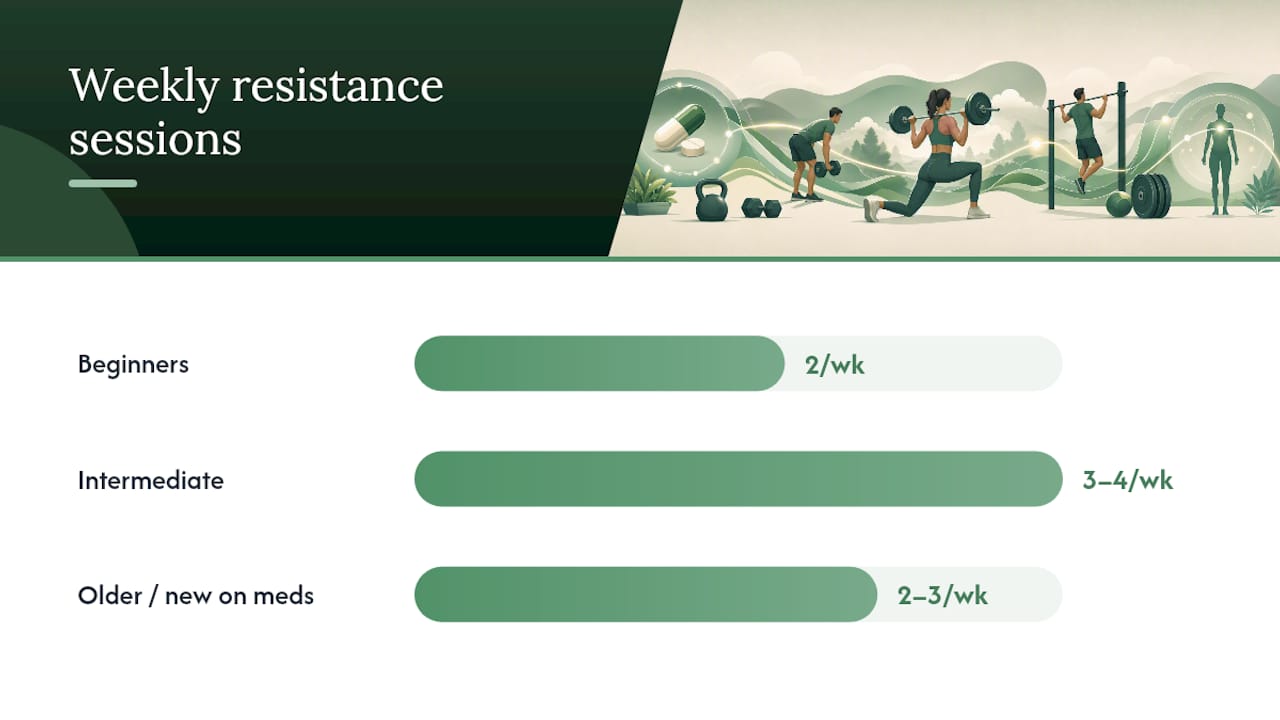
A sample weekly structure that scales across experience levels:
- Beginners: two full-body sessions per week, focusing on compound movements (squats, rows, presses) at moderate intensity with longer rest periods.
- Intermediate lifters: three to four sessions split between upper and lower body, adding progressive overload every two to three weeks.
- Older adults or those newer to training on medication: two to three supervised sessions focused on balance, grip strength, and controlled tempo, with extra attention to warm-up length.
Fuel around your medication’s effect on appetite. If you’re on a GLP-1 drug and food feels unappealing, split your protein target across smaller, more frequent meals rather than trying to hit it in two large sittings. Timing training sessions away from your medication’s peak nausea window, often a few hours after dosing for weekly injectables, tends to make workouts feel more manageable.
Bring this to your next appointment:
- The exact names and doses of every medication you take.
- Your planned training frequency and intensity.
- Any new symptoms: dizziness, unusual soreness, fatigue that doesn’t resolve.
- A request for relevant monitoring, such as an HbA1c check or blood pressure log, if you’re adjusting training intensity significantly.
Warm up for five to ten minutes before lifting, cool down gradually rather than stopping abruptly, and stay ahead of hydration, especially if nausea from medication has reduced your fluid intake.
Pro Tip: If nausea makes a full session impossible, do half of it. A 15 minute session with two compound lifts still sends a meaningful signal to preserve muscle. Consistency beats intensity when you’re managing a medication’s side effects.
How Researchers Measure Whether Training Changes Medication Results
Researchers track body composition, strength, glucose control, and blood pressure because each measure maps to a specific clinical risk, not just a number on a scale.
- DEXA scans separate lean mass from fat mass, showing whether weight loss is coming from muscle or fat.
- One-rep max (1RM) testing measures functional strength gains directly.
- Grip strength is a well-established predictor of frailty and overall health in aging research.
- HbA1c reflects average blood glucose control over roughly three months.
- Ambulatory blood pressure monitoring captures real-world BP response rather than a single clinic reading.
Without lab access, tools like InBody scans, a handgrip dynamometer, or a home blood pressure cuff give a reasonable approximation.
Where the Evidence Runs Thin
Evidence connecting resistance training to medication outcomes is promising but uneven, with many trials running short and samples that vary widely by age and drug class.
- Few large randomized trials test combined drug-plus-exercise protocols over multiple years.
- Long-term follow-up after stopping medication is rare, so we know less than we’d like about whether training-preserved muscle protects against regain.
- Mechanistic studies on how training affects drug-metabolizing enzymes, including cytochrome P450 activity, remain limited.
- Older adults and diverse populations are underrepresented in existing trial cohorts.
Pro Tip: If you read about a new study in this space, check the sample size and duration before adjusting your routine. A three-week trial with 20 participants tells you far less than a coordinated multi-year cohort.
How Nourished Turns This Research Into Real Programs
We prioritize resistance training paired with adequate protein for clients on weight-loss or metabolic medications, because preserving lean mass is one of the strongest levers for durable results. Plans adjust frequency, intensity, and protein targets based on your life stage, whether that’s regular cycling, perimenopause, or menopause, and factor in medication status alongside hormonal patterns rather than treating nutrition as one-size-fits-all.
Pro Tip: Women in perimenopause often need slightly higher protein and more frequent resistance sessions to offset the natural decline in muscle-protective estrogen, a detail that generic fitness plans routinely miss.
Get a Plan That Accounts for Your Medication and Your Hormones
Nourished builds personalized meal and workout plans that adjust for hormone-driven changes in appetite, energy, and recovery, which matters if a medication is also reshaping how hungry or tired you feel week to week.

It’s built for women who are managing weight-loss or metabolic medications and want their nutrition and training to actually support that treatment rather than work against it.
- Personalized protein targets that scale automatically as your training frequency changes.
- Workout plans that adjust intensity around dose changes or appetite shifts from GLP-1 medications.
- Practical tools, including a weight-loss drug checklist and GLP-1-friendly snack ideas, for the days appetite loss makes eating enough protein feel impossible.
- Hormone-aware adjustments across perimenopause, menopause, and post-menopause, not just a generic calorie target.
If you’re navigating medication and want a plan that treats your training and your treatment as one connected system, start with Nourished and see how your plan adjusts to your specific stage and goals.
Frequently Asked Questions
Does strength training actually make medication work better, or just add separate benefits? Both. Resistance training changes insulin signaling, blood flow, and lean tissue in ways that overlap directly with what many medications are trying to achieve, so the effects can compound rather than simply stack side by side.
Why combine exercise with medication instead of relying on the drug alone? Medications largely change hormonal signaling, while resistance training changes structural and metabolic capacity. Relying on medication alone often leads to muscle loss that undermines long-term maintenance once the drug stops.
Does strength training improve recovery from medication-related muscle loss? Yes, for many patients. Case series data on GLP-1 users show resistance training combined with adequate protein can preserve or rebuild lean tissue lost during rapid, medication-driven weight loss.
Is it safe to start resistance training while on blood pressure medication? Generally yes, with attention to cooldowns. Post-exercise hypotension can be more pronounced on antihypertensives, so a gradual cooldown and slow transitions from floor work reduce dizziness risk.
How soon can I expect to see medication-related benefits from strength training? Insulin sensitivity improvements can appear within weeks, while HbA1c and bone density changes typically take several months of consistent training to show up in lab measures.
This article is general information, not a substitute for advice from a qualified doctor. Consult a qualified healthcare professional about your own circumstances before acting on anything here.
Sources
These are the core sources behind the claims in this article, each useful for verifying specific medication-class effects.
- PMC article — GLP‑1 clinical data on lean mass
- Resistance Exercise Training in Individuals With and Without Cardiovascular Disease: 2023 update (AHA, Circulation)
- MASTERS trial secondary analysis — metformin, statins, and PRT (Frontiers in Physiology)
- Umbrella review — resistance training and type 2 diabetes outcomes (ScienceDirect)